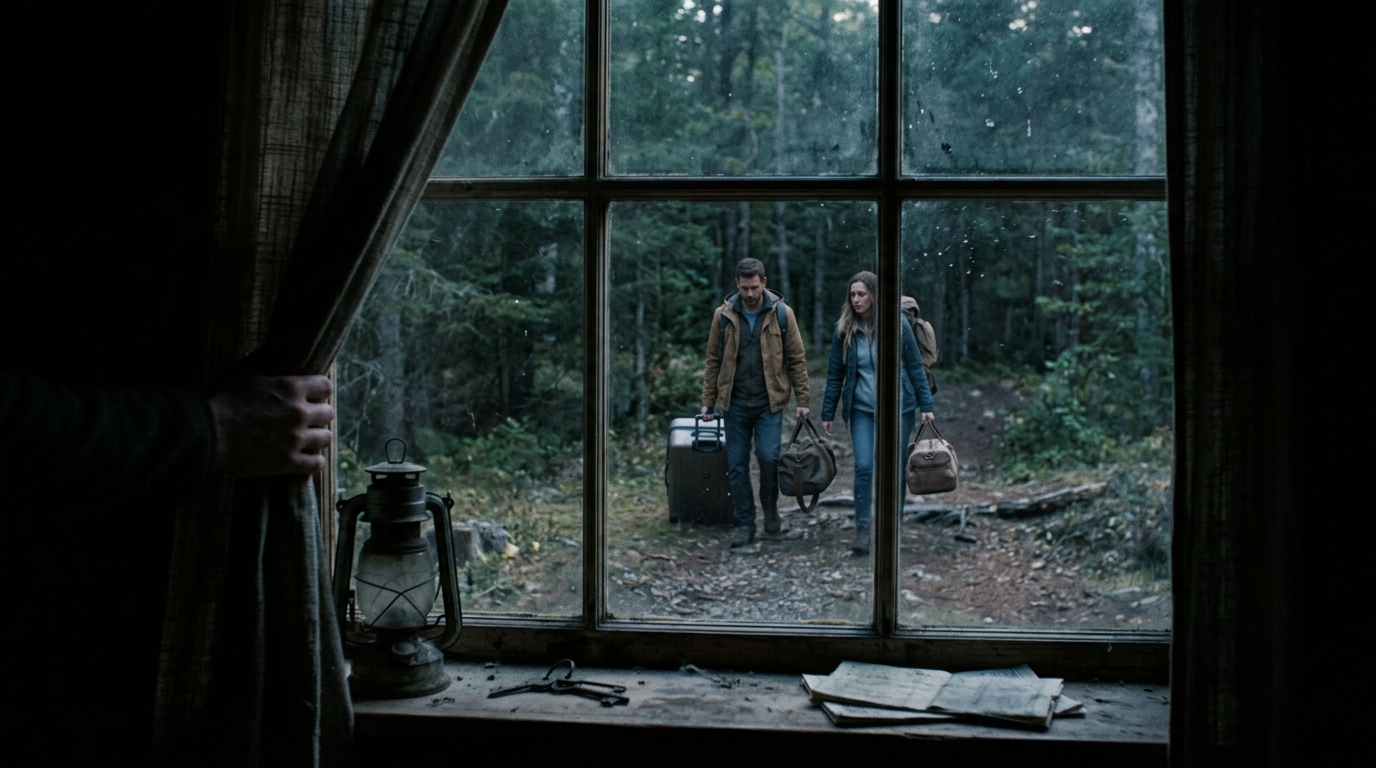
PART 3 I picked up my phone. There were seven missed calls now. Three from James. Two from Briana. One from an unfamiliar number. And one from the cabin manager. Then another message appeared. James: “Mom, please call me. Something is wrong.” I stared at those words for several seconds. Something was wrong.
Yes.
But not with the cabin.
Not anymore.
I finally pressed play on his voicemail.
“Mom, we’re at the cabin, but the code isn’t working. The door won’t open. I thought maybe you changed it by accident. Briana’s parents are here, and we’ve got all the luggage. Can you call me?”
I almost smiled.
Not because I enjoyed his discomfort.
I didn’t.
Because I remembered exactly what I had done two days earlier. I had changed the entry code. I had also changed the reservation information. And, more importantly, I had made sure nobody could use my property without my permission.
But that wasn’t all.
The most important change had nothing to do with a door code.
I called James.
He answered before the first ring finished.
“Mom!”
“Hello, sweetheart.”
“What happened?”
“What do you mean?”
“The door code doesn’t work.”
“Oh.”
I heard voices in the background. Briana was talking rapidly. Someone else was asking whether there was another entrance. Then a man’s voice said something I couldn’t make out. James lowered his voice. “Mom, did you change the code?”
“Yes.”
“Why?”
“Because I changed it.”
There was a long pause.
“Okay. Can you give me the new one?”
“No.”
His breathing became audible.
“Mom.”
“Yes?”
“We’re standing outside.”
“I know.”
“You knew we were coming.”
“Yes.”
“You told me it was fine.” “I told you that you could use the cabin in July.” “You said nothing about changing the code.” “I didn’t realize I needed to.” Another silence. Then Briana’s voice came through the phone. “Is that Sylvia?” James didn’t answer her. “Mom, please. This isn’t funny.”
“I agree.”
“What?”
“This isn’t funny.”
“Then what’s going on?” I looked across the yard. The last sunlight had faded. “I think you should ask Briana.” “What does Briana have to do with this?” I didn’t answer. James lowered his voice. “Mom, please don’t do this.”
“Do what?”
“Make this difficult.”
I closed my eyes.
There it was.
The assumption.
I was the one making things difficult.
Not the woman who had decided my property was hers to distribute.
Not the people who had arrived without asking whether they were welcome.
Me.
I took a breath.
“James, I want you to understand something.”
“Okay.”
“The cabin is mine.”
“I know.”
“No. I don’t think you do.”
He became quiet.
“I’ve never charged you to use it,” I continued. “I’ve paid for repairs. I’ve paid the taxes. I’ve replaced furniture. I’ve stocked the kitchen. I’ve even paid for the maintenance after your visits.”
“Mom—”
“And when you asked whether you could bring Briana’s parents, I wasn’t told they were staying.”
“They’re her parents.”
“I know who they are.”
“They thought—”
“That’s the problem, James.”
“What problem?”
“They thought.”
I heard Briana in the background again.
“Just tell her to let us in!”
James covered the phone.
I heard him say something to her.
Then he returned.
“Mom, this is embarrassing.”
I stared at the darkening garden.
“I imagine it is.”
“You could have told me.”
“You could have asked me.”
That silenced him.
For several seconds, neither of us spoke.
Then he said something that hurt more than I expected.
“Are you punishing us because Briana sent you that text?”
I swallowed.
“No.”
“Then what is this?”
“A boundary.”
“A boundary?”
“Yes.”
He laughed once, but there was no humor in it.
“Mom, we’re family.”
“I know.”
“So why are you treating us like strangers?”
I looked at the framed photograph on the porch table.
Robert and me.
James was seventeen in that picture.
He had one arm around his father’s shoulders and a ridiculous grin on his face.
I remembered that boy.
I remembered every version of him.
The little boy who slept with a flashlight under his pillow.
The teenager who called me from school because he’d forgotten his lunch.
The young man who cried at his father’s funeral.
And I loved all of them.
But loving my son did not mean surrendering every boundary I had left.
“Because family asks,” I said softly.
James didn’t respond.
“Family doesn’t assume.”
Still nothing.
“Family doesn’t take money from an account meant for emergencies and spend it on things they never discussed with the person who funded it.”
The silence that followed was completely different.
“What?”
His voice had changed.
“Mom…”
“You heard me.”
“What account?”
“The one with your name on it.”
“I don’t know what you’re talking about.”
“You don’t?”
“No.”
“Then perhaps you should ask Briana.”
This time, there was no answer.
Not even breathing.
I heard the sound of someone opening a car door.
Then Briana’s voice came sharply through the phone.
“James?”
He didn’t answer.
“What is she talking about?”
I said nothing.
James whispered, “Mom, I’ll call you back.”
“Good.”
He hung up.
I set the phone down.
For the first time in years, my hands were shaking.
Not from anger.
From disappointment.
I had hoped I was wrong.
I had hoped there was some reasonable explanation.
Maybe the withdrawals were legitimate.
Maybe Briana had misunderstood.
Maybe James knew nothing.
But now I wasn’t sure.
Twenty minutes passed.
Then my phone rang again.
This time, it was Briana.
I answered.
Her voice was cold.
“I’m not sure what you think you’ve discovered.”
“I haven’t accused you of anything.”
“You’re making a very serious accusation.”
“No. I’m asking questions.”
“You know James didn’t take your money.”
“I didn’t say he did.”
“Then why are you bringing it up?”
“Because the account was created for him.”
“Yes.”
“And money is missing.”
“He used some of it.”
I leaned back.
“For what?”
She hesitated.
“Family expenses.”
“Which ones?”
“Things you wouldn’t understand.”
That sentence landed heavily.
I looked at the phone.
“Things I wouldn’t understand?”
“You’ve been alone for a long time, Sylvia. You don’t know what it’s like raising children now.”
I almost laughed.
“I raised James.”
“That was decades ago.”
I stared into the darkness.
“So that’s what you think of me?”
“That’s not what I said.”
“It sounded like it.”
She sighed.
“Look, we’re already stressed. Her parents drove six hours to get here. The kids are exhausted. Can you just give us the code?”
“No.”
“Why?”
“Because I didn’t invite them.”
“It’s a cabin.”
“Yes.”
“It’s not like we’re taking your house.”
“No.”
“You’re being unreasonable.”
“Perhaps.”
“You’re really going to leave your own son outside?”
I thought about that.
“No.”
Her voice softened slightly.
“Then—”
“I’ll send someone to help you find a hotel.”
She went silent.
“You’re serious.”
“Yes.”
“You would rather send your son and his family to a hotel than let them stay at your cabin?”
“No.”
I looked toward Robert’s photograph.
“I would rather have my son understand that my home is not something he can claim simply because he’s my son.”
She hung up.
I expected another argument.
Instead, I got a message from James.
James: “I need to talk to you alone.”
I replied:
“Tomorrow morning. Come by yourself.”
Three dots appeared.
Then disappeared.
Then appeared again.
Finally:
“Okay.”
I thought that was the end of the matter for the night.
It wasn’t.
At 11:17 p.m., my doorbell rang.
I nearly dropped my book.
I stood up slowly.
Nobody visited that late.
I walked toward the front door and looked through the glass.
A man stood on my porch.
Not James.
Not Briana.
I recognized him after a moment.
It was Daniel, the cabin manager.
He held a thick envelope in one hand.
I opened the door.
“Daniel?”
“I’m sorry to come this late.”
“What happened?”
He looked uncomfortable.
“I thought you should see this before tomorrow.”
He handed me the envelope.
I opened it.
Inside was a printed copy of a rental agreement.
My eyes moved down the page.
Then stopped.
The cabin address was printed at the top.
The rental dates matched the week James had requested.
And under Guest Name, I saw something I hadn’t expected.
Briana Carter.
Not James.
Not James and Briana.
Just Briana.
My stomach tightened.
“Where did you get this?”
“She sent it to me last week.”
“Why?”
“She said she needed confirmation for a private event.”
“A private event?”
Daniel nodded.
“She asked about bringing twelve people.”
I looked up.
“Twelve?”
“Yes.”
“Who are they?”
“I don’t know.”
I flipped through the pages.
There were notes about catering.
Outdoor lighting.
A photographer.
A furniture delivery.
And one handwritten request:
Keep owner access unavailable during stay.
My fingers went cold.
“Daniel.”
“Yes?”
“Did she tell you I wouldn’t be there?”
“Yes.”
“What exactly did she say?”
He hesitated.
“She said you had given them permission and that you wouldn’t interfere.”
I closed my eyes.
There it was.
The truth.
Not a misunderstanding.
Not a poorly worded text.
A plan.
They hadn’t simply wanted a family vacation.
They had planned something at my cabin.
Something they didn’t want me to know about.
I looked again at the furniture note.
The teak sectional.
The fire table.
The account withdrawals.
Everything suddenly connected.
And then I saw one final page.
It was a guest list.
At the bottom was a name I recognized immediately.
My heart stopped.
Because it wasn’t one of Briana’s relatives.
It wasn’t a friend.
It wasn’t even someone I knew from Asheville.
It was the name of a real-estate agent.
And beside that name, someone had written:
“Discuss future sale.”
I stared at those two words until they blurred.
Future sale.
My cabin.
They weren’t just planning to use my property.
They were planning to discuss selling it.
Without me.
I folded the papers back into the envelope.
“Daniel.”
“Yes?”
“Thank you for bringing this.”
He nodded.
“There’s something else.”
I looked at him.
“What?”
He reached into his jacket and pulled out his phone.
“I received a voicemail from Briana yesterday.”
He pressed play.
Her voice filled the quiet hallway.
“Hi, Daniel. Just confirming that Sylvia won’t be coming up this weekend. She knows we’re using the property, and everything is already approved. Please don’t contact her directly about anything. James and I will handle it.”
The recording ended.
I stood perfectly still.
Then Daniel said quietly:
“Mrs. Hayes, there’s one more thing you need to know.”
I looked at him.
“What?”
He swallowed.
“Briana wasn’t asking me about selling the cabin.”
He paused.
“She was asking me how much the property would be worth if the owner decided to transfer it to her.”
My heart began pounding.
And for the first time that week, I realized the cabin might not be the only thing they had been trying to take from me.
There was something much bigger happening.
And tomorrow morning, when James arrived alone at my house, I intended to find out exactly how much he knew.
PART 4
At 8:02 the next morning, James pulled into my driveway alone.
I watched him from the kitchen window.
He sat in his car for almost two minutes before getting out.
That told me everything I needed to know.
My son wasn’t angry anymore.
He was afraid.
I opened the door before he could knock.
“Come in.”
He stepped inside.
He looked exhausted.
His shirt was wrinkled, his hair was uncombed, and there were dark circles beneath his eyes.
“Mom…”
“Coffee?”
He shook his head.
“No.”
“Then sit.”
He followed me into the kitchen.
Neither of us spoke.
I poured myself coffee and sat across from him.
For a moment, I simply looked at my son.
He was forty-two years old, but sitting there with his hands clasped together, he looked strangely like the little boy who used to sit at this same table after breaking something and wait for me to decide whether he was in trouble.
Except this time, I wasn’t sure who had broken what.
I placed the envelope Daniel had given me on the table.
James stared at it.
“What is that?”
“Something you should see.”
He opened it.
His eyes moved across the first page.
Then the second.
Then the guest list.
His face changed.
“What is this?”
“You tell me.”
He picked up the rental agreement.
“I’ve never seen this.”
“Your name isn’t on it.”
“I know.”
“Briana’s is.”
He stared at the page.
“She did this?”
“That’s what I’m trying to understand.”
He looked at the guest list.
Then his eyes stopped on the real-estate agent’s name.
“What the hell?”
“I asked myself the same question.”
James pushed the papers away.
“Mom, I swear to you, I didn’t know about this.”
I believed him.
At least partly.
“Did Briana ever talk to you about selling the cabin?”
He looked at me.
“No.”
“Not once?”
“No.”
“Did she ever ask you whether I would consider transferring it to you?”
His jaw tightened.
“She said something once.”
I waited.
“She asked what would happen to the cabin when you got older.”
I felt something sink inside me.
“What did you tell her?”
“That it was yours.”
“And?”
“And I said eventually you’d probably leave it to me.”
I looked down at my coffee.
“Eventually.”
“I didn’t mean now.”
“I know.”
“She asked whether you’d ever sell it.”
“What did you say?”
“I said I didn’t think so.”
“Why?”
“Because Dad built it.”
That answer hurt.
In a strange way, it comforted me too.
At least my son remembered.
He remembered the reason I had kept that place.
James leaned forward.
“Mom, I swear I didn’t know she was planning all this.”
“Then explain the money.”
His eyes narrowed.
“What money?”
I pushed the printed transaction history toward him.
He read the first page.
Then the second.
His face slowly lost color.
“I didn’t take this.”
“Do you recognize the payments?”
He stared at the vendor names.
“The contractor…”
“Yes?”
“That was the company that renovated the kitchen at our house.”
I looked at him.
“You told me that was covered by your savings.”
“It was supposed to be.”
“Who paid the deposit?”
“I don’t know.”
“Look at the next one.”
He did.
The furniture company.
His face changed again.
“Briana bought those.”
“With what?”
He shook his head.
“I thought she used her credit card.”
“Apparently not.”
He sat back.
For several seconds, he said nothing.
Then he whispered:
“How much is left?”
“Twelve thousand three hundred.”
He closed his eyes.
“I didn’t know.”
“I believe you.”
His eyes opened.
“You do?”
“Yes.”
“Why?”
“Because if you knew, you wouldn’t look this shocked.”
He looked away.
“Mom, I don’t know what to say.”
“Then don’t say anything yet.”
I reached for the envelope.
“There is something else.”
I handed him the voicemail transcript.
He read it.
Then read it again.
His hands began to tremble.
“She told him I knew?”
“Yes.”
“I never said that.”
“I know.”
“She lied.”
“I know.”
He stood up abruptly and began pacing.
“She lied to Daniel. She used your account. She arranged some kind of event at the cabin. She invited twelve people.”
“And a real-estate agent.”
He stopped.
“Why?”
“That is the question.”
James looked at me.
“I’ll call her.”
“No.”
“Mom—”
“Not yet.”
“Why?”
“Because if she knows what we know, she’ll start changing the story.”
He looked at me for a long moment.
“You’ve already thought this through.”
“I’ve had two days.”
“What did you do?”
I didn’t answer.
He stared at me.
“Mom.”
I folded my hands.
“I made some changes.”
“What kind of changes?”
“The kind that protect me.”
He exhaled.
“Okay.”
Then his phone rang.
Briana.
He looked at the screen.
I said nothing.
He answered.
“Hello?”
Her voice was loud enough that I could hear fragments.
“Where are you?”
James looked at me.
“With Mom.”
There was silence.
Then Briana said something that made his face harden.
“No.”
Another pause.
“I said no.”
He turned away from me.
“You should have told me.”
She continued speaking.
James closed his eyes.
Then he said:
“Did you sign a rental agreement for Mom’s cabin?”
I couldn’t hear her response.
But James could.
His expression changed.
“You what?”
He turned toward me.
“She says it was just a preliminary agreement.”
I raised an eyebrow.
“Ask her about the real-estate agent.”
He repeated the question.
The silence on the other end lasted several seconds.
Then Briana started crying.
James’s shoulders dropped.
He looked exhausted.
“Briana…”
She said something else.
His expression hardened.
“No.”
He shook his head.
“No, don’t do that.”
Then:
“You can’t blame my mother for this.”
He listened.
“Because you knew it wasn’t yours.”
His voice cracked slightly.
“And you knew she never agreed to sell it.”
I looked away.
This wasn’t a conversation I wanted to witness.
But then James said something that made me look back at him.
“You used the money?”
He went completely still.
“What money?”
His face became pale.
“Mom’s account?”
I watched him listen.
Then his voice dropped.
“How much?”
A long pause.
He sat down.
“What do you mean you thought I approved it?”
He looked at me.
I could see the disappointment in his eyes.
Not toward me.
Toward his wife.
Finally he whispered:
“Briana, I need you to come here.”
She said something.
“No. Alone.”
He hung up.
For several seconds, neither of us spoke.
Then he said:
“She says she can explain everything.”
“I imagine she can.”
“She said she was trying to help us.”
“With what?”
“Our mortgage.”
I frowned.
“What does your mortgage have to do with the cabin?”
He rubbed his face.
“Everything.”
I waited.
James looked ashamed.
“We’re behind.”
“How far?”
“Almost six months.”
My heart tightened.
“Why didn’t you tell me?”
“Because you already do too much.”
I stared at him.
“James…”
“I know what you’re going to say.”
“No. You don’t.”
“You’re going to say I should have asked.”
“Yes.”
“I was embarrassed.”
“You’re my son.”
“I know.”
“If you’re drowning, you don’t hide it because you’re embarrassed that your mother might throw you a rope.”
He looked down.
“I thought I could fix it.”
“How?”
He didn’t answer.
“James.”
He finally looked at me.
“Briana believed that if you transferred the cabin to us, we could refinance against it.”
I felt my chest tighten.
“So that was the plan.”
“I didn’t agree.”
“But you knew she wanted it.”
“I knew she hoped you’d leave it to us someday.”
“That’s different.”
“Yes.”
He looked at the papers.
“I never knew she had already contacted an agent.”
“Or arranged a rental.”
“Or used your account.”
“Exactly.”
He swallowed.
“Mom, I’m sorry.”
I nodded.
“I know.”
“No, you don’t.”
His eyes filled with tears.
“I let her believe she could do this.”
“That isn’t the same as doing it.”
“But I didn’t stop her.”
I reached across the table.
“James.”
He looked at me.
“You are responsible for your choices.”
“I know.”
“But you’re not responsible for every choice someone else makes.”
He wiped his eyes.
“Then what do we do now?”
I looked toward the window.
“Now we find out the truth.”
At 10:15, Briana arrived.
She stepped out of her car wearing sunglasses and a cream-colored coat.
She looked nothing like the woman who had been begging to get into my cabin the night before.
She looked composed.
Prepared.
When she entered the house, she didn’t apologize.
Instead, she placed her purse on the chair and said:
“I think there’s been a misunderstanding.”
I almost smiled.
“Sit down.”
She remained standing.
“I never intended to take anything from you.”
“Then why did you ask a real-estate agent how much the cabin was worth?”
Her lips parted.
Then closed.
James stared at her.
“Answer her.”
Briana looked at him.
“I was trying to find options.”
“What options?”
“For us.”
“You mean our family.”
“Yes.”
“You mean you, me, and the kids.”
“Yes.”
“Not Mom.”
She looked at me.
“I knew she would eventually want to help us.”
I said quietly:
“You decided for me.”
“I knew you loved James.”
“I do.”
“And you wouldn’t let your grandchildren lose their home.”
I felt a chill move through me.
“So that’s what you were counting on.”
She said nothing.
“You weren’t asking for help,” I continued. “You were building a situation where I would feel guilty saying no.”
Her eyes narrowed.
“You make it sound horrible.”
“It was horrible.”
“I was desperate.”
“Desperation explains behavior. It doesn’t excuse it.”
James looked at her.
“What about the account?”
Briana’s face changed.
“I was going to replace it.”
“With what?”
“I had a plan.”
“What plan?”
She didn’t answer.
James stood.
“Briana.”
She began crying.
“I was trying to save us.”
“By taking my mother’s money?”
“I borrowed it.”
“You didn’t ask.”
“I knew she’d say no.”
The room went silent.
I looked at my daughter-in-law.
There it was.
The truth.
Not an accident.
Not confusion.
A choice.
She knew I would say no.
So she decided my answer didn’t matter.
I slowly stood.
“Briana, you need to leave.”
Her eyes widened.
“Please.”
“No.”
“Where am I supposed to go?”
“Home.”
She looked at James.
“James?”
He didn’t move.
“James, you’re really going to let her throw me out?”
He closed his eyes.
Then said quietly:
“You threw yourself out when you decided Mom didn’t deserve a choice.”
Briana stared at him as if she’d never seen him before.
Then she picked up her purse.
At the door, she turned toward me.
“You think you’ve won.”
I shook my head.
“This isn’t a game.”
She gave a bitter laugh.
“You’re going to regret this.”
“Perhaps.”
She left.
The door closed.
James stood in the middle of the room.
For a while, neither of us moved.
Then he asked:
“Mom?”
“Yes?”
“Can I stay here tonight?”
I looked at my son.
“Of course.”
He nodded.
But before he could say anything else, my phone rang.
It was Carol, my attorney.
I answered.
“Sylvia, I need you to come to my office today.”
“Why?”
“There is a document you need to see.”
“What kind of document?”
She hesitated.
“One that was filed yesterday.”
My stomach tightened.
“By whom?”
“That’s the problem.”
She paused.
“It appears someone has submitted paperwork claiming that you agreed to transfer an interest in the cabin.”
I looked at James.
He was watching my face.
“Carol,” I whispered.
“Yes?”
“Whose name is on it?”
Her answer made the room feel suddenly cold.
“Briana’s.”
And then Carol added:
“Sylvia, there’s something even more concerning.”
“What?”
“The signature on the document looks remarkably similar to yours.”
PART 5
For a few seconds, I couldn’t speak.
I looked at James.
He had heard enough from my expression to understand that something had happened.
“What is it?” he asked.
I held up one finger, asking him to wait.
“Carol,” I said into the phone, “are you telling me someone forged my signature?”
“I’m telling you that a document has been submitted bearing what appears to be your signature.”
“Where?”
“To the county records office.”
My stomach turned.
“What does the document say?”
“That you agreed to transfer a partial ownership interest in the cabin.”
“To Briana?”
“Yes.”
“How much?”
“Fifty percent.”
I closed my eyes.
The cabin.
Robert’s cabin.
The place where we had spent twenty years building memories.
Someone had tried to make half of it theirs with a signature that wasn’t mine.
“When was it filed?”
“Yesterday afternoon.”
The same day James and Briana had driven to the cabin.
The same day Briana expected the property to be waiting for her.
The same day she had arrived with her parents and luggage.
This wasn’t a vacation.
It had never been a vacation.
It had been a move.
“Carol,” I said, “what happens now?”
“Nothing happens until we challenge it. But I need you here today.”
“I’ll be there.”
I ended the call.
James was standing completely still.
“What did she say?”
I told him.
His face went white.
“She forged your signature?”
“It appears that way.”
“Mom…”
“I know.”
“No. You don’t understand.”
“What?”
He sat down.
“There was a folder in our house.”
“What folder?”
“I thought it was about the mortgage.”
“What was in it?”
“I don’t know. Briana told me not to touch it.”
I stared at him.
“Where is it?”
“At home.”
“Then we’re going there.”
He stood.
“I’ll get it.”
“No.”
He looked at me.
“We’ll get it together.”
Briana wasn’t at the house when we arrived.
Her car was gone.
James unlocked the door.
The house felt strangely unfamiliar.
Maybe because I had never before entered it knowing that my son had been keeping secrets from me.
James went directly upstairs.
I followed.
He stopped outside their bedroom.
“Mom?”
“Yes?”
“I don’t want you to think I knew.”
“I don’t.”
“You really don’t?”
“No.”
He opened the closet.
There was a black filing box behind several winter coats.
He pulled it out.
The box was heavier than I expected.
Inside were mortgage statements, tax records, bank documents, and several envelopes.
James began sorting through them.
Then he stopped.
“Here.”
He handed me a folder.
My name was written across the front.
I opened it.
The first page was a photocopy of the cabin deed.
The second was a property valuation.
The third was a letter from a real-estate attorney.
Then I saw the number.
$1.48 million.
I stared at it.
James whispered:
“I didn’t know it was worth that much.”
Neither did I.
Robert and I had bought the land decades earlier.
We built the cabin slowly.
Over the years, the surrounding area had changed.
Tourism had exploded.
Property values had risen.
The little mountain cabin we had once thought of as our escape was now worth nearly one and a half million dollars.
I turned the page.
There was a handwritten note.
Possible equity solution: transfer 50% interest to daughter-in-law / refinance / sell if necessary.
My hands began shaking.
Then I saw another note.
Owner unlikely to cooperate voluntarily.
I looked at James.
He was staring at the page.
“Mom…”
I turned another page.
There was an email printout.
From Briana.
To the real-estate agent.
The subject line read:
Cabin Ownership Discussion
The message was short.
“Sylvia is emotionally attached to the property, so James may need to convince her gradually. Once the transfer is done, we can refinance and solve the mortgage problem. If she refuses, we may have to consider whether she can legally prevent us from using the property since James is her only child.”
I stopped reading.
James took the page from my hands.
His face collapsed.
“She wrote that?”
“Yes.”
He read it again.
Then again.
He sank onto the edge of the bed.
“She was planning this.”
“Yes.”
“I never knew.”
“I believe you.”
He covered his face.
“I married her.”
I sat beside him.
“That doesn’t make you responsible for every decision she makes.”
“But I brought her into your life.”
“James.”
He looked at me.
“You don’t have to punish yourself for loving someone who made terrible choices.”
He wiped his eyes.
“What do we do?”
“We go to Carol.”
Carol’s office was quiet when we arrived.
She had already prepared a folder.
She placed it in front of me.
“This is the document that was filed.”
I looked at the signature.
At first glance, it looked like mine.
Almost exactly.
The curve of the S.
The way the last letter extended.
Even the small upward stroke Robert used to tease me about.
But something bothered me.
“What date does this say I signed it?”
“June 14.”
I frowned.
“June 14?”
“Yes.”
“I was in Charleston that week.”
Carol nodded.
“I know.”
I looked at her.
“How?”
“Because you sent me the hotel receipt when we were updating your estate documents.”
She pulled out another file.
There it was.
My hotel reservation.
June 13 through June 17.
Nearly five hours away.
I stared at the evidence.
Then Carol said something that made my heart stop.
“There’s more.”
She placed another page on the table.
“This is the notary information.”
I read the name.
I didn’t recognize it.
“Was this notarized?”
“Yes.”
“By whom?”
Carol pointed to the bottom.
I read the address.
Then I looked at her.
“This is the address of Briana’s parents’ business.”
Carol nodded.
“That was my concern.”
James stood up.
“So her parents were involved?”
“We don’t know yet,” Carol said. “But we know the notary is connected to them.”
I looked at James.
He looked devastated.
“My father-in-law?”
Carol shook her head.
“We can’t accuse anyone without evidence.”
She turned to me.
“But we can challenge the document.”
“How?”
“First, we file a formal objection. Second, we notify the county that you dispute the signature. Third, we gather evidence proving you were elsewhere on the date of signing.”
“And the account?”
“I’ve already contacted the bank.”
I looked at her.
“Already?”
“Yes.”
“What did they say?”
Carol hesitated.
“Several transactions were initiated from a device registered to Briana’s phone.”
James closed his eyes.
“So she did it.”
“Possibly,” Carol said. “The investigation will determine who actually authorized the transactions.”
I felt strangely calm.
The anger had already burned through me.
What remained was something quieter.
Clarity.
I looked at Carol.
“What happens to the cabin?”
“If everything goes as expected, you remain the sole owner.”
“And Briana?”
“That depends on what the investigation establishes.”
I nodded.
“Then let’s do it properly.”
Three days later, Briana called.
I almost didn’t answer.
But I did.
“Hello?”
Her voice was different.
No anger.
No confidence.
Just exhaustion.
“Can I see you?”
“Why?”
“I need to explain.”
“You’ve already explained enough.”
“Please.”
I was quiet.
“James won’t speak to me.”
I looked at my son.
He was sitting across the room, reading quietly.
“That isn’t my decision.”
“I know.”
“Where are you?”
“At my parents’ house.”
“Then stay there.”
“Sylvia…”
“Why did you do it?”
Silence.
“I was scared.”
“So was I.”
“I thought if we lost our house, I’d lose everything.”
“You were about to take mine.”
“I wasn’t trying to hurt you.”
“You forged my signature.”
“I didn’t personally forge it.”
The sentence made my blood run cold.
“What does that mean?”
She started crying.
“My father helped.”
I closed my eyes.
There it was.
“The notary?”
“Yes.”
“Did he sign it?”
“He notarized the document.”
“And who forged my signature?”
She didn’t answer.
“Briana.”
“My father knew someone who could reproduce signatures.”
I felt sick.
“Why?”
“Because I thought once the transfer went through, we could refinance the cabin and pay off our debt.”
“You were going to take a property worth nearly one and a half million dollars to solve your mortgage.”
“I was desperate.”
“You could have asked me.”
“You would have said no.”
“I might have.”
She cried harder.
“And that scared you enough to steal from me.”
“Yes.”
I closed my eyes.
For a moment, I felt sorry for her.
Then I remembered the words:
Owner unlikely to cooperate voluntarily.
She hadn’t misunderstood my love.
She had calculated it.
“Briana,” I said quietly, “I hope someday you understand the difference between needing help and deciding that someone else owes you help.”
She didn’t answer.
“I won’t stop the legal process.”
“I understand.”
“But I won’t try to destroy you either.”
She began crying.
“Thank you.”
“Don’t thank me.”
I hung up.
The investigation took nearly four months.
During that time, James moved out of the house he had shared with Briana.
Not into my house.
Into a small apartment.
He got a second job.
He worked late.
He stopped asking me for money.
And every Saturday morning, he came to my house and helped me with the garden.
We didn’t talk about Briana much.
We talked about ordinary things.
Weather.
Food.
His children.
Robert.
Sometimes, the ordinary conversations were the ones that healed us.
One Saturday, while we were trimming the rose bushes, James suddenly said:
“Mom?”
“Yes?”
“Do you remember when Dad built the porch?”
I smiled.
“He almost fell off the roof.”
“He blamed the ladder.”
“He always blamed the ladder.”
James laughed.
Then he became quiet.
“I wish Dad were here.”
“So do I.”
“I think he would have hated what happened.”
I looked at him.
“No.”
James frowned.
“He would have hated what happened to us.”
That made him smile.
“You’re right.”
I placed my hand on his shoulder.
“Your father always believed problems could be repaired if people were honest.”
James looked at the roses.
“I wasn’t honest.”
“You were afraid.”
“I should have told you about the mortgage.”
“Yes.”
“I should have stopped Briana.”
“Yes.”
He nodded.
“But I’m trying now.”
“I know.”
That was enough.
Five months after the original text message, Carol called.
“Sylvia?”
“Yes?”
“The county accepted the challenge.”
I sat down.
“And?”
“The transfer document has been invalidated.”
I closed my eyes.
“So the cabin is mine.”
“It always was.”
I laughed softly.
Then Carol said:
“There is one more thing.”
“What?”
“The district attorney’s office has decided to investigate the forged document and the financial transactions.”
I was silent.
“Do you want to pursue it?”
I looked through the window.
James was outside, helping me rake leaves.
He didn’t know I was on the phone.
I thought about everything.
The cabin.
The money.
The lies.
The humiliation.
And the fact that Briana had crossed a line that could not simply be erased with an apology.
“Yes,” I said.
“I want the truth.”
The truth eventually became much larger than I expected.
Briana’s father had indeed helped create the false transfer document.
The notary had knowingly certified paperwork that had not been signed in my presence.
The bank investigation confirmed that Briana had used funds from the account I created for James.
And the real-estate agent admitted that she had been approached about refinancing the cabin.
But something else emerged.
Briana had not been acting entirely alone.
Her parents had significant debts of their own.
They had seen the cabin’s value.
They believed that if Briana and James controlled it, the property could solve several financial problems at once.
I wasn’t just a mother-in-law standing in the way of a vacation.
I had been standing between them and nearly $1.5 million.
That explained everything.
The furniture.
The guest list.
The real-estate agent.
The fake signature.
The pressure.
The sudden insistence that the cabin was “just for their family.”
They had already started dividing something that had never belonged to them.
A year after that summer, I drove to the cabin for the first time since everything happened.
James came with me.
We parked beside the old wooden fence.
The mountains looked exactly the same.
The porch still creaked.
The fireplace still smelled faintly of smoke.
And the old maple tree Robert had planted was taller than I remembered.
James carried two bags inside.
“Mom?”
“Yes?”
“What do you want to do with this place?”
I looked around.
For the first time, the cabin didn’t feel like a battlefield.
It felt like home again.
“I want to use it.”
“For what?”
“Living.”
He smiled.
“You mean actually living here?”
“Sometimes.”
I walked onto the porch.
The same porch where Robert had stood with sawdust in his hair.
The same porch where James had once chased fireflies.
The same porch Briana had tried to claim.
I looked at the mountains.
Then I understood something.
For months, I had thought the fight was about property.
It wasn’t.
It was about whether my kindness still belonged to me.
I had spent years believing that saying yes made me a good mother.
But sometimes saying no is how you protect the love that remains.
I turned toward James.
“You know what I want?”
“What?”
“I want this place to be full again.”
He smiled.
“Family?”
“Yes.”
He hugged me.
And for the first time in a long time, I didn’t feel like I was losing my son.
I felt like I was getting him back.
Two years later, the cabin looked different.
Not because I sold it.
I never did.
I renovated it.
I kept Robert’s floors.
I kept the stone fireplace.
I kept the photographs.
But I replaced the furniture Briana had chosen.
I planted new flowers around the porch.
And I added a small wooden sign beside the front door.
It read:
THE HAYES CABIN
BUILT WITH LOVE, KEPT WITH LOVE.
James came every month.
Sometimes with his children.
Sometimes alone.
His marriage to Briana ended quietly.
There was no dramatic revenge.
No public humiliation.
No celebration over her downfall.
She faced the consequences of her choices.
James rebuilt his life.
And eventually, he learned something I wished he had understood years earlier:
Being a good husband didn’t mean protecting someone from every consequence.
Being a good son didn’t mean choosing his mother over his wife.
It meant choosing honesty.
Every time.
One autumn afternoon, James and I sat beside the fireplace.
His daughter was outside with her brother, chasing leaves.
He looked at me.
“Mom?”
“Yes?”
“I’ve been thinking.”
“That can be dangerous.”
He laughed.
Then became serious.
“I used to think you saved me when you gave me that emergency account.”
“You did need it.”
“But you were really teaching me something else.”
“What?”
“That help isn’t ownership.”
I smiled.
“Maybe.”
“And love isn’t permission to cross boundaries.”
I looked into the fire.
“Now you’re learning.”
He smiled.
Then he reached into his pocket.
“There’s something for you.”
He handed me a small envelope.
Inside was a photograph.
Robert standing on the unfinished porch decades earlier.
James beside him.
Both covered in sawdust.
On the back, James had written:
“Thank you for keeping Dad’s home safe.”
I pressed the photograph against my heart.
And suddenly, all the anger I’d carried for so long seemed to disappear.
Not because what happened was acceptable.
Not because I had forgotten.
But because I no longer needed the pain to remind me what mattered.
I had learned something that summer that took me years to understand:
You can love your family without surrendering yourself to them.
You can forgive someone without trusting them again.
You can say no without becoming cruel.
And sometimes the strongest thing a mother can do for her child is refuse to rescue him from the consequences of his own choices.
The cabin remained mine.
But more importantly, my relationship with my son survived.
Not because I gave him everything.
Because, finally, we learned how to give each other something more valuable.
Respect.
That evening, James stood on the porch with his children.
The sun disappeared behind the mountains.
For a moment, I could almost see Robert standing beside them.
I imagined him looking at the cabin.
At our son.
At the grandchildren.
At me.
And I knew exactly what he would have said.
“You did good, Syl.”
I smiled through my tears.
“Yes, Robert,” I whispered.
“I finally did.”
The cabin had never been theirs to take. But in the end, it became something far more valuable than property—it became the place where our family finally learned what love was supposed to look like.