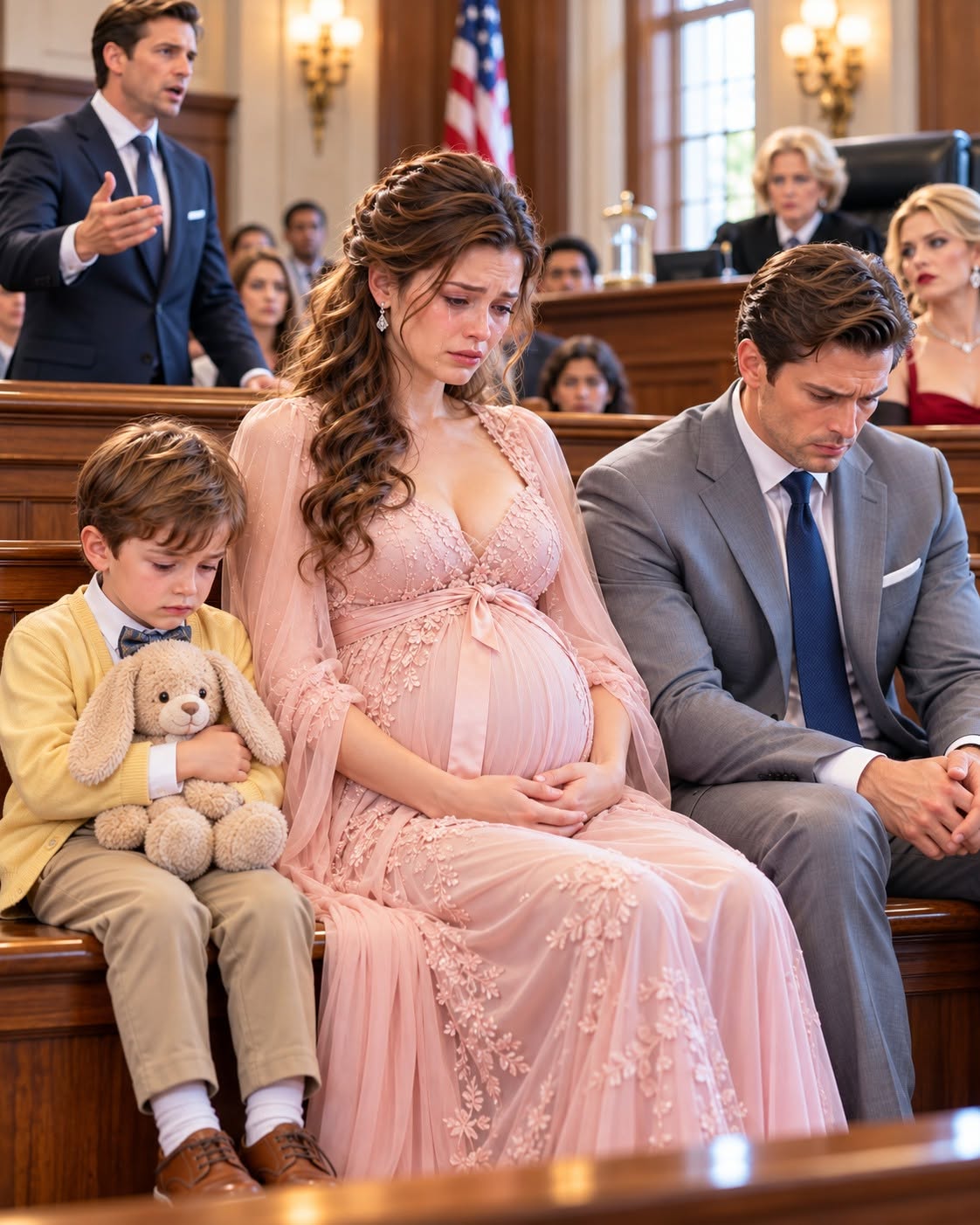
Clara’s fingers closed around Julian’s hand. It was a small movement, almost instinctive, but I saw it clearly. So did Judge Norris. “Let go of him, Ms. Sterling,” the judge said.
Clara released Julian at once.
Leo stood beside the bailiff, clutching his stuffed rabbit beneath his chin. His eyes moved from his father to Clara, then finally back to me.
I wanted to run to him.
But I stayed where I was, afraid that any sudden movement would make him feel more frightened than he already did.
“Leo,” I said gently, “you don’t have to say anything you don’t want to say.”
His face crumpled with relief, but the judge leaned forward.
“That is correct,” Judge Norris said. “You are not in trouble. No one here is angry with you. We only want to understand what you saw and what you were told.”
Leo glanced at the bailiff.
“Can my aunt come in?”
“Which aunt?” the judge asked.
“Miss June. Daddy’s sister.”
Julian’s face tightened.
“She has no reason to be involved in this.”
Judge Norris looked toward the courtroom doors.
“Please ask Ms. Vance’s sister-in-law to join us.”
A few minutes later, June Vance hurried into the courtroom, her brown coat still damp from the rain. She looked from Leo to her brother, then to me.
The confusion on her face changed into concern.
“Leo,” she whispered.
He immediately crossed the room and wrapped his arms around her waist.
June knelt to hold him. “I’m here.”
Julian shifted in his chair.
“June, this isn’t what you think.”
She looked up at him slowly.
“I don’t know what to think anymore.”
The words landed harder than an accusation.
For years, June had been the only member of Julian’s family who treated me like more than an inconvenient wife. She had brought soup when I was sick during my first pregnancy. She had remembered Leo’s school performances when Julian forgot. She had never openly challenged her brother, but she had never joined him in dismissing me either.
Now she held Leo as though she had finally realized how much he had been carrying alone.
Judge Norris softened her voice.
“Leo, would you like to sit with your aunt?”
He nodded.
June took the chair beside the witness stand and settled him on her lap. His rabbit rested between them.
The judge folded her hands.
“Leo, can you tell me why you were waiting near the vending machines?”
“Daddy told me to stay there.”
Julian’s head snapped up.
“I told him to wait with Clara while I spoke to my lawyer. That’s all.”
Judge Norris turned back to Leo.
“Did your father tell you why you had to wait there?”
Leo shook his head.
“I didn’t know where my school bag was.”
“What happened to your school bag?”
“Clara put it in the car.”
Clara’s expression changed.
“I didn’t know he was coming inside. I thought Julian was taking him to his mother’s.”
“That’s not true,” Leo said.
His voice was small, but certain.
Clara went still.
Leo looked at the judge. “She said I wasn’t supposed to tell Mommy that she put my things in Daddy’s car.”
I felt the room tilt.
“Mommy?” I repeated.
Leo looked at me.
“I call you Mommy in my head.”
My breath caught.
He had never called me that aloud.
I had met Leo when he was three, only months after Julian and I married. His mother had moved to another state and rarely visited. At first, I had tried to remain careful and respectful. I told myself I was Julian’s wife, not Leo’s mother.
But children do not always recognize the boundaries adults draw for them.
I had packed his lunches, read bedtime stories, learned which foods made him wrinkle his nose, and sat through his fevers. I had been there when he lost his first tooth. I had held him after nightmares.
Yet every time he started to call me something affectionate, Julian corrected him.
“She’s Audrey,” he would say. “Don’t confuse things.”
So Leo had stopped trying.
The judge looked at me with quiet understanding.
“Leo, what did Clara say you weren’t supposed to tell?”
He rubbed one thumb over the rabbit’s worn ear.
“She said Daddy and her were going to live in our house, and Mommy was going away.”
Clara rose halfway from her chair.
“That is not what I said.”
“Sit down,” Judge Norris instructed.
Clara sat.
Leo continued, “She said the baby would have a different room and I couldn’t go in it because it was for real family.”
My hand moved instinctively to my stomach.
Julian closed his eyes.
“Leo,” he said, his voice strained, “you misunderstood.”
Leo looked toward him.
“You said I could stay with you every other weekend.”
“That was not a final decision.”
“You said Mommy was giving you everything because she didn’t want us anymore.”
The courtroom fell silent.
I stared at Julian.
He had told Leo that?
Perhaps not in those exact words. Perhaps he had complained at home, assuming a child was too young to understand. But children understood more than adults gave them credit for. They gathered meaning from every sigh, every closed door, every whispered phone call.
Judge Norris turned toward Julian.
“Mr. Vance, did you discuss the divorce settlement with your son?”
“I mentioned that changes might happen.”
“Did you tell him his stepmother was leaving because she didn’t want him?”
“No.”
Leo’s grip tightened around his rabbit.
“You did.”
The words were not angry. That made them worse.
Julian looked at his son, and something flickered across his face—shame, perhaps, or fear.
“I was upset,” he said.
“You told me Mommy wanted to take the baby and leave us with nothing.”
I felt a dull ache beneath my ribs.
Not from the baby.
From the realization that Julian had used Leo as a witness to his own bitterness.
June’s hand moved protectively over the boy’s shoulder.
“Julian,” she said quietly, “what have you been telling him?”
He turned toward her.
“Don’t make this worse.”
“I’m asking because he’s six.”
“And you’re acting like you know everything.”
“No,” June said. “I’m acting like I should have asked sooner.”
Her voice trembled, but she did not look away.
Judge Norris leaned back in her chair.
“Leo, you mentioned a notebook. Can you tell me about that?”
Julian’s expression changed immediately.
“What notebook?”
Leo looked at him, then at June.
“The blue one.”
“Where is it?” the judge asked.
“In Daddy’s desk.”
Julian stood.
“I don’t have any notebook of his.”
“You do,” Leo said. “Clara told me to put it there after I wrote down what she said.”
Clara’s face drained of color.
The bailiff glanced at Judge Norris.
“Mr. Vance,” the judge said, “sit down.”
He slowly obeyed.
I could hear rain ticking against the tall windows. Somewhere in the hallway, a door closed. The ordinary sounds made the moment feel even more unreal.
“What did you write in the notebook?” the judge asked.
Leo’s eyes lowered.
“I wrote the days Daddy said Mommy was leaving.”
My heart clenched.
“Why did you write them down?”
“Because I didn’t know which one was true.”
No one spoke.
June held him more tightly.
Judge Norris looked toward the bailiff. “Please retrieve the notebook, if it can be located, with Mr. Vance’s permission or under the appropriate court procedure.”
Julian’s attorney stood quickly.
“Your Honor, I object to turning a custody proceeding into an investigation of private notes kept by a child.”
“The court is not investigating a child,” Judge Norris replied. “The court is determining whether the child has been placed in the middle of an adult dispute.”
The attorney fell silent.
Julian stared at the floor.
I wanted to hate him. It would have been easier if he had looked cruel. If he had shouted or sneered or shown the same confidence he’d worn that morning.
Instead, he looked like a man who had built a story and suddenly discovered that everyone could see the seams.
Judge Norris turned to me.
“Mrs. Vance, did you know about this notebook?”
“No.”
“Did you ever tell Leo that you were leaving him?”
“Never.”
I looked at him.
“Leo, I am not leaving you because of this divorce.”
His lower lip trembled.
“But you’re giving Daddy the house.”
“Yes.”
“Then where will you live?”
“I don’t know yet.”
“Will I be allowed to see you?”
The question broke something open inside me.
I moved one step forward.
“If your father agrees, and if the court believes it’s best for you, I will see you whenever I can.”
Julian looked at me.
For the first time that day, there was no anger in his eyes. Only uncertainty.
“You don’t have to promise that,” he said.
“I’m not promising something I don’t mean.”
Leo’s shoulders loosened slightly.
Judge Norris watched him carefully.
“Leo, what did you want to tell the court today?”
He looked down at his rabbit.
“I wanted Daddy to stop saying Mommy didn’t love us.”
My eyes burned.
He continued, “And I wanted Clara to stop telling me not to go into the baby’s room.”
Clara shook her head.
“I was trying to keep him from disturbing the nursery.”
“You put a lock on it,” Leo said.
Julian’s head turned sharply toward her.
“What lock?”
Clara looked at him.
“I told you about the lock.”
“No, you didn’t.”
“You were never there when I did it.”
The two of them stared at each other.
Something shifted between them—not affection, not loyalty, but the dawning recognition that they had not been telling each other the same version of their lives.
Judge Norris noticed it too.
“Who owns the house?” she asked.
Julian’s attorney answered cautiously.
“Mr. and Mrs. Vance jointly.”
“Then neither party should be restricting a child’s access to any part of the marital home without a clear safety reason.”
“It was temporary,” Clara said.
“Why was it necessary?”
Clara opened her mouth, then closed it.
Leo spoke again.
“She said the room belonged to her baby.”
The words hung there.
Clara’s face went pale.
I looked at Julian.
“Her baby?”
He didn’t answer.
The judge turned to Clara.
“Ms. Sterling, are you expecting a child?”
Clara’s hand moved to her abdomen.
It was the same gesture I had made all morning.
“No,” Julian said.
But he sounded uncertain.
Clara looked at him, and for a second, I saw something almost like panic.
Then she straightened.
“I’m not discussing my medical situation in court.”
“Understood,” Judge Norris said. “But you are not a party to this divorce. Your private circumstances are not relevant unless they affect the child or the marital property.”
“They don’t.”
Leo tucked his face against June’s shoulder.
“Clara said Daddy was going to give her the upstairs room.”
Julian turned toward her.
“You said you didn’t want to move in until after the divorce.”
“I said I didn’t want to move in before you had a plan.”
“What does that mean?”
“It means you kept promising things you couldn’t deliver.”
Their voices remained controlled, but the room had become crowded with everything they had avoided saying.
I felt strangely detached from it.
Only that morning, I had believed Clara was the woman who had taken my husband, my home, and whatever future we might have had.
Now I was beginning to understand that she might not have known the whole truth either.
That did not excuse what she had done. It did not erase the humiliation, the lies, or the coldness that had poisoned our home.
But betrayal was rarely as simple as one person being wicked and another being innocent.
Sometimes it was two frightened people making promises neither could keep.
Judge Norris addressed June.
“Ms. Vance, how did Leo arrive at the courthouse?”
“He was supposed to be with his father,” June said. “Julian called me this morning and asked if I could collect him after the hearing.”
Julian frowned.
“I never called you.”
June looked at him.
“I received a message from your phone.”
“What message?”
She pulled out her phone with unsteady hands and showed it to the judge. “It said, ‘If anything happens, take Leo. Don’t let him go home with Clara.’”
Julian’s face tightened.
“I did not send that.”
“Then who did?”
No one answered.
Judge Norris asked to see the phone. June handed it to the bailiff, who carried it forward.
The judge examined the screen.
“Mr. Vance, did you lend your phone to anyone today?”
“No.”
“Was it accessible to anyone else?”
Julian looked toward Clara.
She shook her head.
“Not by me.”
Leo lifted his head.
“I saw Clara use Daddy’s phone.”
Clara looked at him sharply.
“When?”
“Last night.”
“Why were you watching me?”
“I wasn’t. You told me to bring Daddy his charger.”
Julian rose again, but this time the judge did not need to tell him to sit. He lowered himself into the chair.
“What did she do with the phone?” Judge Norris asked.
Leo frowned, trying to remember.
“She went into the kitchen. She said she needed to call someone. Then she put it back.”
Clara pressed her lips together.
June looked at me.
Neither of us understood.
The judge’s attention returned to Julian.
“Mr. Vance, does anyone else know the passcode to your phone?”
“My office manager.”
“Who is that?”
“Maribel.”
“Where is she now?”
“At work.”
Judge Norris spoke quietly with the bailiff, then asked him to make a call.
While we waited, Leo leaned toward me.
“Are you still my family?”
The question was almost too soft to hear.
I moved closer and crouched in front of him.
“Family isn’t only about what people call you,” I said. “It’s about showing up, caring, and telling the truth.”
He looked at my stomach.
“Even if you have a new baby?”
“Especially then.”
“Will she know me?”
“She already will.”
A tiny smile appeared.
“What’s her name?”
“I haven’t chosen one yet.”
“Can I help?”
I smiled back.
“Yes. When she’s born, you can tell me which name feels right.”
That seemed to settle something in him. He rested his rabbit against my shoulder for a moment, then pulled it back.
June watched us, tears shining in her eyes.
“I’m sorry,” she whispered.
I looked up at her.
“For what?”
“For believing Julian when he said everything was under control.”
I had no strength left for resentment.
“You believed what he let you see.”
She shook her head.
“I should have looked closer.”
Before I could answer, the bailiff returned with a small blue notebook and a woman in her forties wearing a gray cardigan.
The woman’s face was pale.
“Maribel?” Julian said.
She nodded.
Judge Norris gestured toward the notebook.
“Where was this found?”
“In Mr. Vance’s desk drawer,” the bailiff said.
Julian’s attorney objected again, but the judge silenced him with a glance.
“Maribel, did you send a message from Mr. Vance’s phone to Ms. Vance?”
Maribel looked at Julian.
“No.”
“Do you know who did?”
She swallowed.
“I may know how it happened.”
Julian stood once more.
“Maribel, what does that mean?”
“I found something in the office two days ago.”
“What?”
“A folder.”
“What folder?”
She looked toward me.
“One containing copies of financial records and a letter addressed to Mrs. Vance.”
My pulse quickened.
“What letter?” I asked.
Maribel’s eyes filled with regret.
“I didn’t read it. I only saw the name on the envelope.”
Julian’s face had gone white.
“Where is it?”
“I put it in the safe.”
“Why?”
“Because I thought it was important.”
“Who gave it to you?”
“No one. It was already there.”
Judge Norris leaned forward.
“Mr. Vance, what was in the folder?”
Julian said nothing.
Maribel clasped her hands.
“I should have told someone sooner, but I didn’t know what to do. Yesterday, Mr. Vance asked me to prepare documents showing that the company had no retained earnings.”
I turned toward him.
He had told the court his business was worth almost nothing.
That was why I had surrendered my interest without protest. I had assumed the company was collapsing under debt.
Julian had seemed relieved when I agreed not to fight over it.
Now Maribel was saying there were financial records hidden in a safe.
“Were you instructed to falsify anything?” Judge Norris asked.
Maribel shook her head quickly.
“No. He didn’t say that. But he asked me to move several accounts into a new holding company.”
Julian’s attorney stood.
“Your Honor, this is an unverified allegation from an employee.”
“I agree,” Judge Norris said. “Which is why it will be verified before any final ruling.”
Julian turned toward me.
“Audrey, I never meant for you to lose everything.”
The words sounded absurd.
“You asked me to sign.”
“I thought you wanted out.”
“I wanted out of the marriage. Not out of my rights.”
“I was trying to make the process easier.”
“For whom?”
His mouth tightened.
“I thought you’d rather have peace than spend years fighting.”
I stared at him.
“Peace doesn’t mean surrendering blindly.”
“No,” he said. “It means trusting that the person you married wouldn’t take advantage of you.”
The bitterness in his voice surprised me.
I almost laughed, but there was nothing funny about it.
“You stopped being that person long before I signed anything.”
He looked away.
Judge Norris removed her glasses.
“Mrs. Vance, given the information presented today, I will not enter a final property judgment. The proposed settlement is suspended pending financial disclosure and review.”
Clara exhaled sharply.
Julian’s attorney began to object, but the judge continued.
“Temporary custody arrangements will also be established. Leo will remain with Ms. Vance’s sister-in-law tonight, unless an appropriate alternative is agreed upon. Neither parent will discuss the litigation or property with him.”
Julian lowered his head.
“Understood.”
Judge Norris looked at me.
“Mrs. Vance, you may need to reconsider whether surrendering all marital assets serves your interests or those of your children.”
I placed my hand over my stomach.
“I understand.”
The hearing was not over, but the decision I had made that morning was.
I was no longer walking away with nothing.
Not because I wanted revenge.
Because my children deserved stability, and I had mistaken self-erasure for protection.
As people began gathering their papers, Clara remained seated. She looked exhausted rather than victorious.
I moved toward the doors, but she spoke.
“Audrey.”
I stopped.
She rose slowly.
For a moment, neither of us said anything.
“I didn’t know about the business accounts,” she said.
“I believe you.”
Her eyes widened slightly.
“I didn’t know he told Leo those things either.”
“That part is harder to believe.”
She accepted that without protest.
Then she reached into her purse and removed a folded sheet of paper.
“I found this in the nursery yesterday.”
I did not take it immediately.
“What is it?”
“A letter.”
“From whom?”
“I don’t know.”
She held it out.
The envelope was cream-colored, creased at one corner. My name was written across the front in handwriting I recognized instantly.
My mother’s.
My mother had been dead for three years.
I took the envelope with trembling fingers.
There was no stamp. No postmark. Only my name, and beneath it, a date from six months earlier.
A date when I had still believed Julian loved me.
Clara watched my face.
“It was tucked behind the loose baseboard in the baby’s room. I thought Julian had hidden it there.”
“Did you open it?”
“No.”
“Why give it to me now?”
She looked toward Julian, who was speaking quietly with his attorney.
“Because I’m beginning to think he hid more than one thing from both of us.”
I turned the envelope over.
The seal had already been broken.
Inside was a single folded page.
I opened it.
The first line made my breath stop.
Audrey,
If you are reading this, then Julian has finally done what I feared he would.
And beneath that, in my mother’s unmistakable handwriting, were the words:
He was never the owner of the Vance company. Your father put it in your name before he died.
The words blurred before I reached the end of the page.
He was never the owner of the Vance company. Your father put it in your name before he died.
I read the sentence again.
Then a third time.
The courthouse seemed to recede around me—the scrape of chairs, the low murmur of attorneys, the rain tapping against the windows. All I could hear was the quiet, familiar voice of my mother in my memory.
Audrey, if you are reading this, then Julian has finally done what I feared he would.
My fingers tightened around the paper.
“What does it say?” Clara asked.
I folded the letter against my chest.
“Where did you find it?”
“In the nursery. Behind the baseboard, near the window.”
“Did Julian know it was there?”
“I don’t know.”
The answer should have relieved me. Instead, it deepened the uneasiness growing inside me.
My mother had never trusted Julian completely.
She had been polite to him, even affectionate at times, but she watched him in a way I had once mistaken for protectiveness. After my father died, she became quieter. More careful. She often asked whether I had reviewed documents before signing them, whether our accounts were truly joint, whether I understood the structure of Julian’s business.
I had always laughed and told her that Julian handled those things.
She had never laughed with me.
“Audrey?” Clara said.
I looked down at the page again.
The handwriting was unmistakable, but the words beneath the opening line were only partially visible. The lower half of the letter had been torn away.
A jagged edge ran across the paper.
“Was it like this when you found it?” I asked.
Clara nodded. “Yes.”
“Did you find anything else?”
“No.”
“Why didn’t you give it to me earlier?”
She lowered her gaze.
“Because I was afraid you’d think I planted it.”
The honesty of the answer caught me off guard.
I looked toward Julian. He stood near the courtroom doors with his attorney, speaking in a low voice. His shoulders were tense. Every so often, his eyes moved toward us, but he pretended not to notice the letter.
Clara followed my gaze.
“I thought he loved me,” she said quietly.
I didn’t know what to say.
It was not the kind of confession I had expected from her. I had imagined Clara as confident, amused, certain of her place in Julian’s life. But up close, she looked tired and uncertain, her carefully arranged appearance beginning to unravel.
“You believed what he told you,” I said.
“So did you.”
The words were gentle, but they landed with painful accuracy.
I folded the letter and returned it to its envelope.
“My mother wrote this six months ago.”
Clara’s expression changed.
“Could she have been ill?”
“She was already gone.”
“I’m sorry.”
I nodded, unable to explain that grief did not always grow quieter with time. Sometimes it simply learned to wait for unexpected moments.
June approached with Leo beside her. He held his rabbit in one hand and a small paper cup of water in the other.
“Are you ready to go?” she asked him.
Leo nodded, but his attention remained fixed on me.
“Can Mommy come with us?”
June looked at me.
“I’d like to,” I said.
Julian heard me and turned.
“Audrey, we need to talk.”
“Not here.”
His lawyer murmured something to him, but Julian ignored it.
“I didn’t know about any letter,” he said.
“I didn’t ask whether you knew.”
His face tightened.
“I’m trying to help.”
“Then help by making sure Leo gets home safely with June.”
“I can take him.”
“No,” June said.
Julian stared at her.
She met his eyes steadily. “The judge said he would remain with me tonight.”
“I heard what she said.”
“Then you understand.”
For a moment, anger threatened to return to his expression. But Leo was standing between them, watching.
Julian’s face softened.
“All right,” he said. “I’ll see you tomorrow, buddy.”
Leo looked uncertain.
“Will Clara be there?”
Clara flinched.
Julian glanced at her, then back at his son.
“I don’t know.”
Leo nodded, though he clearly did not understand.
I placed my hand lightly on his shoulder. “Your aunt will take you home, and I’ll call you tonight.”
“Promise?”
“Promise.”
He hugged me around the waist carefully, avoiding my stomach. I rested my cheek against his hair.
He smelled faintly of crayons and rain.
When he pulled away, he looked at Clara.
“Are you still going to be mean?”
Clara’s lips parted.
I expected her to become defensive. Instead, she knelt in front of him.
“I don’t want to be mean to you,” she said. “I’m sorry if I made you feel unwelcome.”
Leo studied her face.
“Are you going to lock the baby’s room again?”
“No.”
“Why?”
“Because it isn’t mine to lock.”
He considered that.
Then he nodded once, as though accepting an answer that was not perfect but honest.
June guided him toward the door.
I watched them leave, feeling the strange ache of losing something I had never officially been allowed to claim.
Julian came to stand beside me.
“He loves you,” he said.
I looked at him.
“Then why did you tell him I didn’t?”
His face fell.
“I was angry.”
“That isn’t an explanation.”
“No,” he said. “It’s an admission.”
The rain had grown heavier outside. People hurried past the courthouse windows with umbrellas tilted against the wind.
Julian lowered his voice.
“I didn’t mean for him to hear everything.”
“But he did.”
“I know.”
“Do you?”
He looked toward the doors where Leo had disappeared.
“I do now.”
We stood in silence.
Once, silence with Julian had felt comfortable. We had shared entire evenings without speaking, sitting on the back porch while Leo played in the yard. I had thought quiet meant intimacy.
Now I wondered how much of that silence had been avoidance.
“Where is the rest of the letter?” he asked.
I turned toward him.
“You tell me.”
“I don’t have it.”
“Then who does?”
“I don’t know.”
“Did my mother ever speak to you about the company?”
“No.”
“She asked me questions about the business.”
“I don’t remember.”
“You don’t remember, or you don’t want to?”
His jaw tightened.
“Audrey, I made mistakes. I lied about the settlement. I handled the divorce badly. But I didn’t forge your father’s documents or steal a company from you.”
“Did you know it was in my name?”
He didn’t answer immediately.
That pause was enough.
My chest tightened.
“How long?”
“A few months.”
The words seemed to echo.
“You knew?”
“I found out last year.”
“And you said nothing?”
“I was trying to confirm it.”
“By moving money into another company?”
His eyes dropped.
“I was protecting the business.”
“No. You were protecting yourself.”
“That company was failing.”
“Then why did you tell the court it was worthless while you transferred its accounts?”
“It wasn’t worthless when I started. It became unstable.”
I stared at him.
“What does that mean?”
He rubbed a hand over his face.
“Your father created a holding structure before he died. The operating company was managed by me, but the controlling shares were placed in a trust. Your name was listed as beneficiary.”
“What trust?”
“I don’t know all the details.”
“You knew enough to hide it.”
“I didn’t hide it from you.”
“You hid it from me by omission.”
He looked genuinely pained.
“I thought if I told you, you’d take control.”
“I was your wife.”
“You were also angry with me.”
“I became angry after you began treating me like a stranger.”
He had no answer to that.
Clara had moved a few feet away. She was watching us, but not intruding.
Julian’s attorney approached.
“Mr. Vance, we need to leave. The court clerk is waiting for the financial disclosure order.”
Julian nodded but kept looking at me.
“There’s a safe in my office,” he said. “The key is in the desk.”
“Why are you telling me?”
“Because if the letter came from your mother, the rest may be there.”
“You said Maribel found a folder.”
“She did.”
“What was in it?”
“Documents I didn’t understand.”
“Yet you moved money based on them.”
“I was advised to.”
“By whom?”
His eyes shifted toward Clara.
She frowned. “Don’t look at me.”
“I didn’t say anything.”
“You didn’t have to.”
I looked between them.
“What does Clara have to do with your business?”
“Nothing,” Clara said.
Julian’s expression hardened. “She introduced me to someone.”
“Who?”
“No one important.”
Clara gave a short, humorless laugh.
“That’s what you called him when he promised to solve your debt problems.”
Julian turned to her.
“You said he was legitimate.”
“I said he was your responsibility.”
“Because you knew him.”
“I knew his brother.”
The exchange left me colder than the rain outside.
“Who is he?” I asked.
Neither answered.
Julian’s attorney stepped closer. “This is not the place to discuss unverified business matters.”
“Then where should we discuss them?” I asked. “At the next hearing, after more money disappears?”
The attorney’s face tightened.
Julian exhaled.
“His name is Robert Hale.”
The name stirred something in my memory.
“Why do I know that name?”
“He worked with your father,” Julian said.
My breath caught.
“My father’s company?”
“Years ago. Before I met you.”
“Why would he be advising you?”
“He approached me after your father died.”
“Why?”
“He said your father had left unfinished agreements.”
“What agreements?”
“I don’t know.”
“You keep saying that.”
“Because I don’t know.”
Clara folded her arms.
“He knew exactly enough to frighten Julian.”
Julian looked at her.
“Stop.”
“No,” she said quietly. “You brought me into this because you needed someone to reassure you. Then you lied about what was happening.”
“You wanted the house.”
“I wanted you to be honest.”
The words silenced him.
I looked at Clara. “Did you know the house might belong to me?”
“No.”
“Did you know about the trust?”
“No.”
“Did you know Julian was moving company money?”
“I knew he was trying to keep the business alive. I didn’t know whose money it was.”
Her voice had become unsteady.
“I’m not asking you to forgive me. I know what I did to you was wrong. But I won’t accept blame for a scheme I didn’t understand.”
I believed her, at least partly.
The problem was that belief had become dangerous.
Trusting Julian had cost me years of peace. Trusting myself had been even harder, because I had ignored every warning that might have protected me.
I held the letter tightly.
“I’m going home,” I said.
Julian looked surprised. “Home?”
“The house.”
“You shouldn’t be alone.”
“I won’t be. June and Leo are coming with me.”
“I thought you gave it to me.”
“I gave you nothing. I signed a proposed settlement that the judge has suspended.”
His expression flickered with shame.
“You can’t stay there if Clara is—”
“Clara is not the owner either.”
Clara’s eyes lowered.
“I’ll find somewhere else tonight.”
“You don’t have to leave because of me,” I said.
She looked at me.
“I think I do.”
Julian turned toward her. “Clara—”
“No.” She shook her head. “You don’t get to decide where I sleep anymore.”
The words were quiet, but final.
She picked up her purse.
“I’ll send someone for my things tomorrow.”
“Clara,” he said again.
She stopped near the doors without looking back.
“I hope you tell her the whole truth before she finds it herself.”
Then she walked out.
Julian remained still.
I left him there with his attorney and his unfinished explanations.
June’s car was parked beneath the courthouse awning. Leo sat in the back seat, buckled safely, his rabbit tucked beside him. June opened the passenger door for me.
“You look pale,” she said.
“I’m fine.”
“You don’t have to say that every time you’re frightened.”
I looked at her.
She gave me a tired smile. “I’m learning.”
I got in.
The drive to the house was quiet. Leo asked whether the baby could hear rain, and I told him I thought she probably could. He pressed his palm to the window and watched the drops race down the glass.
June kept both hands on the steering wheel.
After several minutes, she said, “Julian knew about the trust?”
“He said he found out last year.”
“And you believe him?”
“I don’t know what I believe.”
“That’s fair.”
I looked at her.
She continued, “I spent years believing he was careless but fundamentally decent. Then I watched him lie in court. Now I’m wondering which parts of him I knew at all.”
“Did he ever talk to you about my father?”
“Not much. He said your father didn’t like him.”
“He didn’t.”
“Why?”
I looked out at the wet streets.
“My father thought Julian was ambitious in a way that made him forget people.”
June was silent.
“That sounds like him,” she said.
When we reached the house, the front porch light was on.
I had left it off that morning.
June noticed it too.
“Did you turn that on?”
“No.”
The house looked unchanged from the outside, but something about it felt unfamiliar. Maybe it was the knowledge that so many conversations had taken place inside its walls without me.
Leo climbed out of the car.
June held his hand as we walked to the front door.
It was unlocked.
My stomach tightened.
“Stay here,” June said.
“I’m coming with you.”
“You’re eight months pregnant.”
“I’m not helpless.”
“I didn’t say you were.”
She opened the door slowly.
The entryway was dark except for a lamp glowing in the living room.
Nothing appeared disturbed.
No drawers stood open. No furniture had been moved. The house smelled faintly of cedar and the lemon cleaner I used every Saturday.
“Maybe Julian came back,” June said.
“He left after us.”
Leo’s hand tightened around hers.
“Is someone here?”
“No,” I said gently. “We’re just checking.”
We moved through the rooms together.
The kitchen was empty. The dining room was untouched. In the hallway, the nursery door stood open.
The lock Clara had installed was gone.
I stepped inside.
The room was painted a soft green, with a white crib near the window. I had spent months choosing the curtains, arranging the books, folding tiny clothes into drawers. It was the only room in the house that had felt entirely hopeful.
June remained in the doorway with Leo.
I crossed to the window and knelt carefully beside the baseboard where Clara had found the letter.
There was a narrow gap behind the molding.
I ran my fingers along it.
Something caught beneath my nail.
A small brass key slid out and landed on the floor.
June inhaled.
“What is it?”
I picked it up.
A paper tag was attached with faded string.
On the tag, in my mother’s handwriting, were two words:
Vance Archive.
I looked toward the closet.
The nursery had been built over an old storage room. My father had converted it before Leo was born, but I remembered a narrow door behind the wardrobe, one I had never been able to open.
I moved the wardrobe aside with June’s help.
Behind it was a small wooden door.
The key fit the lock.
Leo watched from the hallway.
“Is it for the baby’s room?”
“No,” I said. “I think it belonged to my father.”
The lock turned with a soft click.
Inside was a cramped, dusty space lined with shelves. Most of the boxes were empty, but one sat on the floor beneath a gray cloth.
My name was written across its lid.
Not Audrey Vance.
Audrey Mercer.
My maiden name.
I lifted the lid.
Inside were bank statements, property records, and a sealed envelope bearing the seal of a law firm I recognized from my father’s funeral.
June stood beside me.
“What does it say?”
I picked up the envelope.
The date was three years ago—the week before my mother died.
My hands trembled as I broke the seal.
There was one page inside.
Audrey,
Your father did not leave you a business. He left you a choice.
If Julian has asked you to sign anything concerning Vance Holdings, do not do it until you speak with Martin Bell.
He knows where the original trust agreement is.
And there was one final line, written darker than the rest:
If Martin is no longer willing to help you, ask him what happened to the missing beneficiary page.