The first thing Brent Whitmore did after seeing the elderly woman in the silver minivan was drop his coffee mug.
It struck the wooden deck, shattered against the railing, and sent dark liquid splashing across the expensive outdoor furniture he had imported from Italy.
Nobody laughed.
Nobody even spoke.
Because everyone in our backyard had noticed the same thing.
Our wealthy neighbor, the man who had spent months demanding that my seventy-nine-year-old father destroy his vegetable garden, looked absolutely terrified.
And the woman standing in our driveway was looking straight at him.
My father, Arthur Lindqvist, gently took the grocery bags from her hands.
“It’s all right, Eleanor,” he told her. “You’re among friends.”
The woman nodded, but her eyes never left Brent.
“Arthur,” she whispered, “does he know?”
Dad looked toward the enormous gray house next door.
“I believe he’s beginning to understand.”
I stood beside the county inspector, completely lost.
Who was Eleanor?
Why did Brent recognize her?
And what did any of this have to do with the garden the county had ordered my father to remove?
Twenty-four hours earlier, I would have sworn the answer was simple.
A wealthy man wanted a prettier view, and an elderly gardener had become an inconvenience.
By Saturday afternoon, I would discover that my father had been quietly feeding an entire community for nearly twenty years—and that our neighbor’s perfect life had been built on a secret he desperately wanted buried.
But to understand what happened that morning, I need to explain something about my father.
Arthur Lindqvist had never been a man who needed applause.
He was the kind of man who repaired a neighbor’s broken fence without mentioning it, shoveled snow from an elderly widow’s driveway before clearing his own, and slipped grocery money into the hands of struggling families without expecting them to thank him.
My mother used to say that Dad measured a man’s character by what he did when nobody was watching.
After she died six years earlier, I worried that his quiet life had become too lonely.
I had no idea how many people were already part of it.
And I certainly had no idea that one of them would bring our neighbor’s carefully constructed world crashing down.
## Chapter One: Thirty Days to Erase a Lifetime
The county notice arrived on a Tuesday.
Dad was sitting at his kitchen table, peeling an orange with the small pocketknife he’d carried since childhood.
He handed me the envelope.
“Looks official,” he said.
I opened it and read the first paragraph.
Then I read it again.
The county had received a complaint alleging that Dad was operating an unauthorized agricultural enterprise in a residential neighborhood.
He had thirty days to remove the garden or face escalating penalties.
“An agricultural enterprise?” I exclaimed. “You’re growing vegetables, not running a factory!”
Dad continued peeling his orange.
“Apparently, the distinction isn’t obvious to everyone.”
I marched to the window.
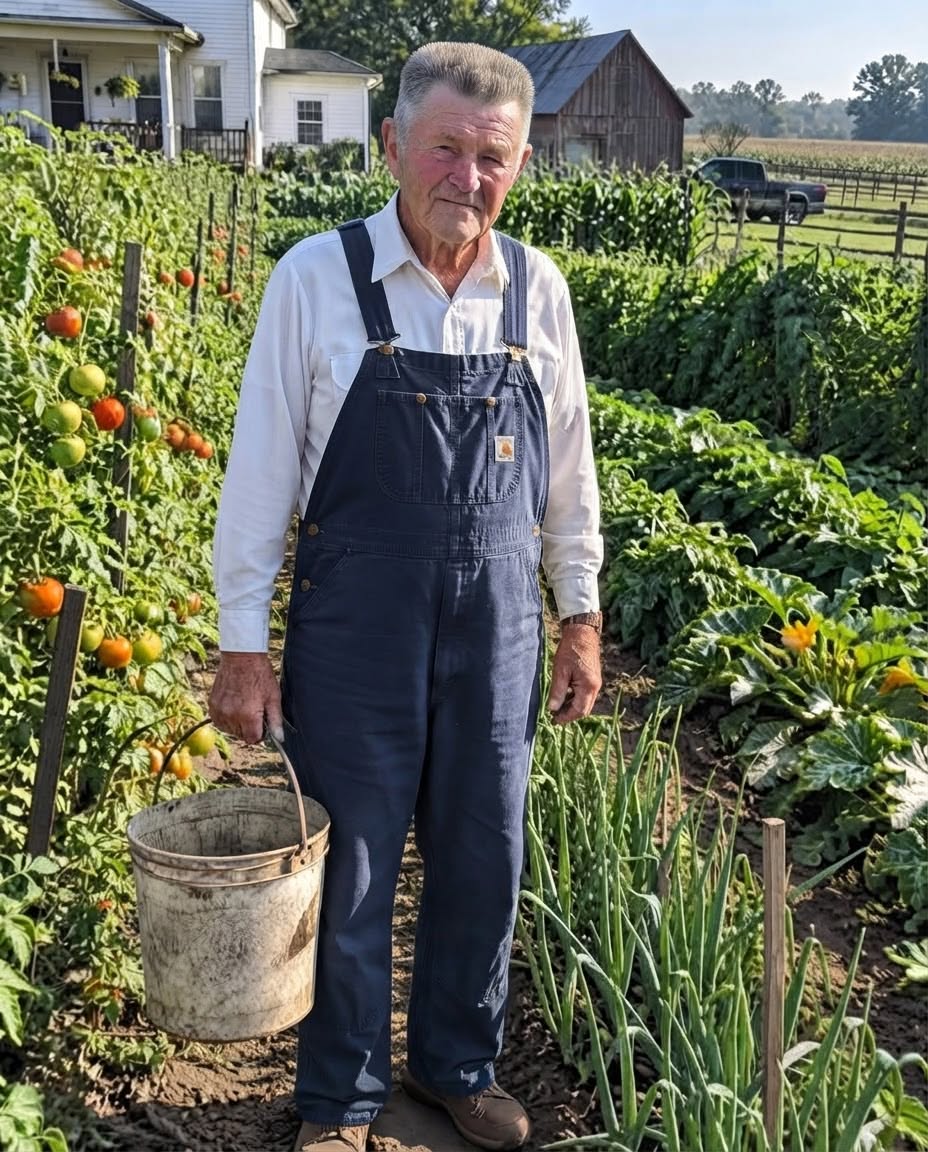
Outside, his garden stretched across nearly half an acre. Tomatoes climbed wooden stakes. Beans curled around handmade trellises. Potatoes, onions, squash, and sweet corn filled carefully maintained rows.
It was the same garden I’d played in as a child.
My mother had planted the first apple tree there when I was seven. Dad had expanded the vegetable beds over the years, turning the backyard into something that looked like a small farm.
After Mom died, the garden became his refuge.
He worked before sunrise, rested when his knees hurt, and returned in the evening to check the plants.
But he grew far more food than one elderly man could possibly eat.
I’d asked him about that once.
“Why so much, Dad?”
He had shrugged.
“People need to eat.”
I assumed he shared vegetables with a few neighbors.
I never imagined the real scale of what he was doing.
“I’m calling an attorney,” I announced.
Dad looked up.
“Why?”
“Because this is ridiculous! You’ve owned this property for decades. You can’t be forced to destroy everything because somebody doesn’t like looking at it.”
His expression remained peaceful.
“Let’s see what happens first.”
I stared at him.
“What happens? The county gave you thirty days!”
“I can read, sweetheart.”
“Then why aren’t you angry?”
He placed the orange peel beside his plate.
“Because anger doesn’t tell me what I need to know.”
At the time, I thought he was being stubborn.
I would later understand that he was waiting for the right people to arrive.
## Chapter Two: The Man in the Gray House
Brent Whitmore had purchased the neighboring property eleven months earlier.
The previous owners had lived there for forty years. Their little farmhouse had a wraparound porch, an old swing beneath an oak tree, and a garden almost as charming as Dad’s.
Brent demolished everything.
In its place, he constructed a modern mansion with towering windows, a rooftop terrace, and an elevated deck overlooking our backyard.
He drove a black luxury SUV and wore watches that probably cost more than my first car.
He wasn’t necessarily unpleasant when we first met.
He was simply accustomed to getting his way.
The first time he complained about Dad’s garden, he approached our fence while Dad was harvesting tomatoes.
“Have you considered landscaping this area?” Brent asked.
Dad looked around.
“It’s already landscaped.”
Brent gestured toward the vegetables.
“I mean something more attractive. Decorative shrubs. Flowers. A clean lawn.”
Dad smiled politely.
“I like growing food.”
“Yes, well, your preferences affect the value of surrounding properties.”
“My vegetables haven’t complained about your house.”
I nearly choked trying not to laugh.
Brent didn’t.
He walked away.
Over the following months, he complained about the corn blocking his view, the wooden trellises, the compost bins, and even the occasional muddy footprints near the garden gate.
Dad ignored him.
Then the county notice arrived.
I was certain Brent had filed the complaint.
When I confronted him over the fence, he didn’t bother denying it.
“I made a formal inquiry about the zoning regulations,” he said. “It’s not personal.”
“You’re asking a seventy-nine-year-old man to destroy something he’s maintained his entire life.”
“I’m asking him to comply with the law.”
“You know perfectly well that garden has been there for decades.”
Brent smiled.
“Then I’m sure he’ll have no trouble demonstrating that it’s permitted.”
I wanted to tell him exactly what I thought of him.
Instead, I returned inside and called the attorney.
Dad stopped me before I could finish explaining the situation.
“Not yet,” he said.
“Dad, please. Let me help you.”
He touched my shoulder.
“You are helping me.”
“By doing nothing?”
“By being here Saturday morning.”
I didn’t understand.
But I promised I’d come.
## Chapter Three: Six O’Clock in the Fog
The inspector arrived shortly before six on Saturday.
His name was Daniel Reeves, and he looked younger than I was.
He carried a clipboard, a camera, and a folder containing the complaint.
Dad greeted him as though he were an old friend.
“Thank you for coming back.”
Daniel glanced around the garden.
“I have to admit, Mr. Lindqvist, I’m curious about what you wanted me to see.”
“Give it a moment.”
Across the fence, Brent stood on his deck with a fresh cup of coffee.
He had apparently decided the morning would provide entertainment.
Then the first pickup truck appeared through the fog.
A man named Harold climbed out, carrying two empty buckets.
A woman arrived with grocery bags.
A young mother brought her little boy.
Two teenagers unloaded cardboard boxes.
Within minutes, cars lined both sides of the road.
People of every age began entering Dad’s garden.
They greeted him by name.
“Morning, Arthur!”
“Good to see you, Mr. Lindqvist!”
“How’s your knee doing?”
“Better than last week. Thank you for asking.”
They spread out between the rows, collecting vegetables with quiet familiarity.
There were no price signs.
No cash register.
No posted schedule.
Nobody asked how much anything cost.
A woman filled a bag with potatoes. Harold harvested beans. The teenagers packed tomatoes into boxes for families who couldn’t attend.
Daniel watched them in confusion.
“Is this a farmers’ market?”
“No,” Dad answered.
“Then what is it?”
Dad pointed toward a woman carefully selecting squash.
“That’s Lisa. She works two jobs and has three children. That’s Harold. His wife has been recovering from surgery. Those boys help deliver food to people who can’t leave their homes.”
He paused.
“Most of them have helped me grow this garden. Today, they are collecting what they need.”
Daniel looked at the visitors again.
“Do they pay you?”
“No.”
“Then how do you afford all this?”
Dad smiled faintly.
“We grow it together.”
I felt something tighten in my chest.
All those early morning trips. The empty crates in his truck. The produce that disappeared faster than he could harvest it.
Dad had been doing this for years.
And I hadn’t known.
“How long?” I whispered.
He turned toward me.
“Eighteen years.”
“Eighteen?”
“Your mother and I started it together.”
I stared at him.
He looked across the garden, and for the first time that morning, I saw the sadness behind his smile.
“After she passed, I couldn’t bear the thought of stopping.”
He picked up a basket.
“So I kept planting.”
Then the silver minivan arrived.
## Chapter Four: The Woman Brent Feared
The elderly woman stepped out slowly, clutching two grocery bags.
She was small, with silver hair and a faded brown coat.
Dad immediately recognized her.
“Eleanor,” he called.
She began walking toward us.
Then she looked up at Brent’s house.
Her face changed.
The color drained from her cheeks.
Brent froze.
The coffee mug slipped from his hand and shattered.
I watched him gripping the deck railing as if he needed it to remain standing.
“Who is she?” I whispered.
Dad approached the woman and took her bags.
“Eleanor, this is my daughter, Claire.”
She gave me a faint smile.
“Your father has told me about you.”
I looked at Dad.
“You know her?”
“Of course.”
Eleanor’s eyes shifted toward Brent again.
“Is that the man who filed the complaint?”
Dad didn’t answer immediately.
Daniel stepped forward.
“Ma’am, do you know Mr. Whitmore?”
Eleanor swallowed.
“Unfortunately, yes.”
Brent suddenly appeared at the side gate.
He had changed out of his robe and into an expensive navy suit.
His smile was forced.
“Eleanor,” he said. “I didn’t know you lived around here.”
“I don’t.”
“Then I don’t understand why you’re here.”
She lifted her chin.
“I’m here for vegetables.”
He glanced at the people around us.
“This is a private property matter. I don’t think your presence is relevant.”
Dad set the grocery bags down.
“Actually, Brent, I think it is.”
Brent turned toward him.
“Arthur, this has nothing to do with anyone except you and the county.”
Daniel cleared his throat.
“I would appreciate it if everyone remained calm. I’m here to assess the complaint, not mediate a personal dispute.”
“Then assess the property,” Brent snapped. “You’ll see that this operation is incompatible with the neighborhood.”
Eleanor let out a quiet, disbelieving laugh.
“Incompatible?”
She reached into her coat pocket and pulled out a folded envelope.
“Is that what you called it when you promised my husband you would protect this community?”
Brent went completely still.
The silence around us deepened.
Dad looked at Eleanor.
“You don’t have to do this if you’re not ready.”
She shook her head.
“I’ve been ready for a long time.”
Then she turned toward Daniel.
“My name is Eleanor Hayes. For twenty-six years, I was married to Robert Hayes, the man who founded the Hayes Community Foundation.”
She paused.
“And Brent Whitmore was our financial director.”
Brent’s face became even paler.
I had heard of the Hayes Foundation. It had funded food programs, community centers, and emergency assistance throughout the county.
But I had never heard of Brent’s connection to it.
Eleanor opened the envelope.
“Before my husband died, he discovered serious irregularities in the foundation’s accounts. Money intended for community programs had disappeared.”
Brent shook his head.
“This is absurd.”
She continued.
“An independent audit was ordered. Brent resigned before it was completed.”
“That has nothing to do with this!” he shouted.
“No?” Eleanor asked. “Then perhaps you can explain why you tried to convince the board that my husband was confused and incapable of managing his own affairs.”
Brent’s jaw tightened.
“That was years ago.”
“Yes,” she replied. “Years ago, when you thought nobody would remember.”
Daniel looked between them.
“I don’t understand what this has to do with the garden.”
Eleanor turned toward Dad.
“Perhaps Arthur should explain.”
Every eye in the garden shifted to my father.
He sighed.
“I’d hoped this wouldn’t become necessary.”
Then he walked to the small wooden shed near the back fence.
He returned carrying an old metal box.
And suddenly, Brent looked as though he wanted to run.
## Chapter Five: What My Father Had Kept
Dad placed the box on a wooden table.
Its corners were rusted, and the latch had been repaired with a piece of wire.
He opened it carefully.
Inside were folders, old photographs, handwritten ledgers, and a stack of letters tied together with string.
“I was a bookkeeper for thirty-one years,” Dad explained to Daniel. “Before I retired, I did some volunteer accounting for the Hayes Foundation.”
I stared at him.
“You never told me that.”
“You were busy raising your family.”
He lifted one of the folders.
“Robert Hayes was a good man. He wanted to make sure money reached the people who needed it.”
Dad explained that the foundation had once funded a community food program in our neighborhood.
Families received fresh produce, groceries, and emergency support.
The program had been particularly important during a recession, when several local factories closed.
My parents had volunteered to help distribute food.
When the program’s accounts stopped matching its receipts, Dad noticed.
At first, he assumed there had been an administrative error.
But the discrepancies continued.
Some payments had been recorded as deliveries that never happened. Other expenses had been approved using authorization records that didn’t match the foundation’s files.
Dad documented the discrepancies and brought them to Robert Hayes.
An independent audit followed.
Brent, who had managed the foundation’s finances, resigned before the process was completed.
The board recovered some money through insurance and legal action, but the community program never fully recovered.
Then Robert died.
The foundation reorganized, and the remaining food distribution network eventually closed.
Families who had depended on it were left scrambling.
Dad and Mom couldn’t bear to watch.
“So you started growing vegetables?” I asked.
“Not immediately,” he replied. “First, we helped a few families with groceries. Then we planted tomatoes and beans. One garden became two. Friends started bringing seeds. Someone donated a refrigerator. A church gave us crates.”
He looked around at the visitors.
“People kept asking how they could help.”
The garden had grown from a few vegetable beds into a community network.
Farmers donated surplus seeds. Volunteers helped maintain the rows. Families collected produce without charge, and people who couldn’t visit received deliveries.
Dad had continued the work for eighteen years.
Eleanor wiped her eyes.
“Robert always believed the program would survive because people cared about one another.”
She looked at Brent.
“He was right. Just not in the way he expected.”
Brent stepped forward.
“These documents are old. They prove nothing about me now.”
Dad nodded.
“Perhaps.”
He removed a final folder from the box.
“But the original audit records were preserved. Robert asked me to keep copies because he was worried the foundation’s findings might disappear during the reorganization.”
He handed the folder to Daniel.
“I never wanted to use them against anyone. I simply didn’t want the truth lost.”
Daniel examined the documents.
Then he looked at Eleanor.
“Are these copies of the original audit?”
“Yes,” she replied. “The foundation’s current legal trustees have authenticated them.”
Brent’s voice rose.
“This is a ridiculous attempt to embarrass me because I filed a legitimate complaint!”
Dad remained calm.
“You were entitled to contact the county. Nobody disputes that.”
“Then stop making this personal!”
“I didn’t make it personal, Brent.”
Dad gestured toward the garden.
“You saw people collecting food and decided they were a problem. You saw vegetables growing on land you don’t own and decided they had to disappear.”
His voice softened.
“You could have asked why this garden existed. You could have asked who it helped.”
He paused.
“Instead, you asked the county to erase it.”
For the first time, Brent had no immediate answer.
## Chapter Six: The Inspector’s Decision
Daniel spent nearly an hour reviewing the documents and taking photographs of the property.
He measured the garden boundaries, checked the access path, and asked questions about how the produce was distributed.
Dad answered everything honestly.
There was no commercial storefront.
No paid employees.
No sales to the public.
The garden operated through volunteers and donations, with produce distributed freely to households in need.
Daniel explained that he would need to review the applicable zoning provisions before making a final determination.
“But I want to be clear,” he said. “The complaint alone doesn’t establish that a violation has occurred. We have to evaluate the actual use of the property and the relevant rules.”
I felt some of the tension leave my shoulders.
“So the thirty-day order isn’t necessarily final?”
“Correct. I’ll review the original notice and determine whether the cited provisions apply.”
Brent folded his arms.
“This is exactly why we have regulations. If everyone starts running operations from their backyards, property values—”
“Mr. Whitmore,” Daniel interrupted, “the property values aren’t the question I’m here to decide.”
Brent stared at him.
Daniel continued.
“I will review the zoning issue independently. The historical records you have seen are not, by themselves, proof of a zoning violation or a defense to one. But the facts about this property’s actual use matter.”
Dad nodded.
“That seems fair.”
Brent looked around the garden.
People were still gathering vegetables.
A little boy was helping Harold place potatoes into a box.
A woman had brought coffee for the volunteers.
Someone else was repairing a broken wheel on an old garden cart.
The gathering had become an ordinary morning of community work.
That, more than anything, seemed to irritate Brent.
He had expected the inspector to arrive, photograph the vegetables, and order Dad to remove them.
Instead, he had discovered an entire community standing behind the garden.
And the elderly woman he had hoped never to see again had brought the past directly to his doorstep.
“I’m contacting my attorney,” he muttered.
Eleanor nodded.
“You should.”
He glared at her.
“You have no idea what you’re talking about.”
“I know exactly what I’m talking about, Brent.”
She held his gaze.
“My husband spent the final months of his life trying to ensure the foundation’s records were preserved. You told people he was confused. You told them the missing money was an accounting mistake. You thought everyone would eventually forget.”
Her voice trembled, but she did not look away.
“I didn’t forget.”
Brent turned and walked toward his house.
This time, nobody watched him go.
They were too busy helping one another.
## Chapter Seven: The Truth Behind the Complaint
The county review took twelve days.
During that time, I helped Dad organize the garden’s records.
We gathered seed receipts, volunteer schedules, donation letters, photographs, and delivery logs.
For the first time, I saw the full extent of what he and Mom had built.
There were records of hundreds of households receiving vegetables over the years.
Some families had moved away after finding better jobs.
Others had stayed and become volunteers themselves.
One former recipient was now a nurse who delivered produce to elderly residents.
Another had started a small farm and donated a portion of every harvest back to the community.
The garden wasn’t merely feeding people.
It was teaching them how to feed one another.
I found a photograph taken twenty years earlier.
Mom stood beside Dad beneath the old apple tree, holding a basket of tomatoes.
Behind them were six volunteers, all smiling at the camera.
On the back, Mom had written:
If we have enough for ourselves, we have enough to share.
I cried when I read it.
Dad found me sitting at the kitchen table.
“Your mother would have been pleased,” he said.
“I can’t believe you kept all this from me.”
He pulled out a chair.
“I didn’t keep it from you. I just never thought it needed explaining.”
“You should have told me how many people depended on you.”
He shook his head.
“They don’t depend on me, Claire. They depend on each other. That’s the difference.”
A week later, Daniel called.
The county had reviewed the original complaint, the property history, and the garden’s actual use.
The initial notice was being withdrawn because the cited zoning provision did not establish that the garden, as documented, constituted a prohibited agricultural business.
The county would still require compliance with applicable rules governing structures, waste management, and access, but Dad would not be ordered to destroy the garden under that notice.
I nearly shouted into the phone.
“Does that mean he can keep it?”
“Based on the review, yes, subject to the ordinary requirements I just mentioned.”
I thanked him repeatedly.
When I told Dad, he was sitting on the porch repairing a broken handle on his watering can.
He listened quietly.
Then he smiled.
“Good.”
“Good? Dad, we won!”
He shook his head.
“No, sweetheart. We were given another chance to keep doing something useful.”
That was all he said.
But the story wasn’t finished.
Because Eleanor had received a phone call of her own.
And this one would change everything.
## Chapter Eight: Eleanor’s Promise
Three days after the county withdrew the notice, Eleanor returned to our house.
This time, she arrived with a young attorney and a thick folder.
Dad invited them into the kitchen.
I made coffee and sat beside him.
Eleanor explained that the Hayes Foundation had reopened its historical financial review after she presented the records Dad had preserved.
The foundation’s current trustees had commissioned an independent examination of the old accounts.
They wanted to determine whether any unresolved claims remained and whether money had been improperly diverted.
She made it clear that the review was ongoing.
“No final findings have been issued,” she said. “But the records justify further investigation.”
Her attorney added that the foundation had also decided to restore funding for community food programs.
They wanted to begin with our neighborhood.
Eleanor looked at Dad.
“Robert would have wanted that.”
Dad folded his hands.
“We don’t need a large building or a complicated program.”
“We know,” she said. “That’s why we’re here.”
The foundation proposed funding seeds, soil, tools, accessible garden paths, and a small refrigerated storage space.
It would also provide grants to nearby growers willing to donate surplus produce.
The garden would remain community-run, and Dad would have no obligation to expand beyond what he could comfortably manage.
I watched him consider the proposal.
For years, he’d paid for supplies from his retirement income and accepted whatever donations people could spare.
The offer would make the garden more sustainable.
But Dad had one condition.
“Don’t put my name on a sign,” he said.
Eleanor smiled through her tears.
“I thought you might say that.”
“Put the money toward the food.”
“That’s exactly what we intend to do.”
Then she reached across the table and took his hand.
“Arthur, you and your wife kept a promise my husband made to this community. I can’t thank you enough.”
Dad squeezed her hand.
“You don’t owe us anything.”
“I know.”
She glanced toward the garden.
“That’s why this matters.”
## Chapter Nine: Brent’s Last Attempt
Brent did not take the news well.
When the foundation announced its renewed food initiative, a local newspaper published a short article about the garden.
The story described how volunteers had maintained the project for eighteen years and how the county had withdrawn its original notice after review.
It did not accuse Brent of any financial wrongdoing.
It did not suggest that the historical audit proved he had committed a crime.
But the article mentioned that records from the former foundation director had been preserved and were now part of an independent review.
That was enough to make Brent furious.
He came to our fence the following evening.
“This has gone far enough,” he said.
Dad was tying up tomato vines.
“Good evening, Brent.”
“Don’t pretend you don’t know what you’ve done.”
Dad straightened.
“I haven’t done anything to you.”
“You’ve turned this neighborhood against me.”
“No,” Dad replied. “I’ve grown vegetables.”
Brent’s face reddened.
“You’ve made me look like a criminal.”
“I haven’t called you anything.”
“Your little newspaper story—”
“I didn’t write it.”
“You gave them those documents!”
“I gave them to the people responsible for reviewing them.”
Brent stepped closer to the fence.
“You think you’re some kind of hero because you give away vegetables?”
Dad looked at him for a long moment.
“No. I think people are hungry, and vegetables help.”
Brent scoffed.
“Enjoy your victory while it lasts.”
He turned to leave.
Then Dad spoke again.
“Brent?”
He stopped.
“You’re welcome to help on Saturday.”
Brent looked back, stunned.
“What?”
“We always need extra hands. The potato beds could use some attention.”
For a moment, Brent seemed unable to comprehend what he’d heard.
“You cannot be serious.”
“I am.”
Brent laughed bitterly.
“You think I’m going to come out here and dig in the dirt with these people?”
Dad shrugged.
“That’s entirely your decision.”
Brent walked away without another word.
I turned toward Dad.
“Why would you invite him?”
He picked up his watering can.
“Because being ashamed doesn’t teach anyone how to become better.”
I stared at him.
“And if he never changes?”
Dad looked toward the gray mansion.
“Then the garden will still be here.”
## Chapter Ten: The Morning Everything Changed
The following Saturday, I arrived at six in the morning again.
The fog had lifted, revealing the garden in all its green and gold.
A dozen volunteers were already working.
Harold was harvesting beans. Lisa was organizing deliveries. The teenagers were loading crates into a borrowed van.
Eleanor stood near the shed, speaking with the foundation’s attorney.
Dad was showing a new volunteer how to recognize ripe tomatoes.
Then I noticed someone standing beside the gate.
Brent.
He wore jeans, an old sweatshirt, and rubber boots that looked as though they had never touched mud.
In his hands was a pair of gardening gloves.
Nobody said anything.
He looked uncomfortable.
Dad approached him.
“Morning.”
Brent nodded.
“You said you needed help with the potatoes.”
“We do.”
Dad handed him a small shovel.
“The rows along the fence need attention.”
Brent glanced at the muddy ground.
Then at the people working nearby.
“I should explain something,” he said.
Dad waited.
Brent swallowed.
“When I bought the property, I thought I was buying a certain kind of life. Quiet mornings. Beautiful views. A neighborhood that looked exactly the way I wanted it to look.”
He looked toward the garden.
“I saw the vegetables and thought they made everything look untidy.”
Dad said nothing.
Brent rubbed the back of his neck.
“I didn’t ask what they were for. I didn’t ask why so many people came here. I just wanted them gone.”
His voice grew quieter.
“When I saw Eleanor, I remembered what happened at the foundation. I remembered how easily people can lose trust in you.”
He looked directly at Dad.
“I was afraid the past would catch up with me.”
Eleanor had approached quietly enough to hear the last sentence.
“Then you should help the current review find the truth,” she said.
Brent nodded slowly.
“I will cooperate with the review.”
“That is the right place to start,” she replied.
There was no dramatic embrace.
No instant forgiveness.
No declaration that everything was settled.
Some matters still needed to be examined, and any conclusions about the foundation’s old accounts would have to come from the independent review.
But Brent had shown up.
For the first time since moving into the neighborhood, he was standing among the people he had previously dismissed.
Dad pointed toward the potato beds.
“Ready to work?”
Brent looked at the shovel.
Then he nodded.
“Show me what to do.”
Dad demonstrated how to loosen the soil without damaging the potatoes.
Brent listened.
He made mistakes.
He got dirt on his clothes.
He had to ask for help more than once.
Nobody mocked him.
By eight o’clock, he had filled two crates.
Lisa approached and handed him a paper cup of coffee.
“First Saturday?” she asked.
Brent managed a small smile.
“Is it that obvious?”
“Only because you haven’t learned where the good gloves are kept.”
For the first time, I saw him laugh without looking around to see who was watching.
It wasn’t a complete transformation.
One morning couldn’t erase months of arrogance or resolve every question about the past.
But it was a beginning.
And sometimes, a beginning is enough.
## Epilogue: What the Garden Taught Me
Six months later, the garden looked different.
The foundation had funded improved paths, a small storage shed, and equipment that made the work easier for older volunteers.
Local farmers contributed surplus produce.
A nearby school began sending students to learn about planting, composting, and food distribution.
The county continued to inspect the property as required, but the garden remained open and operated within the applicable rules.
Dad still woke before sunrise.
His knees still hurt.
His hands were still stiff.
But he no longer carried every heavy crate himself. There were always people willing to help.
Brent became a regular Saturday volunteer.
He never became the garden’s leader, and nobody treated him as a hero.
He simply showed up, worked, and gradually learned people’s names.
The independent foundation review continued through the appropriate channels. Whatever its eventual findings, Brent could no longer pretend the community’s needs were invisible.
As for Eleanor, she visited every few weeks.
She usually brought empty grocery bags and left with tomatoes, beans, and potatoes.
One afternoon, I found her sitting beside Dad beneath the old apple tree.
They were looking at a photograph of my mother.
“Your father reminds me of Robert,” she said when she noticed me.
Dad shook his head.
“Robert was the one who started everything.”
“No,” Eleanor replied gently. “Robert started a program. You helped keep its purpose alive.”
She turned toward me.
“Your mother understood something important. Giving people food isn’t just about filling their stomachs. It’s about reminding them that somebody sees them.”
I looked across the garden.
Harold was helping a young father load vegetables into a car.
Lisa was packing produce for an elderly couple who couldn’t leave their home.
Brent was teaching two schoolchildren how to loosen the soil around a tomato plant.
And Dad was standing near the gate, greeting another family who had come for their weekly groceries.
I thought about that first Saturday morning.
The fog.
The inspector’s clipboard.
The line of cars.
The silver minivan.
And Brent’s terrified expression when Eleanor stepped out.
I had assumed the garden’s greatest value was the food it produced.
I was wrong.
Its greatest value was the people it brought together.
One evening, I asked Dad whether he had planned the entire Saturday gathering to prove a point to the inspector.
He chuckled.
“Not exactly.”
“Then why did you ask him to come at six?”
Dad looked toward the vegetable beds.
“Because that’s when the people arrive.”
He paused.
“And I wanted him to see what the garden really was before deciding what it should become.”
I leaned against the fence.
“Were you ever afraid you’d lose it?”
Dad was quiet for a moment.
“Of course.”
“Then why didn’t you fight harder when the notice arrived?”
He smiled.
“I was prepared to fight if I had to. But first, I wanted the truth to speak for itself.”
He reached down and picked up a ripe tomato.
Its skin glowed red in the evening light.
“People sometimes look at something and see only what it is to them. Brent saw vegetables blocking his view. The inspector saw a possible zoning violation. You saw your father being threatened.”
He handed me the tomato.
“But the families saw food. Your mother saw hope. And I saw a way to keep a promise.”
I held the tomato in my hands.
For eighteen years, my father had quietly kept that promise without asking anyone to notice.
Then one wealthy neighbor tried to take his garden away.
And by doing so, he accidentally brought the entire community into the light.
I looked toward the gray mansion next door.
From Brent’s deck, the garden was still visible.
The tall corn still swayed in the wind. The bean poles still stood in uneven rows. The wooden stakes and wire cages remained exactly where they had always been.
It wasn’t the kind of view Brent had originally wanted.
But on Saturday mornings, I sometimes saw him standing at the gate before sunrise, waiting for Dad to arrive.
And every time, Dad greeted him with the same simple question.
“Ready to get started?”
Brent always nodded.
Because he had finally learned what my father had known all along.
A garden is never just a garden when the people who tend it are growing something bigger than food.
Sometimes, it is a lifeline.
Sometimes, it is a promise.
And sometimes, it is the one thing standing between a community and the people who have forgotten that wealth doesn’t give anyone the right to decide who deserves to eat.