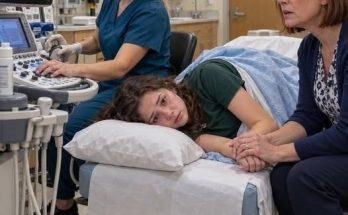
The day I was discharged, Brent arrived early with my sweater, my phone charger, and a small bag of groceries. He helped me gather my belongings while Sandra reviewed my medication schedule and reminded me to take my recovery seriously.
My parents didn’t come. Mom sent a text saying she couldn’t make it because Vivian needed help unpacking the last few boxes. I read the message twice.
Then I put my phone away. For the first time in my life, I didn’t ask why.
Brent drove me home and carried my bag upstairs. Before leaving, he made sure I had food in the refrigerator, water beside my bed, and my doctor’s number within reach.
“Call me if you need anything,” he said.
“I will.”
He gave me a skeptical look.
“Actually, call me even if you think you don’t need anything.”
I smiled.
“I’ll try.”
After he left, I stood in the middle of my quiet apartment.
Everything looked exactly as I had left it. My shoes were beside the door. A half-finished book sat on the coffee table. My work bag was still resting against the wall.
But I was different.
I had spent years believing that being independent meant never needing anyone.
Now I understood that independence also meant choosing whom to trust, whom to invite into my life, and whom to stop waiting for.
I walked to the window and watched the city moving below.
Somewhere out there, people were rushing to work, arguing over parking spaces, buying groceries, and making plans for the weekend.
My life had nearly ended in an ordinary parking lot.
I had no idea how much time I had left.
But I knew I didn’t want to spend whatever time I had remaining trying to convince people to care about me.
I wanted to live.
Really live.
And that meant beginning with myself.
Two weeks later, Michael Reyes called.
His voice was gentle and a little nervous.
“I heard you’re recovering,” he said. “I’m glad.”
I struggled to find the right words.
“I’ve been wanting to thank you.”
“You don’t have to thank me.”
“Yes, I do.”
There was a brief silence.
Then he said, “I was leaving work when I saw you fall. At first, I thought you had tripped. Then I realized you weren’t responding.”
He explained that someone had called emergency services while he began CPR. He remembered the paramedics arriving, taking over, and asking questions he couldn’t answer.
He had gone home that evening wondering whether I had survived.
“I didn’t know your name,” he said. “I just kept hoping you made it.”
I started crying.
Not because he had saved my life, although he had played an extraordinary role in it.
I cried because a man who had never met me had worried about whether I would live.
He had no obligation to care about me.
He had no family connection, no financial interest, and no reason to expect anything in return.
Yet he had acted when my life depended on someone acting.
We arranged to meet at a quiet café once my doctor cleared me for the outing.
When the day arrived, I recognized him immediately from the photograph the hospital had shared with my permission.
He looked like an ordinary man in his early fifties, wearing a blue jacket and carrying a paper cup of coffee.
I stood when he approached.
“Michael?”
He smiled.
“You must be the woman who has been making me feel like a hero.”
I laughed through my tears.
“You saved my life.”
“I helped until the professionals arrived,” he corrected gently. “And you did the rest by surviving.”
We sat together for almost an hour.
He told me about his wife, his grown children, and his job. He didn’t speak about the CPR as though he had performed some impossible miracle. To him, it had been a moment when someone needed help and he had known what to do.
Before we parted, I asked whether he would allow me to share his story with a cardiac research organization I had been learning about.
He agreed, provided I didn’t portray him as someone who had acted alone.
“People need to learn CPR,” he said. “And people need to take heart symptoms seriously. If telling your story helps someone recognize an emergency, that’s worth doing.”
I promised him I would.
That evening, I returned home with a feeling I hadn’t experienced in a long time.
Gratitude.
Not the anxious gratitude that made me feel indebted to people who occasionally gave me attention.
This was different.
It was the quiet recognition that goodness existed in unexpected places.
And I wanted to help it reach someone else.
My recovery was slower than I expected.
Some days, I felt almost normal. On others, fatigue arrived without warning, forcing me to cancel plans and rest.
I followed my cardiologist’s instructions and gradually adjusted my routine.
I also began researching cardiac health organizations and the work being done to support people affected by spontaneous coronary artery dissection.
The more I learned, the more I understood how frightening it could be to experience a serious medical emergency without knowing what was happening to your body.
I decided to use my resources to support research and awareness.
My attorney helped me identify an appropriate organization and structure a future charitable gift through my estate plan. I also made a modest donation from my current income once my finances and recovery allowed.
I wasn’t trying to buy my way out of what had happened.
I simply wanted something meaningful to grow from an experience that had nearly taken everything from me.
Months earlier, I had measured security by the size of my savings account and the stability of my career.
Now I measured it differently.
Did I have people I could call?
Could I ask for help without feeling ashamed?
Was I spending my time on things that mattered to me?
And was I building a life that reflected my values rather than my fear of disappointing others?
Those questions changed the way I lived.
I returned to work gradually, setting boundaries around my hours.
I stopped volunteering for every extra assignment.
I began taking short walks when my medical team approved them.
On Sundays, I cooked meals I actually enjoyed instead of eating whatever was easiest after a long day.
I even joined a small community group that organized support for people recovering from serious illnesses.
I didn’t tell everyone my story.
But when someone asked why I had become so protective of my time, I answered honestly.
“Because I learned that tomorrow isn’t something any of us can guarantee.”
My parents didn’t understand the changes at first.
They were accustomed to the daughter who always answered the phone, attended every gathering, and quietly helped whenever the family needed something.
When Mom called asking me to help Vivian organize her finances, I told her I couldn’t.
“I thought you were feeling better,” she replied.
“I am feeling better. But I have a medical appointment that day, and I need to rest afterward.”
“You could do it another time.”
“Vivian can arrange another time with someone else.”
Mom fell silent.
“You’ve changed,” she finally said.
“Yes,” I answered. “I have.”
A few weeks later, Dad called to ask whether I could lend Vivian money for an unexpected expense.
In the past, I would have opened my banking application before he finished explaining.
This time, I asked whether Vivian had reviewed her budget and explored other options.
Dad became irritated.
“She’s your sister.”
“And I’m her sister, not her emergency fund.”
He accused me of becoming selfish.
The word hurt, even though I knew I hadn’t done anything wrong.
For days, I wondered whether I was becoming the kind of person I had always disliked.
Then I remembered the hospital room.
I remembered the unanswered calls.
I remembered how quickly my parents had expected me to understand their reasons while offering so little understanding of mine.
I wasn’t refusing to love my family.
I was refusing to let love become an endless obligation that flowed in only one direction.
I told Dad I hoped Vivian found a solution.
Then I ended the call.
For the first time, I didn’t spend the rest of the evening feeling guilty.
I made dinner, called Brent to ask how his week had gone, and went to bed at a reasonable hour.
The world did not fall apart because I said no.
And neither did I.
Nearly six months after my collapse, Mom called and asked if she could visit.
Her voice sounded different.
Less cheerful. Less certain.
I agreed.
When she arrived, she sat on my sofa and looked around my apartment.
“You look healthier,” she said.
“Thank you.”
She noticed the small folder on my coffee table containing information about cardiac research and awareness.
“What’s all this?”
I explained the organization I was supporting and why I had decided to direct part of my estate toward that work.
Mom listened, then asked the question I had expected sooner or later.
“So, if something happens to you, none of your money comes to us anymore?”
I took a breath.
“My estate plan reflects my wishes. I want my assets to support research into the condition that nearly killed me.”
“But we’re your parents.”
“I know.”
“We raised you.”
“I know that too.”
She looked hurt.
I didn’t deny that my parents had provided for me in many ways when I was a child. They had fed me, housed me, sent me to school, and given me memories I still treasured.
But those things did not erase what happened in the hospital.
“I don’t hate you, Mom,” I said. “I’m not doing this to make you suffer. But I need you to understand that I can’t keep organizing my life around the hope that you’ll eventually treat me differently.”
Her eyes filled with tears.
“We never thought you felt that way.”
“I tried not to. I kept telling myself that you were busy, that Vivian needed more help, that I could handle things on my own.”
I paused.
“Then I woke up in a hospital and realized I had been unconscious for three days. I didn’t know whether I would recover. And when I finally heard from you, the first thing I heard was that I was strong enough to manage.”
Mom covered her mouth.
“I was scared,” she whispered.
“I understand that.”
“No, you don’t. I was terrified when I realized how serious it had been.”
I looked at her carefully.
“Then why didn’t you come?”
She began crying.
For a long time, neither of us spoke.
Finally, she said, “I thought you would be fine. You’ve always been fine. Your sister falls apart over everything, and I thought you didn’t need me the way she did.”
I felt a familiar ache in my chest, but this time it wasn’t physical.
“Mom, needing you doesn’t always look like crying or asking for help. Sometimes it looks like the daughter who keeps saying she’s fine because she doesn’t want to inconvenience anyone.”
She lowered her head.
“I should have come.”
“Yes,” I said softly. “You should have.”
It was the first time either of us had spoken those words without an excuse attached.
I didn’t hug her immediately.
I didn’t tell her everything was forgiven.
I let the truth remain in the room between us.
Eventually, she wiped her eyes and asked whether we could try to rebuild our relationship.
I told her we could try.
But I also told her that rebuilding trust would require more than one emotional conversation.
It would require consistency.
It would require her to listen when I spoke, even when my needs were inconvenient.
And it would require both of us to accept that our relationship might never return to what it had been.
Mom nodded.
For once, she didn’t argue.
When she left, I felt neither triumphant nor completely relieved.
I simply felt honest.
And that was enough for one day.
Dad took longer.
For several months, he maintained that I had overreacted.
He believed changing my will had been unnecessary and that removing my parents from my medical power of attorney was an insult.
He didn’t understand why I couldn’t simply move on.
Then, one afternoon, he called to tell me that a longtime friend of his had suffered a heart attack.
The man had survived, but the experience had frightened Dad.
He asked me how my recovery was going.
I told him the truth.
Some days were good. Others were difficult. I still attended my follow-up appointments and followed my medical team’s guidance.
Then he asked something unexpected.
“Do you ever think about what would have happened if nobody had found you?”
I was silent for a moment.
“Sometimes.”
“I think about it too,” he admitted.
I waited.
He took a breath.
“I should have answered the phone.”
It wasn’t a perfect apology.
It didn’t explain everything, and it didn’t repair the damage overnight.
But it was the first time Dad had acknowledged his responsibility without blaming the circumstances.
“Yes,” I said. “You should have.”
“I don’t know how to make it right.”
“I don’t think you can change what happened.”
“Then what do I do?”
I looked toward the window.
“Start by being present now. Don’t promise me that you’ll always be there. Just show me that you can be there when it matters.”
He was quiet.
Then he said, “I’ll try.”
I accepted that answer for what it was.
A beginning, not a guarantee.
A year after my collapse, I returned to the office parking lot where everything had changed.
I hadn’t planned to visit that day.
I was attending an appointment nearby when I found myself standing at the edge of the same lot, looking at the space where I had fallen.
Cars moved in and out.
People hurried toward the building, carrying bags and checking their phones.
Everything looked ordinary.
That was the strangest part.
The place where my life had nearly ended didn’t look like a place where anything important had happened.
I stood there for a few minutes, thinking about the stranger who had stopped to help, the paramedics who had fought to keep me alive, the nurses who had cared for me, and the coworker who had noticed I was missing.
I thought about my parents, too.
I no longer spent every day wondering why they hadn’t come.
I had accepted that I might never receive the explanation I once wanted.
My relationship with Mom had slowly improved. She called more often and had begun asking how I was feeling instead of assuming I was fine.
Dad and I were still cautious with each other, but he had started making an effort.
Vivian remained largely unchanged. She didn’t understand why I had stopped helping her financially whenever she asked, and our relationship became more distant.
I was sad about that.
But I was no longer willing to sacrifice my peace to keep everyone comfortable.
My life had become smaller in some ways.
I attended fewer family gatherings. I said no more often. I stopped trying to solve problems that belonged to other adults.
Yet my world had also become larger.
I had made new friends.
I had learned to accept help.
I had found meaningful work supporting cardiac awareness, and I had begun sharing educational resources with people who wanted to understand the condition that had changed my life.
Most importantly, I had stopped treating my own needs as something that could always wait.
I took one last look at the parking lot and whispered, “I’m still here.”
Then I walked toward my car.
On the anniversary of my collapse, I received a handwritten card from Michael.
Inside, he wrote that he was grateful I had survived and that he hoped the year ahead would bring me peace.
He reminded me that the day he performed CPR had not been about knowing who I was.
It had been about recognizing that someone needed help.
I placed the card beside a photograph of the two of us from the café.
Then I called Brent.
He answered with his usual greeting.
“Tell me you’re not calling to ask about work.”
I laughed.
“No work. I just wanted to say thank you.”
“For what?”
“For noticing I was missing.”
He was quiet for a moment.
“I’m glad I did.”
“Me too.”
We talked for a while before hanging up.
Later that evening, Mom called.
She asked whether I would come to dinner the following Sunday.
“Just the family,” she said. “Nothing special.”
I considered the invitation.
A year earlier, I would have accepted immediately, then spent days wondering whether I could do something to make the gathering go smoothly.
This time, I asked who would be there and what time dinner would begin.
Mom answered.
I told her I would come for an hour, provided I was feeling well.
“Of course,” she said. “Whatever works for you.”
It was a small answer.
But it was different.
And I had learned to appreciate small changes without mistaking them for complete transformation.
At dinner, Dad looked older than I remembered.
Mom had prepared one of my favorite dishes, and she asked whether I wanted more before clearing my plate.
For a while, we talked about ordinary things.
Work. Weather. A neighbor’s renovation.
Then Dad put down his fork.
“I’ve been thinking about what you said last year,” he began.
The table grew quiet.
He looked at me.
“I spent so much time assuming you were fine that I stopped asking whether you were.”
I didn’t interrupt.
“When the hospital called, I told myself you were strong enough to get through it. I used that as an excuse not to stop what I was doing.”
He swallowed.
“I was wrong. I should have answered. I should have come.”
Mom reached for a napkin.
Dad continued.
“I can’t undo it. And I know an apology doesn’t give you those days back. But I’m sorry.”
For a moment, I couldn’t speak.
There had been a time when I would have waited my entire life to hear those words.
Now that they had finally arrived, they didn’t magically heal everything.
But they mattered.
“Thank you for saying that,” I replied.
Dad nodded.
I reached across the table and placed my hand over his.
“I love you, Dad. But I need you to understand something. If I ever forgive you completely, that doesn’t mean I will go back to being the person who never needs anything.”
He squeezed my hand.
“I understand.”
“And if I say no to something, it doesn’t mean I don’t love you.”
“I understand,” he repeated.
For the first time, I believed he was trying to.
After dinner, Mom walked me to the door.
She hugged me gently, then stepped back.
“Drive safely,” she said. “And call me when you get home.”
“I will.”
As I drove away, I felt something settle inside me.
Not the old hope that everything would become perfect.
Something steadier.
I had stopped waiting for my family to rescue me from loneliness.
I had stopped measuring my worth by how much I could give them.
And I had stopped believing that being strong meant enduring every disappointment in silence.
My parents were still my parents.
I loved them.
I might always wish they had answered those calls.
But my future no longer depended on their ability to become the people I had needed them to be.
I had my health to protect, friendships to nurture, meaningful work to pursue, and a life that belonged to me.
My will still directed my estate toward the causes I had chosen. My medical decisions remained entrusted to someone who had knowingly accepted that responsibility. Those choices weren’t threats, and they weren’t punishments.
They were simply mine to make.
I couldn’t change the three days I had spent unconscious.
I couldn’t change the stranger who had saved me into a relative.
I couldn’t make my parents return to that hospital and sit beside my bed when I needed them most.
But I could decide what happened next.
And that, I finally understood, was its own kind of survival.
I had spent thirty-five years trying to prove that I was strong enough not to need anyone. It took nearly losing my life to learn that real strength was knowing whom to trust, when to ask for help, and when to stop begging for love that should never have required proof.
I didn’t survive because I was the strong one.
I survived because someone saw me, someone acted, and a team of strangers refused to give up.
And from that day forward, I promised myself one thing:
I would never again confuse being needed with being loved.
The End.