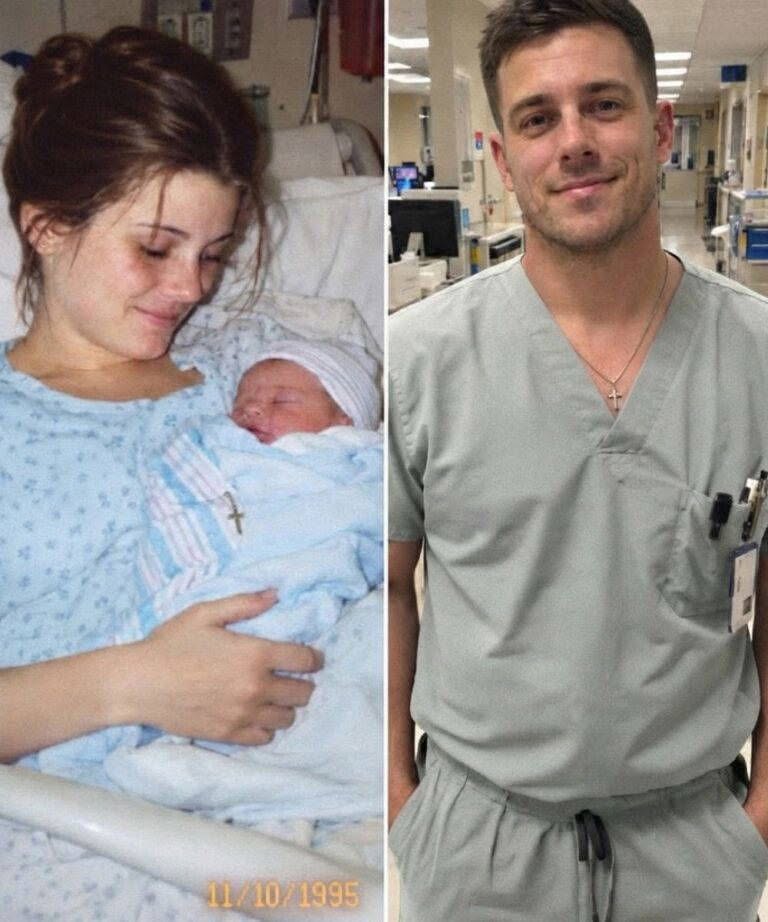
The surgeon stood beside my hospital bed, holding the silver cross between his fingers.
For several seconds, he didn’t speak. I was forty-nine years old, recovering from emergency abdominal surgery, and staring at a necklace I had not seen in thirty-one years.
I knew every detail of it. The delicate chain. The tiny indentation near the clasp. The small scratch on one arm of the cross that my grandmother had accidentally made when I was a child.
I had hidden that necklace inside my newborn son’s blanket the day he was born.
Now it hung around the neck of the man who had saved my life.
“Doctor,” I whispered, “please tell me where you got that.”
He pulled a chair beside my bed.
“My name is Dr. Fabian Bennett,” he said quietly. “I was adopted as an infant.”
My breath caught.
Fabian.
The name I had chosen for the baby I never got to bring home.
He watched my face carefully before continuing.
“My adoptive mother gave me this necklace when I turned eighteen. She told me it had been found among my belongings when I was brought home from the hospital.”
My eyes filled with tears.
“Your birthday?” I asked.
“October fourteenth, 1995.”
I covered my mouth.
October fourteenth.
The date was carved into my memory so deeply that even thirty-one years of searching had never dulled it.
He leaned forward.
“There’s something else. My adoption records have always been incomplete. When I was a teenager, I asked my parents about my birth mother. They told me she had been very young and had voluntarily placed me for adoption.”
He paused.
“But a few months ago, I received permission to review some sealed records. I discovered that my original birth certificate had been amended, and there were inconsistencies in the paperwork.”
His fingers tightened around the cross.
“Then, during your surgery, I reviewed your medical history. Your date of birth caught my attention. I remembered the year in my records, and I asked the hospital’s social worker to check whether there might be a connection.”
He looked directly at me.
“Your full name is Margaret Ellis, isn’t it?”
I nodded.
Nobody had called me Margaret Ellis with such careful seriousness in years.
“Then I need to ask you something,” he said. “Did your parents ever tell you what really happened after you signed those adoption papers?”
I stared at him.
“No,” I whispered. “They told me my son had gone to another family. They never told me where. They never gave me a name, an address, or a single photograph.”
Fabian closed his eyes briefly.
“My adoptive mother gave me a letter before she died. She said it had been written by the woman who gave birth to me. But she never knew whether the letter had actually reached its intended recipient.”
He reached into his pocket and carefully unfolded a small piece of paper.
The handwriting was unfamiliar, but the words made my heart stumble.
To my precious baby boy,
If you ever read this, please know that I did not give you away because I didn’t love you. I loved you before I ever saw your face. I loved you when I held you, and I loved you every day afterward.
If life ever brings us together, I hope you’ll understand that I was eighteen, frightened, and surrounded by people who told me I had no choice.
I wanted to bring you home.
I wanted to be your mother.
I am so sorry.
Love always,
Your birth mother.
I pressed the letter against my chest.
“I wrote that,” I said. “I wrote it the night they took him from me.”
Fabian looked as though the ground had shifted beneath him.
“You’re saying you’re my mother?”
“I believe I am.”
He looked down at the cross.
Then, very slowly, he reached across the bed and took my hand.
“Then we need to find out what happened thirty-one years ago.”
I had spent my entire adult life searching for my son.
I never imagined I would find him while lying in a hospital bed, with stitches in my abdomen and an IV in my arm.
But finding him was only the beginning.
Because the truth about his adoption was far worse than anything I had ever imagined.
And it began with the people I had trusted most.
My parents.
## Thirty-One Years Earlier
I was eighteen when I discovered I was pregnant.
My name was Margaret Ellis, and I had just graduated from high school in a small town in Ohio.
I had no savings, no college acceptance worth mentioning, and a part-time job at a grocery store. I lived with my parents, Thomas and Evelyn Ellis, in a white house with green shutters and a backyard full of rose bushes.
My father believed that life should follow a carefully arranged plan.
Finish school. Get a respectable job. Marry the right man. Have children when you could afford them.
I had disrupted that plan before I even understood what it meant to become a mother.
When I told my parents about the pregnancy, my mother’s face crumpled.
My father stood so abruptly that his chair scraped against the kitchen floor.
“Who is the father?”
I refused to answer.
The boy I had been seeing had left town months earlier. We had been young, foolish, and uncertain about the future. I wasn’t ready to expose his name to my father’s anger, and I knew he couldn’t provide a stable home for a child.
My father called my pregnancy a disaster.
My mother cried whenever she thought I couldn’t hear her.
For weeks, every conversation became an argument about adoption.
“You cannot raise a child on grocery-store wages,” my father told me.
“I’m willing to work,” I replied.
“You don’t even have a car.”
“I’ll find a way.”
“You’re a child yourself.”
“Then help me become a better mother!”
That silenced him, but only temporarily.
Eventually, something changed.
My mother began attending prenatal appointments with me. My father stopped shouting and started talking about practical arrangements.
One evening, they sat me down at the kitchen table.
“We’ve thought about this carefully,” Mom said. “We’re going to support you.”
Dad nodded.
“We’ll help you raise the baby until you can stand on your own feet.”
I wanted to believe them so desperately that I didn’t notice how quickly they changed the subject whenever I asked about the baby’s room or bringing him home.
I found a second part-time job and began saving every dollar I could.
I bought tiny socks, a blue blanket, and a stuffed rabbit with floppy ears.
I named my son Fabian.
Every night, I placed my hands on my stomach and whispered stories to him.
I promised him that we would be all right.
When I went into labor, my mother drove me to the hospital.
My son was born just after sunrise.
He had a little tuft of dark hair and fingers so small that they curled around only the tip of mine.
The nurse placed him against my chest, and the world seemed to become very quiet.
I didn’t care about my father’s disappointment anymore. I didn’t care about the money I lacked or the future I couldn’t predict.
I had my baby.
I had Fabian.
Before the nurse took him for a routine examination, I slipped my grandmother’s silver cross into the folds of his blanket.
My grandmother had raised me to believe that love wasn’t measured by what someone could afford to give.
When she died, she left me the necklace.
I wanted Fabian to have something that connected him to the family who had loved me unconditionally.
“This is from your great-grandmother,” I whispered. “And someday, when you’re older, I’ll tell you all about her.”
I kissed his forehead.
Then my parents arrived.
My father carried a folder.
He placed it on the hospital bed and opened it.
Adoption documents.
For a moment, I thought I had misunderstood.
“What is this?”
My mother wouldn’t meet my eyes.
“We’ve made arrangements,” she said. “There’s a family ready to take the baby.”
I tried to sit up, but exhaustion and pain made me dizzy.
“You promised me!”
My father lowered his voice.
“Sign the papers, Margaret.”
“No.”
“Then you’ll have to leave our house. We’re not raising another person’s child.”
“He’s not another person’s child! He’s my son!”
My mother began crying.
“Please don’t make this harder than it needs to be.”
I looked at the two people who had promised to help me and realized that they had already decided my future without me.
I was eighteen. I had almost no money. My clothes were still in my parents’ house, and I had nowhere safe to take a newborn.
I asked them for another day.
My father refused.
I asked my mother to help me find somewhere to live.
She turned away.
Finally, terrified and overwhelmed, I signed the documents they placed in front of me.
I told myself it would be temporary.
I told myself that if I could find a job, rent a room, and get back on my feet, perhaps I could undo the decision.
But when I asked to see Fabian again, the nurse told me he had already been transferred to another unit.
My parents said the adoption agency would handle everything.
By the time I left the hospital, my baby was gone.
And so was the silver cross.
## The Search That Never Ended
For weeks, I barely slept.
I kept expecting to hear Fabian crying in the next room. Sometimes, I woke in the middle of the night convinced I had forgotten to feed him.
Then reality returned.
There was no baby in my room.
There was no crib beside my bed.
There was only an empty space where my future had been.
My parents insisted I should move on.
“You have your whole life ahead of you,” my mother said.
I got a full-time job at a small accounting office and rented a modest apartment.
The first thing I did when I had enough money was contact the adoption agency my parents had mentioned.
The receptionist searched her records.
There was no adoption file under Fabian’s name.
I gave her my name, the hospital, and the date of his birth.
She told me she couldn’t locate the case without additional information.
I contacted another agency.
Then another.
I wrote letters to the hospital, the county clerk, and every office I could find that handled adoption records.
Most told me the records were sealed.
Some had no record of my son at all.
I hired an investigator when I was twenty-four. He discovered that the paperwork I had signed was incomplete, but without the original case file, he couldn’t establish where Fabian had been placed.
My parents continued to say they knew nothing.
“An agency handled it,” my father insisted. “You signed the papers. What more do you want us to do?”
“I want to know where my son is!”
“You need to stop punishing yourself.”
I never understood how they could call it punishment when all I wanted was to know whether my child was safe.
Years passed.
I married a kind man named Daniel when I was twenty-seven. He knew about Fabian before our wedding.
He never asked me to forget my first child.
Instead, he helped me search.
We contacted adoption registries, joined reunification groups, and saved money for legal consultations.
When Daniel and I had a daughter, Claire, I told her about Fabian when she was old enough to understand.
She asked if I thought he was alive.
“I pray he is,” I said.
“Then we’ll find him someday, Mom.”
I wanted to believe her.
Daniel died unexpectedly when Claire was twenty-one. For a while, grief swallowed everything else.
Still, every birthday, I wrote Fabian a letter.
I never knew where to send them, so I kept them in a box in my closet.
Some contained memories of his birth.
Others described his sister, the places we had lived, and the ordinary things I wished I could share with him.
I wrote about the first snowfall of every winter.
The meals I learned to cook.
The terrible jokes his father used to tell.
I wrote about the years I had lost, and the hope I had never managed to surrender.
By the time I was forty-nine, I had accepted that I might never meet my son.
I had not accepted that I would stop looking.
Then I collapsed at work.
And the surgeon who saved me walked into my hospital room wearing my baby’s necklace.
## The File That Changed Everything
The morning after Fabian showed me my letter, a hospital social worker helped us arrange a private meeting.
Fabian had already contacted the attorney who had assisted him in reviewing his adoption records.
The attorney, a woman named Rebecca Shaw, arrived that afternoon carrying a thick folder.
She explained that the hospital had preserved certain archived records, while Fabian’s adoptive parents had kept every document they had received.
The first surprise was that Fabian’s adoption had not been processed through the agency my parents named.
Instead, the records identified a private intermediary who had since died.
The second surprise was more disturbing.
The documents contained two different dates for the transfer of custody.
One indicated that I had voluntarily surrendered Fabian.
Another suggested that the baby had been transferred before my final consent paperwork was completed.
Rebecca placed copies on the table.
“These discrepancies don’t automatically establish wrongdoing,” she explained. “But they give us legitimate reasons to investigate.”
Fabian stared at the pages.
“Who arranged the placement?”
Rebecca pointed to a signature.
“Thomas Ellis.”
My father’s name.
I felt the room tilt.
“No,” I whispered.
Fabian turned toward me.
“You didn’t know?”
I shook my head.
“My father told me an agency handled everything.”
Rebecca opened another document.
“There’s a payment receipt here. It identifies a private placement service and a substantial fee paid by your father. We need to establish what that payment covered and whether the intermediary acted lawfully.”
I couldn’t stop staring at his signature.
My father had not merely pressured me to surrender my child.
He had arranged the placement himself.
But why?
For thirty-one years, I had wondered whether he had been ashamed of me, frightened of scandal, or simply convinced that a teenage mother couldn’t provide a good life.
Now I had to consider something worse.
Perhaps he had wanted control over where my baby went.
Rebecca turned to Fabian.
“Your adoptive parents were not involved in any wrongdoing that we can establish from these documents. They appear to have received you through the intermediary in good faith.”
That mattered to me.
I had imagined Fabian growing up unwanted, passed between strangers, or wondering why nobody wanted him.
Instead, he had been raised by two people who loved him.
His adoptive father was a retired teacher. His mother had been a librarian.
They had tried for years to have children before adopting him.
“They told me I was their greatest blessing,” Fabian said. “My mother kept every drawing I made. My father taught me to ride a bicycle. They came to every school play, every graduation, every important day.”
His eyes grew wet.
“I don’t want to lose them just because I found you.”
“You won’t,” I said immediately.
He looked surprised.
“They raised you. They loved you. Nothing about our story changes that.”
I meant every word.
I had spent thirty-one years longing for my son.
I wasn’t going to ask him to erase the people who had been there for him.
Fabian nodded, visibly relieved.
Then Rebecca removed a final document from the folder.
It was a handwritten note attached to the original placement file.
The note read:
Birth mother’s family requests that identifying information remain confidential. Contact from biological relatives is not desired.
The signature beneath it was my father’s.
I stared at the words until they blurred.
My father had told the adoption intermediary that I didn’t want contact.
He had made sure I couldn’t find my son.
And all those years, he had let me believe the records were simply unavailable.
## The Question I Had Avoided for Thirty-One Years
I was discharged from the hospital four days later.
Fabian drove me home because Claire was away on a work assignment and I wasn’t yet permitted to drive myself.
The journey was awkward at first.
He asked whether I needed another pillow.
I asked whether he was comfortable with the radio on.
He called me Margaret.
I told him that was fine.
We were strangers who shared a birthday story, a silver necklace, and a lifetime of missing information.
Neither of us knew how to become mother and son in a single afternoon.
But when he helped me up the steps to my house, he noticed the framed photograph on the hallway table.
It showed Daniel and me holding Claire as a newborn.
“Is that my sister?” he asked.
“Yes.”
He studied the photograph.
“She looks like you.”
“She has your father’s stubbornness,” I said, then paused. “At least, that’s what I used to tell her.”
Fabian smiled.
It was the first unguarded smile I had seen from him.
That evening, we sat at my kitchen table and talked about his childhood.
He told me about his first day of medical school, the exhaustion of residency, and the time he nearly abandoned medicine because he couldn’t save a young patient.
I told him about Claire, my marriage, and Daniel’s terrible habit of burning toast.
We laughed at some of the same things.
Other moments were painfully quiet.
At one point, Fabian took the silver cross from his pocket.
“My mother used to tell me that it was the one thing that had traveled with me from my first family,” he said. “She said it was a reminder that my life began with love, even if I didn’t know the people who loved me first.”
I couldn’t speak.
He placed it in my hand.
“I’d like you to keep it for a while.”
I closed my fingers around the cross.
For thirty-one years, I had wondered whether Fabian remembered being held by me.
Now I knew he had carried a piece of that day through every stage of his life.
And I had to confront the truth that the necklace had survived while the rest of our connection had been deliberately hidden.
The next morning, Rebecca called.
She had located a former employee of the private placement service who was willing to speak with us.
The woman, Helen Morris, was eighty-one and living in an assisted-living community.
She remembered the Ellis case.
More importantly, she remembered my father.
## The Woman Who Remembered
Helen met us in a small sitting room overlooking a courtyard.
She had a careful voice and a habit of folding her hands whenever she became uncomfortable.
“I’ve wondered whether this day would come,” she said.
Rebecca explained that we wanted to understand how Fabian’s placement had been arranged.
Helen looked at me.
“Your father contacted the service before the baby was born. He said you were emotionally unstable and unable to make decisions for yourself.”
I gripped the arms of my chair.
“That wasn’t true.”
“I know that now,” Helen replied. “At the time, I had only his account.”
She explained that my father had insisted on handling the paperwork because I was young and inexperienced.
He described himself as the person responsible for protecting the family.
“He said you had agreed to adoption,” Helen continued, “and that you didn’t want the child’s father involved.”
“That part was true,” I said. “I didn’t want the father involved. But I never agreed to give up my baby until my father threatened to throw me out.”
Helen lowered her eyes.
“He told us you had changed your mind repeatedly. He said you would eventually thank him for making the difficult decision.”
I felt sick.
“What happened after the birth?”
Helen explained that my father had arranged a meeting with a prospective adoptive family before I entered the hospital.
The family had initially been approved through a private process, but the transfer was delayed because certain documents were missing.
Helen remembered my father becoming angry.
“He told us you were about to change your mind and that we needed to act quickly.”
“Did you know I had signed the papers only under pressure?”
“No,” she said. “I did not know the full circumstances. I believed your father was acting with your consent.”
Rebecca asked about the cross.
Helen remembered seeing it inside Fabian’s blanket.
She had assumed it was a family keepsake.
“I wrote down that the infant arrived with a silver cross,” she said. “I thought the receiving family should know it belonged with him.”
“Was it ever removed?” Fabian asked.
Helen shook her head.
“Not while I was involved. I remember the adoptive mother telling me it was precious and that she intended to preserve it.”
That meant the necklace had traveled with Fabian to the family who raised him.
It had never been stolen by my father.
But the information needed to find him had been withheld.
Helen then gave Rebecca a copy of a letter she had kept from the original file.
It was dated six weeks after Fabian’s placement.
My father had written:
The birth mother has accepted the final arrangement. She does not wish to receive further information. Please ensure that no future contact is initiated.
I read the sentence twice.
Then I began to cry.
For thirty-one years, I had been told there was nothing anyone could do.
My father had made sure there was nothing I could find.
## The Confrontation
My father was seventy-eight when I called him.
My mother had died three years earlier, and he lived alone in the same white house where he had once promised to help me raise Fabian.
I told him I was coming to visit.
He sounded pleased.
“It’s been too long, Margaret.”
I almost laughed at the irony.
When I arrived, he had made coffee and placed a plate of biscuits on the table.
He asked about my recovery.
I answered politely.
Then I placed copies of the documents in front of him.
His expression changed as he read them.
“Where did you get these?”
“That doesn’t matter.”
He pushed the papers away.
“Some of this is being taken out of context.”
“Did you arrange Fabian’s adoption?”
He stared at the table.
“Your mother and I did what we thought was best.”
“Did you tell the agency I didn’t want contact with him?”
“You were eighteen.”
“That isn’t an answer.”
He sighed.
“I knew you couldn’t support a baby. You had no money, no stable relationship, and no future planned. I thought you would eventually understand.”
“I spent thirty-one years searching for him.”
His jaw tightened.
“I didn’t know you would take it so far.”
“So far?” My voice cracked. “I wrote letters to agencies. I hired investigators. I searched records. I wondered every birthday whether my son was alive. I begged you to help me, and you watched me suffer.”
He looked away.
“I was trying to protect you.”
“No, Dad. You were trying to protect your reputation.”
His face flushed.
“You don’t understand what people were like back then. A young unmarried mother was judged. People would have talked about our family.”
“So you took my child to keep people from talking?”
He didn’t answer.
For the first time in my life, I saw my father without the authority I had assigned him as a child.
He was an old man who had made a terrible decision and spent decades refusing to face it.
“Did you ever think about what Fabian wanted?” I asked. “Did you think about the fact that he deserved to know where he came from? Or that I deserved the chance to tell him I loved him?”
My father rubbed his forehead.
“I believed he’d have a better life.”
“He did have a good life,” I replied. “His adoptive parents loved him. But that doesn’t make what you did right.”
He looked at me sharply.
“You found him?”
“Yes.”
For a moment, something like relief crossed his face.
“Then perhaps this can finally be put behind us.”
I stood up.
“No. Finding Fabian doesn’t erase what happened.”
I told him that Fabian had become a doctor. That he had been loved and cared for. That he was a good man.
I also told him that Fabian knew about the documents and wanted the truth recorded properly.
My father began to cry.
“I thought you would hate me forever.”
“I don’t know what I feel yet,” I said honestly. “But I know that forgiveness cannot be another decision you make for me.”
I left without hugging him.
For the first time, I didn’t feel responsible for comforting him about the consequences of his own actions.
## A Family We Had to Build Slowly
Fabian and I didn’t become inseparable overnight.
We agreed to meet once a week while we learned about one another.
Sometimes we had lunch.
Sometimes we walked through a park.
Sometimes we sat in silence because there were questions neither of us knew how to ask.
He told me about his adoptive parents, James and Margaret Bennett.
His mother had died two years earlier, and his father still lived in the house where Fabian had grown up.
“I want you to meet him,” Fabian said one afternoon. “But I need you to understand something.”
I waited.
“He is my dad. I love him. He never tried to keep me from you because he didn’t know you were searching.”
“I understand.”
“And I don’t want to feel guilty for loving both of you.”
I reached across the table and took his hand.
“You don’t have to choose.”
The following Sunday, I met James Bennett.
He was a gentle man with silver hair and warm eyes. He welcomed me into his home and showed me photographs of Fabian from childhood.
There was Fabian at five, missing his front teeth.
Fabian at twelve, holding a science-fair ribbon.
Fabian at eighteen, wearing a graduation gown.
And Fabian at medical school, looking exhausted but proud.
James had kept them all.
“I’ve always wondered about the woman who gave him the necklace,” he said.
“I put it in his blanket.”
James nodded.
“Then you gave him something beautiful.”
I cried, and he passed me a tissue.
“I never wanted to take your place,” I told him.
He looked genuinely surprised.
“You didn’t. I got to be his father because life brought him to me. That doesn’t mean you stopped being his mother.”
It was the kindest thing anyone had said to me about Fabian’s adoption.
Before I left, James gave me a small envelope.
Inside was a photograph taken the day Fabian came home.
He was wrapped in a blue blanket, his tiny fingers curled around the silver cross.
On the back, James had written:
Our son, the day our family began.
I held the photograph for a long time.
For thirty-one years, I had imagined that picture as something I would never see.
Now I could finally look at my baby and know he had been safe.
Not every question had been answered.
Not every wrong could be undone.
But the truth was no longer hidden.
## The Birthday We Had Lost
One year after our reunion, Fabian invited Claire and me to dinner.
He had chosen a small restaurant near the hospital where he worked.
Claire arrived first and hugged him as if they had known each other for years.
“You’re really my brother,” she said, still sounding amazed.
Fabian smiled.
“That’s what the records suggest.”
She laughed.
I watched them talk about their work, their childhoods, and the strange ways they had each developed the same stubborn habits.
At the end of the meal, Fabian placed a small box in front of me.
Inside was the silver cross.
“I think it belongs with you,” he said.
I shook my head.
“It was yours before it was mine to give.”
He closed my fingers around it.
“I know. But I’d like you to have it until we decide what to do with it.”
I looked up at him.
“Are you sure?”
He nodded.
Then he reached into his jacket and produced another small box.
Inside was a simple silver chain.
“I had a jeweler make a copy of the cross,” he explained. “The original has too much history to risk losing. This one is for you to wear.”
I began to cry again.
Fabian looked slightly embarrassed.
“I thought you might like it.”
“I love it.”
He fastened the chain around my neck.
For the first time in thirty-two years, I wore a silver cross again.
After dinner, we walked outside into the cool evening air.
Fabian stopped beneath a streetlamp.
“There’s something I’ve wanted to ask you,” he said.
“Anything.”
“Do you ever regret that I was raised by another family?”
I thought carefully before answering.
“I regret that we lost each other. I regret that I wasn’t allowed to make an informed decision. I regret every birthday we spent apart.”
I paused.
“But I don’t regret that you were loved.”
His eyes filled with tears.
“I used to wonder whether my birth mother had ever thought about me.”
“Every day.”
“Even after you had Claire?”
“Especially then. Every time I held her, I thought about how much I had wanted to hold you.”
He looked down at the necklace around my neck.
“I’m sorry we lost so much time.”
I took his hand.
“Neither of us chose those thirty-one years. We can’t get them back. But we can decide what happens next.”
He nodded.
Then he leaned forward and rested his forehead briefly against mine.
It was a small gesture, uncertain and tender.
And somehow, it felt like the beginning of everything.
## The Truth That Finally Set Us Free
A few months later, Fabian and I visited my father’s house together.
He had asked to see us.
We found him sitting beside the window, looking older than I remembered.
When he saw Fabian, he struggled to stand.
“I’m your grandfather,” he said, his voice shaking.
Fabian remained quiet for a moment.
“Yes,” he replied. “You are.”
My father began to explain himself again.
He spoke about fear, reputation, and the future he had imagined for me. He said he had believed that arranging an adoption was the only way to keep me from ruining my life.
Fabian listened without interrupting.
When my father finished, Fabian spoke.
“My adoptive parents gave me a wonderful childhood. They loved me, and I love them. I’m grateful for the life they gave me.”
My father nodded quickly, as though he expected that to settle everything.
“But that doesn’t excuse what you did,” Fabian continued. “You made a decision that belonged to my mother. Then you prevented her from finding me.”
My father’s eyes filled.
“I know.”
“Do you?” Fabian asked. “Because she spent thirty-one years believing that nobody could help her. She spent birthdays wondering where I was. She carried that loss while you knew you had helped decide where I went.”
My father bowed his head.
“I was wrong.”
It was the first time he had said those words without following them with an excuse.
I didn’t suddenly forgive him.
I didn’t pretend that his apology could restore the years we had lost.
But I listened.
And when we left, I realized something had changed.
For most of my life, I had imagined that finding Fabian would require my father to admit what he had done.
It had taken that admission to uncover the truth.
But my healing no longer depended on whether my father understood the depth of his mistake.
I had found my son.
He was alive.
He was loved.
And he knew that I had never stopped searching for him.
That was enough to begin.
On Fabian’s next birthday, we gathered at James’s house.
Claire brought a cake.
James made too much food.
Fabian complained that nobody had consulted him about the menu, and Claire reminded him that doctors weren’t allowed to control every family event.
We laughed until James had to sit down.
Later, Fabian and I stepped into the garden.
He took the silver cross from the chain beneath his shirt.
“I’ve worn it every day since I was eighteen,” he said. “I used to think it was simply something my birth family had left behind.”
He held it out so the evening light caught the tiny scratch.
“Now I know it was something you gave me.”
I touched the cross.
“I gave it to you because I wanted you to carry a piece of my love.”
He smiled.
“You did a pretty good job.”
For a moment, neither of us spoke.
Then he asked, “Do you think we would have found each other if you hadn’t needed surgery?”
I looked at my son, the man who had saved my life without knowing who I was.
“I don’t know,” I said. “But I’m grateful we did.”
He slipped the necklace back beneath his shirt.
Then he put his arm around my shoulders, and we walked back toward the warm light spilling from the house.
I had spent thirty-one years believing that the worst day of my life was the day I signed those papers.
For a long time, I believed that everything afterward was merely a life lived around an absence.
But I had been wrong about one thing.
My story hadn’t ended when my baby was taken from me.
It had continued through every letter I wrote, every record I searched, every birthday I remembered, and every quiet promise I made that I would never stop looking.
And when I finally found Fabian, I learned that love does not always arrive in the way we expect.
Sometimes it arrives in a hospital room.
Sometimes it wears a doctor’s coat.
And sometimes, after thirty-one years of silence, it comes back to us in the form of a tiny silver cross.
I couldn’t reclaim the years I had lost.
But I could hold my son’s hand.
I could hear his voice.
I could learn his favorite meals, listen to his stories, and watch him build a life that was entirely his own.
Most importantly, I could finally tell him the words I had whispered to him when he was only hours old.
“Goodnight, Fabian. Mommy loves you.”
This time, he was old enough to hear me.
And this time, he answered.
“I love you too, Mom.”