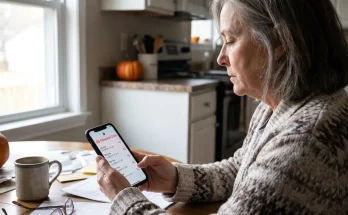
Why did I keep giving Preston a key to my house after I knew he didn’t ask before using things? I’ve asked myself that for years now. I didn’t have a good answer then, and I still don’t. The last time he used it, I was sitting at my kitchen table with Eleanor’s blue mug beside me and a bank envelope open under my hand.
I was sixty-nine, retired from the auto plant outside Cleveland, and a widower for three years.
I still put Eleanor’s little Christmas village on the mantel every December. It wasn’t a big village, just a few houses and a church with a plastic bell that never rang. I liked the routine. Preston knew I liked it, which was why he used his mother to make his point when I called about the $30,000 charge.
The charge was for a luxury ski resort in Telluride. Preston was still an authorized user on one of my cards. I’d added him years before, when he traveled for work and we thought it would be handy in an emergency. I should have taken him off after he stopped traveling. I knew that. I kept putting it off because every time I brought it up, he said it made him feel like I didn’t trust him.
I called him at work. He answered on the fourth ring, sounding distracted. I asked why there was a thirty-thousand-dollar resort charge on my account, and he sighed before he replied. “Dad, it’s Christmas.” I said that wasn’t an answer.
He said I always found a way to make the holiday about money, and then he told me my wife would’ve wanted us all to enjoy ourselves.
“Don’t use your mother to explain a charge I didn’t approve,” I said. He didn’t answer for a few seconds. Then he said, “You’ll understand when you see the itinerary.” I was annoyed enough to say something about him being forty-two years old and perfectly able to pay for his own trip. I didn’t say it. I wish I had. Instead, I waited for the email.
It came fifteen minutes later. Preston meant to forward the flight details, but he sent the whole chain between himself and Marissa. I read through the flights, the ski rentals, and the reservation for a six-bedroom lodge. Then I found my name on an earlier booking. Raymond. One room at a roadside motel three miles away.
I thought it had to be an error. I read that line again, then scrolled up to Marissa’s message.
She wrote that I couldn’t stay in the main house because my old flannel shirts and “gloomy look” would spoil the family photos she wanted to post. Preston replied, “Already handled.” A later note said I should bring my card because I could cover dinners and incidentals.
I read the messages twice. The family at the lodge would include Preston and Marissa, her parents, her sisters and their husbands. Eleven people. I would have been invited to dinner, apparently, then sent back to the motel. The card could stay. I couldn’t.
I don’t remember how long I sat there. The Christmas lights blinked behind me. One of the little village houses had tipped over, and I could see the bare wire under its roof. I fixed it later. That’s the kind of thing I remember clearly, which probably tells you where my mind was.
There were older emails in the chain, and I almost didn’t read them. I was ashamed to be looking through my son’s private messages, even though they were in an email he’d sent me. Then I saw a message from three weeks earlier. Marissa wrote that the value of my house was being wasted on one person. Preston said January was better, after the trip, when I’d be tired and easier to talk into “simplifying.”
That was not a vague thought. They had discussed it. They wanted me to sell the Cleveland house Eleanor and I had spent thirty years paying off. The messages said they could frame it as making my life safer and easier. They’d talk about the stairs. They’d talk about the yard. They’d talk about how much equity I could free up.
I had never told them I wanted to move. I liked the house. I knew the furnace was old and the upstairs bathroom needed work, but I could still manage it. I’d spent my working years on factory floors so Preston could finish college without loans. Eleanor and I skipped trips when tuition came due. I never said that out loud to him. I thought it was just what parents did.
At some point, I printed the emails. The printer fed out page after page while I watched the tray. I don’t know why that sound stayed with me. Maybe because it was the first thing I did that felt like a decision instead of a reaction.
My phone buzzed. The bank alert said $5,000 had come out of a joint savings account I’d opened for Preston years ago. It was supposed to be an emergency fund. I called the bank, and a woman confirmed the withdrawal. I asked her to remove his access and lock the account while she checked the details. She asked if I was sure. I said yes.
Then I went upstairs to the bedroom. Behind a landscape painting was a small wall safe. I kept the deed there, along with insurance papers, our marriage certificate, and a dark blue velvet box. The box held Eleanor’s anniversary jewelry. It was supposed to go to our granddaughter Emma when she turned eighteen.
The deed was there. The insurance papers were there. The box wasn’t.
I checked the safe again, even though I’d already seen the empty spot. Then I looked behind the papers and under the shelf. I got down on the floor and checked the carpet. Nothing. Only Preston and I knew where I’d hidden the spare key to the safe after Eleanor died. I had told him because he was my son and I thought I was being sensible.
I didn’t call him yet. I took a picture of the open safe. I gathered the bank statements, the emails, and my old power-of-attorney papers. I put them in a manila folder and brought it downtown the next morning to my attorney, Julian Vance.
Julian read through everything without saying much. At one point he asked me if I wanted coffee. I said no, then changed my mind. He brought it anyway. It had too much cream, which is how I know I was paying attention to stupid things.
When he got to the last page, he looked at me and asked what I wanted. Not what would calm Preston down. Not what would make things easier for Christmas. What I wanted.
“I want my decisions to belong to me again,” I said.
By noon, Julian had started the paperwork. Preston’s power of attorney was revoked. The old account was closed, and the balance was moved to an account he couldn’t reach. Julian helped separate the other accounts and put the house into a trust that required my approval before anyone could sell it or borrow against it.
I also called the bank myself. I removed Preston from every card and changed the access codes. The whole thing was calm. I signed my name, confirmed my identity, and answered a few questions. It was less dramatic than I’d imagined. Years of letting things slide, reduced to initials and signatures.
I asked Julian what to do about the missing jewelry. He said I could report it stolen. He also said I should call Preston first, if I wanted to hear what he had to say. I did not want to hear it, but I wanted to know where the box was. So I called.
He didn’t pick up. I left a message asking him to call me about the safe. He called back that evening, after dinner. His voice was careful, which was not how he usually sounded with me.
“What safe?” he asked.
“The one in my bedroom. Eleanor’s jewelry is gone.”
He said he didn’t know anything about it. I asked if he’d been in the house. He said he had been there to get some old tax papers. I told him the safe had been opened. There was a pause.
“I might’ve moved the box,” he said. “I was going to give it to Emma.”
“You could’ve asked me.”
“I didn’t want to upset you.”
That made no sense, and we both knew it. I asked where it was. He said he’d look. I told him he had until the next afternoon to bring it back or I’d make a police report. He said I was making a big deal out of nothing. I said, “Then bring it back.”
He hung up.
I slept badly that night. Not because I was afraid of Preston, exactly. I was worried I’d done something I couldn’t take back. I’d been the one who gave him access. I’d been the one who let him use my card and my money for years. Part of me wanted to call and apologize for making things hard. I didn’t. I put the folder on the table where I could see it in the morning.
The next day, Preston didn’t come by. He didn’t call. I phoned Julian and asked him to help me file a report. The officer who came to the house was polite. I showed him the photo of the safe and explained what was missing. He wrote everything down and asked if I knew who could have taken it.
I said I knew who had access. I didn’t say I knew who took it. That distinction mattered to me, even then.
On December twenty-third, Preston started sending instructions about the trip. Don’t miss the airport shuttle. Pack warm clothes. The motel shuttle runs every hour. Marissa wanted everyone ready for pictures by five. Call me when you land.
I was not going to Telluride. I was not flying anywhere. I read his messages on my phone while I sat at the kitchen table, with the printed itinerary beside me. I replied, “Have a wonderful Christmas.”
His answer came right away. “You’re not coming?”
I didn’t respond. There was a part of me that wanted him to call and say he was sorry. I could admit that now. I wanted the trip to be a misunderstanding. I wanted the safe to have some boring explanation. I wanted to be wrong about my own son, which was not the same as wanting to be right.
At 4:00 p.m. on Christmas Eve, my phone started ringing. Preston called first. Then Marissa. Then Preston again. I didn’t answer. The card had been declined when they tried to pay for a meal at the resort. They had expected it to work. There had been no other plan.
He left a voicemail. “Dad, call me back. We’re trying to sort this out.”
Marissa texted that I was embarrassing them in front of her family. Then she called. I answered that one because I was tired of watching the phone light up.
She said the restaurant was holding the bill and Preston couldn’t reach the bank. I told her I’d canceled the card. She said the card was for the trip. I said I hadn’t agreed to pay for the trip. She replied, “You said you wanted us all to have a good Christmas.”
I told her I had not said that. She got quiet for a second, then said she didn’t know why I was doing this now. I told her she’d booked me a motel room and asked me to pay for dinner. She said, “That’s not what this was about.”
I asked what it was about, then. She said she didn’t want to argue on Christmas Eve. I said, “Neither did I.” Then I ended the call.
Preston rang again immediately. I let it go to voicemail. I was not proud of how calm I sounded. I was also not proud of the part of me that enjoyed knowing the card wasn’t going to save them. I’d been hurt, and I wanted them to feel some of what I felt. It wasn’t a noble feeling. It was still there.
The calls kept coming until after six. At 6:18, I got a text from Preston: “I need to explain about the box.”
I called him. He didn’t answer, so I left a message that I wanted the jewelry back and I wanted it before I spoke with him about anything else. Then I called Julian and told him Preston had mentioned the box. Julian said not to meet him alone if I felt uncomfortable. I said I was comfortable enough. I wasn’t sure that was true.
Preston showed up the next morning. He had the blue velvet box in his hand. I opened the door but didn’t invite him in. His eyes looked tired. His coat was unzipped, and he had a small white receipt folded in his other hand.
“I’m sorry,” he said. “I should’ve asked.”
I held out my hand for the box. He gave it to me. I opened it right there in the doorway. The jewelry was inside. I checked the clasp on Eleanor’s bracelet and the little gold necklace she wore on our anniversary. I didn’t know what to say. So I asked him where it had been.
He glanced at the paper in his hand. “I took it to a pawn shop. I needed money for a couple days. I was going to get it back.”
I looked at the receipt. He told me he’d paid to redeem it on Christmas Eve after I stopped the card. The reason he had come over was to return it. He had not meant to sell it for good, he said. He had only needed a short loan.
The receipt had a date, a name, and a number. It showed what the shop had given him. It was less than the cost of one night at the lodge. I held the paper between two fingers, and Preston kept talking. He said the money was for bills. He said he thought I would understand. He said Emma was going to get the jewelry someday anyway.
I told him he didn’t get to decide when I gave it to her. He said he knew. Then he said he’d been ashamed to ask me for money, so he’d taken the box instead. He looked at me when he said it, but I couldn’t tell if he was asking for forgiveness or just hoping I would stop talking about it.
I told him the house was in a trust now, his access to my accounts was gone, and he was not to use the key again. He said he understood. I took the key from him. He didn’t argue.
I didn’t file charges over the jewelry. The police report was closed after I told the officer it had been returned. Preston paid me back the $5,000 from the savings account over the next six months. Julian kept the trust in place, and I didn’t put my son back on any account. That part was done.
Christmas was quiet at my house. I ate soup and toast, then watched the little plastic bell on the village church fail to ring. I didn’t call Preston. He didn’t call me either. We spoke in January about Emma’s birthday, and he asked if I would come. I said I would think about it.
I still haven’t decided what to do with Eleanor’s jewelry. The box is back in the safe, and the key is in my desk drawer. On the receipt, in small print under the pawn amount, it says the box was redeemed on December twenty-fourth.