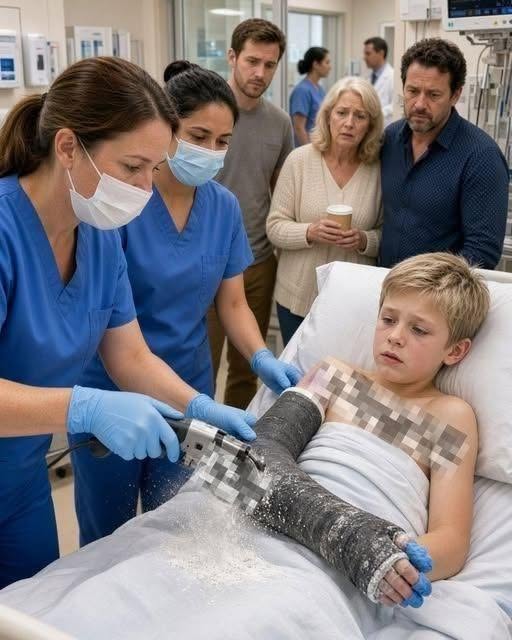
For one long second, nobody moved. The cast saw sat beside the boy’s arm, its small vibrating blade catching the fluorescent light.
Martha stared at it as if it were a weapon pointed directly at her. “Please,” she repeated. “You don’t understand.” “I understand that your son is in septic shock,” I said. “I understand that his fingers are losing circulation.
And I understand that something inside that cast is producing an odor I have never heard a parent describe as ‘the flu.’” Her face tightened.
“It’s complicated.” “Then explain it.” She looked toward her son. For the first time since they had entered the emergency department, her expression changed.
An eight-year-old boy was brought into my ER………
Not fear.
Guilt.
The boy’s eyelids fluttered.
“Mom…”
His voice was barely audible.
Martha immediately stepped toward him.
“I’m here, sweetheart.”
His eyes opened a fraction.
“Don’t let her…”
He stopped.
I leaned closer.
“Don’t let who?”
His eyes moved toward me.
Then toward the cast.
“Open it.”
A shiver went through me.
Martha covered her mouth.
“Marcus,” I said quietly, “I need another IV. Blood cultures, lactate, CBC, CMP, coagulation studies. Start broad-spectrum antibiotics now. Call pediatric surgery and orthopedics. I want the operating room alerted.”
Marcus nodded and moved.
I turned back to Martha.
“You need to tell me what happened to his arm.”
“He fell.”
“When?”
“Four weeks ago.”
“Where?”
“Our backyard.”
“Why was the cast placed?”
“He fractured his wrist.”
“What kind of fracture?”
She hesitated.
“I don’t know.”
That answer stopped me.
A parent might not remember the exact name of a fracture. But most parents knew whether their child had broken a wrist, forearm, elbow, or hand.
“You don’t know what bone he broke?”
“He was treated at a private orthopedic clinic.”
“Which one?”
She gave me a name.
I recognized it.
Expensive. Exclusive. The sort of practice where patients waited weeks for appointments and doctors rarely sent anyone to an emergency department without a detailed handoff.
“Who placed the cast?”
“Dr. Bell.”
“Did he see your son after the cast was applied?”
“Yes.”
“When?”
“About two weeks ago.”
“And?”
“He said everything was healing normally.”
I looked at the boy’s fingers again.
They were darker now.
“Did your son complain?”
Martha didn’t answer.
“Mrs. Harris.”
Her eyes filled with tears.
“Yes.”
“How often?”
“Every day.”
“What did he say?”
She swallowed.
“He said it hurt.”
“That’s expected after a fracture.”
“He said it smelled.”
I went still.
“What?”
“He said something smelled bad inside the cast.”
“Did you tell the doctor?”
She nodded.
“And what did he say?”
“He said children imagine things.”
My jaw tightened.
“Did your son have swelling?”
“Yes.”
“Numbness?”
“Yes.”
“Fever?”
“Not until yesterday.”
“Drainage?”
Martha looked away.
That was answer enough.
“Where did the drainage come from?”
Her silence stretched.
Then she whispered, “There was a little.”
“A little what?”
“Blood.”
Clara exchanged a glance with me.
“Why didn’t you bring him in?”
“I did.”
“When?”
“Three days ago.”
I stared at her.
“Our records show no visit.”
“Not here.”
“Where?”
She didn’t answer.
“Mrs. Harris, your son may have a rapidly spreading infection. If you took him somewhere else, I need those records immediately.”
“I took him to Dr. Bell.”
“Three days ago?”
“Yes.”
“And what did he do?”
“He changed the medication.”
“What medication?”
“Antibiotics.”
“Oral?”
She nodded.
I felt a cold sensation settle in my stomach.
“Did he remove the cast?”
“No.”
“Did he examine the skin underneath it?”
“He said the cast had to stay.”
“Did he take an X-ray?”
“No.”
“Did he test for infection?”
“No.”
“Then what exactly did he examine?”
Martha began crying.
“I don’t know.”
The cast saw suddenly seemed louder than before, even though it hadn’t moved.
I turned to Clara.
“Let’s cut it.”
Martha grabbed my sleeve.
“No.”
I looked down at her hand.
“Move.”
“You don’t know what’s inside.”
“That’s precisely why I’m opening it.”
She shook her head violently.
“You don’t understand what he told me.”
“Who?”
“Dr. Bell.”
“What did he tell you?”
She looked toward the hallway.
Then lowered her voice.
“He said if anyone tried to remove the cast, I could make everything worse.”
“How?”
“He wouldn’t explain.”
“That’s not a medical instruction.”
“He said there was a reason the cast couldn’t come off.”
“Mrs. Harris, your son is dying.”
She closed her eyes.
A tear rolled down her cheek.
“I know.”
Those two words changed the room.
Not denial.
Not confusion.
Acceptance.
She knew.
And somehow, that frightened me more than anything else she had said.
I took a breath.
“Clara, hold his arm steady.”
The cast saw started.
The boy whimpered.
“It’s okay,” I told him. “I’m right here.”
The blade moved through the fiberglass.
A white powder filled the air.
The smell intensified.
Marcus turned his head.
“Oh, God.”
We opened a second cut along the opposite side.
Then a third.
The cast separated.
And something fell onto the sterile drape.
A small piece of black fabric.
I stared at it.
It looked like part of a child’s sock.
But it was wet.
And dark.
Martha made a sound behind me.
“That’s not…”
She stopped.
I carefully lifted the cast away.
The boy’s arm was swollen to nearly twice its normal size.
His skin was mottled purple and black.
There were deep pressure wounds along the forearm.
And near the wrist was a small puncture wound surrounded by necrotic tissue.
The infection had eaten through the skin.
But that wasn’t what made me stop breathing.
There was something beneath the wound.
A thin, translucent tube disappeared into the tissue.
I looked at Marcus.
“Did anyone put a drain in this arm?”
“No.”
I looked at Martha.
She was shaking.
“I told you,” she whispered.
“Told me what?”
Her eyes fixed on the tube.
“He didn’t fall.”
The room went silent.
“What?”
“He didn’t fall from a tree.”
I stepped closer.
“Then how did he hurt his arm?”
Martha’s lips trembled.
“I found him in the basement.”
“What was he doing?”
“I don’t know.”
“Mrs. Harris, what happened?”
She looked at her son.
Then at me.
And finally she whispered the words that made the entire case change.
“He said someone had been coming into our house.”
My stomach tightened.
“Someone?”
“He said he heard footsteps at night.”
Marcus looked toward the doorway.
Martha continued.
“At first I thought it was a nightmare. Then he started saying someone was standing outside his bedroom.”
“Did you see anyone?”
“No.”
“Did your husband?”
Her expression changed.
“My husband isn’t in the picture.”
I nodded.
“Go on.”
“Two nights before the fall, Marcus woke me up. He was crying.”
“What did he say?”
“He said someone had touched his arm while he was sleeping.”
I looked at the injured limb.
“What happened next?”
“He wouldn’t tell me.”
“Why?”
“He said the person told him not to.”
A chill moved across my shoulders.
“Did you call the police?”
“No.”
“Why?”
“Because I thought he was imagining it.”
“And the next morning?”
“He had bruising around his wrist.”
Martha stared at the floor.
“I took him to Dr. Bell.”
“And Dr. Bell diagnosed a fracture?”
“He said it was a fracture.”
“Did he tell you how it happened?”
“He said Marcus probably injured himself.”
“Did Marcus agree?”
“No.”
“Why not?”
“He kept saying he hadn’t fallen.”
I looked again at the strange tube.
“What is this?”
Martha’s eyes widened.
“I don’t know.”
I gently examined the tubing without pulling on it.
It disappeared deeper into the infected tissue.
This wasn’t a normal cast complication.
This wasn’t a simple fracture.
Something had been inserted into the boy’s arm.
And whoever had done it had left it there.
“Sarah,” Marcus said quietly.
I looked at him.
He was holding a small object he’d found inside the cast.
A folded piece of paper.
There was dried blood across one corner.
“Where did you find that?”
“Inside the padding.”
I opened it carefully.
There were only four words written in uneven black ink.
DON’T TRUST MY MOM.
I looked up.
Martha was staring at me.
She wasn’t crying anymore.
Her face had gone completely white.
“Marcus wrote that,” she whispered.
“How do you know?”
“Because…”
Her voice broke.
“Because I watched him write it.”
I felt the room tilt.
“Then why did you bring him here?”
Martha looked toward the hallway again.
“Because I finally realized the person he was afraid of wasn’t a stranger.”
She took one trembling breath.
“He was afraid of someone who already had a key to our house.”
Before I could ask another question, the monitor screamed.
Marcus’s oxygen saturation dropped.
His blood pressure collapsed.
“Pressure’s seventy systolic!” Clara shouted.
“Push fluids. Start vasopressors. Get anesthesia down here now.”
The room exploded into motion.
But as everyone moved around the bed, Marcus suddenly opened his eyes.
He looked directly at me.
And this time, his voice was clear.
“Dr. Jenkins…”
I bent toward him.
“What is it?”
His fingers weakly closed around mine.
“I know who did it.”
“Who?”
He glanced past me.
Toward the door.
His eyes widened.
Then he whispered:
“It’s the doctor who put on my cast.”
Behind me, someone gasped.
I turned.
Martha was gone.
The door was open.
Martha Harris was gone.
For two seconds, nobody seemed to understand what had happened.
Then Clara shouted, “Security!”
Marcus’s monitor continued screaming behind us.
His blood pressure was dangerously low.
His oxygen saturation was falling.
But my attention was fixed on the empty doorway.
Martha had been standing there less than thirty seconds earlier.
She couldn’t have gone far.
“Lock down the pediatric floor,” I said.
Marcus grabbed my wrist.
“No…”
I looked down.
His eyes were barely open.
“Don’t…”
“Marcus, I need you to stay with me.”
“Not her.”
His breathing became shallow.
“Who?”
He swallowed painfully.
“Dr. Bell.”
A nurse rushed into the room.
“Dr. Jenkins, anesthesia is on the way.”
“Good. We’re going straight to the OR.”
Marcus suddenly started shaking.
I leaned closer.
“What did Dr. Bell do to you?”
He stared at me.
“He said it was going to help.”
“What was going to help?”
“The tube.”
I looked at the thin piece of tubing disappearing beneath the infected tissue.
“What does it do?”
“I don’t know.”
“Why did he put it there?”
Marcus’s eyes filled with tears.
“He said…”
His voice faded.
I waited.
“He said it would keep the bad thing from getting out.”
A cold feeling moved through me.
“What bad thing?”
Marcus didn’t answer.
His eyes rolled backward.
“Marcus!”
The monitor changed tone.
“Pulse is dropping!”
“Bag him!”
Clara moved immediately.
I stepped back as the room filled with people.
For the next several minutes, there was no mystery.
There was only medicine.
Airway.
Pressure.
Blood.
Fluids.
Antibiotics.
The desperate rhythm of a team trying to keep an eight-year-old child alive.
Eventually, Marcus stabilized enough for transport.
As we rushed him toward the operating room, I caught sight of myself reflected in the glass doors.
Blood covered my gloves.
My mask was damp with sweat.
And for the first time since this case began, I realized something terrifying.
I wasn’t just treating an infection.
I was treating evidence.
Whatever had happened to Marcus had been deliberately hidden beneath that cast.
And someone had gone to extraordinary lengths to keep it hidden.
The surgery took nearly three hours.
When Dr. Patel finally stepped out of the operating room, his expression told me the news wasn’t simple.
“How bad?”
He removed his surgical cap.
“Extensive necrosis. There was a deep abscess extending around the wrist. The infection had tracked along the forearm.”
“Bone involvement?”
“Yes.”
My stomach sank.
“Osteomyelitis?”
“Looks that way.”
“Will he lose the arm?”
“We don’t know yet.”
I closed my eyes for a moment.
“How did he get that tubing inside?”
Dr. Patel hesitated.
“We found something else.”
He handed me a specimen bag.
Inside was a tiny plastic capsule.
It looked almost like a piece of medical tubing.
“What is it?”
“We don’t know yet.”
“Was it inside the arm?”
“Embedded near the fracture site.”
I stared at it.
“Send it to pathology and toxicology.”
“I already did.”
“What about the fracture?”
Dr. Patel’s expression hardened.
“There was no normal fracture.”
I looked at him.
“What?”
“There was a small cortical defect, but it doesn’t look like a typical fall injury.”
“Then what caused it?”
He shook his head.
“Something penetrated the bone.”
I felt my pulse quicken.
“Deliberately?”
“That’s what it looks like.”
Before I could respond, a security officer appeared.
“Dr. Jenkins?”
“Yes?”
“We found Mrs. Harris.”
“Where?”
He looked uncomfortable.
“She was trying to leave through the service entrance.”
“Is she being detained?”
“She refused to explain where she was going.”
“Bring her back.”
“She asked for a lawyer.”
“That’s her right.”
He nodded.
Then he said something that made me stop.
“She also asked whether Dr. Bell had arrived.”
I stared at him.
“Dr. Bell is here?”
“No.”
“Are you sure?”
“We checked the visitor log.”
He handed me a tablet.
There was no record of Dr. Bell entering the hospital.
But there was something else.
A vehicle had been parked outside the emergency entrance for almost two hours.
Black SUV.
Tinted windows.
The license plate was partially obscured.
“Has anyone checked it?”
The security officer shook his head.
“Not yet.”
“Do it.”
He started walking away.
“Wait.”
He turned.
“Don’t approach it alone.”
He nodded.
Martha was waiting in a small consultation room.
She had lost the polished composure she’d arrived with.
Her hair was disheveled.
Her sweater was stained.
Her hands trembled in her lap.
I entered alone.
She looked up.
“Is he alive?”
“Yes.”
She closed her eyes.
A sob escaped her.
“Thank God.”
“He’s in surgery.”
“I know.”
“Then you know this is serious.”
She nodded.
I sat across from her.
“Why did you lie to me?”
She didn’t answer.
“Why did you tell me he fell from a tree?”
“I was scared.”
“Of Dr. Bell?”
Her eyes lifted.
“Yes.”
“Why?”
“He told me Marcus would die if I took him to another hospital.”
My jaw tightened.
“He threatened you?”
“Not exactly.”
“What does that mean?”
“He showed me something.”
“What?”
“A photograph.”
“Of Marcus?”
“No.”
She looked toward the door.
“Of me.”
My expression changed.
“What was in the photograph?”
“I was standing outside my house.”
“So?”
“I was asleep.”
I stared at her.
“What?”
“He had a camera.”
She began crying again.
“He showed me photographs of my house. My bedroom. Marcus’s room. My car.”
“Why would he do that?”
“I don’t know.”
“Did he blackmail you?”
“He said if I told anyone, Marcus would be taken away from me.”
“By whom?”
“He never said.”
I leaned forward.
“Mrs. Harris, I need the truth. Everything.”
She wiped her face.
“There was a night when Marcus disappeared.”
“When?”
“Three weeks ago.”
“The same week the cast was put on?”
“Yes.”
“Where did you find him?”
“In the basement.”
“Was he injured?”
“He was unconscious.”
“Was his arm broken?”
“I thought so.”
“Who called the ambulance?”
She looked at me.
“Dr. Bell.”
The room seemed to become colder.
“Why was Dr. Bell at your house?”
“I don’t know.”
“You invited him?”
“No.”
“Then why was he there?”
“I found him standing beside Marcus.”
I said nothing.
Martha continued.
“He told me Marcus had fallen down the basement stairs.”
“Did you see the fall?”
“No.”
“Did Marcus?”
“He was unconscious.”
“So Dr. Bell was the only person who claimed to know what happened.”
“Yes.”
“And then he took Marcus to his clinic?”
“Yes.”
“Before the hospital?”
She nodded.
I felt anger rising.
“Why didn’t you call emergency services?”
“He told me not to.”
“Why?”
“He said the police would get involved.”
“Why would the police be involved in a child’s fall?”
“He said because Marcus had been injured by a piece of equipment in the basement.”
“What equipment?”
“I don’t know.”
“Did you see it?”
“No.”
“Did you look?”
Martha shook her head.
“I was afraid.”
“Afraid of what?”
She looked directly at me.
“Dr. Bell.”
I was silent for several seconds.
Then I asked:
“Why didn’t you leave?”
She stared at me.
“I tried.”
“And?”
“He found us.”
A knock interrupted us.
The door opened.
The security officer stood there.
“Doctor, we found something.”
“What?”
He handed me a small evidence bag.
Inside was a cell phone.
“Where did you find this?”
“In the black SUV.”
I looked at Martha.
Her face drained of color.
“That’s his.”
“Dr. Bell’s?”
She nodded.
“He left it in my driveway last night.”
“Why didn’t you tell anyone?”
“I didn’t know if it was a trap.”
I examined the phone through the plastic.
The screen was cracked.
But it was still on.
There was one notification.
A message.
YOU SHOULD HAVE LISTENED TO ME.
The sender was unknown.
Timestamp: two minutes ago.
I looked at the security officer.
“Can you trace it?”
“We’ll try.”
Martha suddenly stood.
“Doctor…”
“What?”
She pointed at the phone.
“That’s not his phone.”
I looked at her.
“What do you mean?”
“Dr. Bell never used a phone like that.”
“Then whose is it?”
She shook her head.
“I don’t know.”
A second message appeared.
This time, there was an image.
My hands went cold.
It was a photograph of Marcus lying unconscious in the operating room.
Taken from above.
Taken recently.
Someone was watching us.
Someone had access to the hospital.
And whoever it was had just sent me a message.
A third notification appeared.
YOU’RE ASKING THE WRONG QUESTIONS, DR. JENKINS.
Then another.
ASK MARTHA WHAT HAPPENED TO THE FIRST BOY.
I looked at Martha.
She stopped breathing.
“What first boy?”
She didn’t answer.
“Mrs. Harris?”
Her eyes filled with tears.
“There was another child.”
“Who?”
She whispered a name.
“Ethan.”
“What happened to him?”
Martha looked toward the hallway.
“He had the same cast.”
Before I could ask another question, every light in the hospital wing went out.
The emergency generators kicked in.
The room fell into red darkness.
And somewhere down the corridor, a child began screaming.
The child’s scream echoed through the darkened hallway.
For one terrible second, every instinct in me screamed that someone had reached Marcus.
I ran.
“Security, with me!”
Emergency lights flickered on, bathing the corridor in red.
The scream came again.
But it wasn’t coming from Marcus’s room.
It was coming from the pediatric observation area.
I pushed through the doors.
A little boy was sitting upright on a hospital bed, crying.
His nurse was beside him.
“What’s happening?”
“He woke up when the power went out,” she said. “He’s frightened.”
I looked at the boy.
“Ethan?”
The nurse nodded.
My heart stopped.
Ethan.
The first boy.
The name Martha had whispered only minutes earlier.
I approached slowly.
“Ethan, I’m Dr. Jenkins.”
He stared at me.
“Are you here because of Marcus?”
His lower lip trembled.
“Yes.”
“Do you know him?”
He nodded.
“We go to school together.”
“Ethan, can you tell me what happened to your arm?”
His eyes dropped.
“He said I fell.”
“Who?”
“Dr. Bell.”
I felt the pieces beginning to connect.
“Did he put a cast on you?”
“Yes.”
“What happened after?”
Ethan looked at the nurse.
She gave him a reassuring nod.
“He kept saying I had to wear it.”
“Did your arm hurt?”
“Yes.”
“Did you tell your parents?”
“I told my mom.”
“What did she do?”
“She took me to another doctor.”
“And?”
“He took the cast off.”
I exhaled.
“Was there an infection?”
Ethan nodded.
“Did they find anything inside?”
He shook his head.
“Just a little piece of plastic.”
I froze.
The capsule.
The strange tube.
The deliberate injuries.
“What did Dr. Bell tell you?”
Ethan’s eyes filled with tears.
“He said if I talked, he’d hurt my little sister.”
My heart sank.
“Did he know Marcus?”
“Yes.”
“How?”
“They were looking for him.”
“Who?”
Ethan hesitated.
“Dr. Bell and another man.”
“What other man?”
“I don’t know his name.”
“What did he look like?”
“Tall. Gray hair.”
Martha suddenly appeared in the doorway.
Her face changed when she saw Ethan.
“Ethan…”
The boy looked at her.
“You knew.”
Martha covered her mouth.
“I tried to protect you.”
“You didn’t tell anyone.”
“I was afraid.”
Ethan looked down.
“So was Marcus.”
I turned toward Martha.
“What is going on?”
She finally broke.
“The other man was Dr. Bell’s business partner.”
“Why were they doing this?”
She shook her head.
“I don’t know everything.”
“Then tell me what you do know.”
Martha wiped her tears.
“Dr. Bell was running an illegal research program.”
The words seemed impossible.
“He was using children who came through his clinic.”
“For what?”
“Experimental medical devices.”
My mind returned to the capsule.
“The tubing?”
“Yes.”
“He implanted devices in injured children without proper consent.”
“Why?”
“He wanted to collect data.”
I felt sick.
“And the fractures?”
“Some were accidental. Some weren’t.”
Silence filled the room.
Martha continued.
“When I discovered what he was doing, I tried to report him.”
“What stopped you?”
“He threatened Marcus.”
“So you helped him?”
“No.”
Her voice cracked.
“I pretended to cooperate because I was trying to find evidence.”
She reached into her pocket.
Then she handed me a tiny memory card.
“I’ve been collecting everything.”
I stared at it.
“Why didn’t you give this to the police?”
“Because I didn’t know who I could trust.”
I understood then why she had seemed so strangely calm.
She wasn’t calm.
She was terrified.
She had been terrified for weeks.
But none of that changed what had happened to Marcus.
“You should have told us.”
“I know.”
Her shoulders collapsed.
“I know.”
The investigation moved quickly after that.
The memory card contained photographs, recordings, appointment records, and messages from Dr. Bell.
There were enough documents to expose the entire operation.
The black SUV belonged to Bell’s partner.
The mysterious messages had been sent automatically through a monitoring device connected to the phone.
And the photograph of Marcus in the operating room had been taken by a hidden camera someone had installed in the hospital weeks earlier.
But the most important discovery came from the hospital’s security footage.
Dr. Bell had never entered the hospital that night.
His partner had.
He had disguised himself as a medical technician.
Security found him hiding in a restricted corridor.
He was arrested before he could reach the operating room.
Dr. Bell himself was taken into custody the following morning.
For the first time in weeks, Martha was able to sleep.
And for the first time since Marcus arrived, I allowed myself to believe that he might actually recover.
Three days later, I entered Marcus’s room.
The machines were still there.
The IV lines were still running.
His arm was heavily bandaged.
But his eyes were open.
“Hey,” I said softly.
He looked at me.
“Did you catch him?”
I smiled.
“Yes.”
“Dr. Bell?”
“Yes.”
Marcus smiled weakly.
“I knew you would.”
“How?”
“Because you opened the cast.”
I laughed softly.
“You were right about that.”
He looked down at his bandaged arm.
“Am I going to lose it?”
I pulled a chair beside his bed.
“No.”
His eyes widened.
“No?”
“No. The infection damaged it badly, but the surgeons were able to save your arm.”
A tear slipped down his cheek.
“Really?”
“Really.”
He looked toward the window.
“Can I play baseball again?”
“Eventually.”
“Climb trees?”
“Absolutely not.”
He laughed.
It was the first time I’d heard him laugh.
And somehow, that tiny sound felt more powerful than every alarm that had screamed through Trauma Room 2.
Weeks passed.
Marcus recovered slowly.
The infection cleared.
His fever disappeared.
His blood pressure normalized.
Eventually, he was able to sit up.
Then stand.
Then walk.
His mother stayed beside him through every physical therapy session.
She had changed, too.
The expensive sweater and perfect appearance were gone.
She came to the hospital in ordinary clothes, slept in a chair beside her son, and never left him alone.
One afternoon, she stopped me in the hallway.
“I owe you an apology.”
“You don’t owe me anything.”
“I lied.”
“You were afraid.”
“I should have trusted someone.”
I nodded.
“Yes.”
She looked toward Marcus’s room.
“I thought protecting him meant keeping everything secret.”
“And now?”
“Now I know protecting him means making sure he never has to be afraid to tell the truth again.”
I smiled.
“That sounds like a good place to start.”
Six months later, Marcus returned to the hospital.
He walked through the emergency department wearing a baseball cap and carrying a small wooden box.
His arm was scarred.
But he could move his fingers.
He could throw a ball.
And, according to his mother, he had become much more careful around trees.
He handed me the box.
“What is this?”
“Open it.”
Inside was a tiny red bracelet.
A handwritten note sat underneath it.
For Dr. Jenkins. Thank you for opening the cast.
I looked at him.
“You made this?”
He nodded.
“I wanted you to have something.”
I smiled.
“I’ll keep it forever.”
Then he hugged me.
It was a short, awkward, eight-year-old hug.
But I held on.
Because sometimes medicine gives you something no textbook can teach.
A second chance.
Months later, the investigation officially closed.
Dr. Bell lost his medical license and faced multiple criminal charges.
The children involved were placed under long-term medical supervision.
Ethan recovered completely.
Marcus recovered completely.
And the hidden research program was dismantled.
There were still unanswered questions.
There always are.
We never learned exactly how many children Dr. Bell had experimented on.
We never discovered every person who had helped him.
But the children who survived finally had adults willing to listen.
That mattered.
A year after Marcus’s admission, I was working another ordinary evening shift when a familiar voice came from the waiting room.
“Dr. Jenkins!”
I turned.
Marcus stood there.
He was wearing a baseball uniform.
His mother stood behind him, smiling.
He held up a baseball.
“Look!”
I smiled.
“What?”
“I can throw with my right hand again.”
He tossed me the ball.
I caught it.
“Not bad.”
“I told you.”
He grinned.
Then he pointed at his arm.
“See?”
There was still a scar.
But beneath it was healthy skin.
Proof of what his body had survived.
Proof that the story hadn’t ended in that emergency room.
It had continued.
And this time, it had continued with sunlight instead of fear.
Marcus looked at me seriously.
“Dr. Jenkins?”
“Yeah?”
“Do you still remember the cast?”
I looked at him.
“I’ll never forget it.”
He smiled.
“Good.”
“Why?”
“Because you saved me.”
I shook my head.
“No.”
He looked confused.
“You saved yourself,” I told him. “You kept telling people something was wrong. You didn’t stop until someone listened.”
He smiled.
Then his mother called him.
“Marcus, we’re going.”
He waved.
“Bye, Dr. Jenkins!”
“Bye, Marcus.”
I watched them walk through the hospital doors.
For a moment, I thought about the smell that had filled Trauma Room 2 that night.
The fear.
The blood.
The hidden message.
The cast nobody wanted opened.
And the little boy who had been brave enough to say something was wrong.
I had spent years believing that being a good doctor meant knowing exactly what to do.
That night taught me something different.
Sometimes being a good doctor simply means refusing to look away.
Sometimes it means asking one more question.
Sometimes it means trusting the child who says, Something is wrong.
And sometimes—
sometimes it means having the courage to cut through the thing everyone else is afraid to open.
I looked down at the little red bracelet still around my wrist.
And smiled.
Because beneath that terrible cast, there had been something stronger than infection.
There had been a child who refused to give up.
And in the end, he made it home.