The Call at 4:23 At exactly 4:23 p.m., the phone rang. Margaret reached for it while she was still smiling. “Hello?” I watched the smile disappear. Not slowly. All at once. Her shoulders stiffened.
Her eyes moved toward me. “Who is this?” There was a pause. Then Margaret stood up. “What?” Beverly lowered her champagne glass. “What happened?”
Margaret didn’t answer her. She turned toward the window, as if somehow the person on the other end could see her. “No,” she said. “That can’t be right.”
Another pause. Then she whispered: “Are you sure?” I sat perfectly still. For the first time that afternoon, Margaret looked frightened.
She finally hung up. Beverly was the first to speak. “Margaret?” Margaret stared at the phone in her hand. “The buyer wants his money back.”
Trevor laughed. “That’s it?” “He says the motorcycle isn’t what he thought it was.” I looked at her. “What did he think it was?” Margaret’s eyes met mine. “I don’t know.” “You sold it.” “I know what I sold.” “You sold my father’s motorcycle.
For thirty-six years, my wife laughed at me every Sunday………
She swallowed.
“Harold, don’t start.”
“I haven’t started anything.”
Beverly stood up.
“Who bought it?”
Margaret hesitated.
“A man named Richard Vale. He owns a collector’s dealership outside Asheville.”
I felt something tighten in my chest.
“Richard Vale?”
“Yes.”
“Did he tell you what he planned to do with it?”
“He said he’d restore it.”
I looked down at the untouched champagne in front of me.
“Did you give him the documents?”
Margaret frowned.
“What documents?”
“My father’s papers.”
“What papers?”
“The box that was underneath the workbench.”
She laughed nervously.
“Oh, Harold. There wasn’t any box.”
I looked at her.
“There was.”
“No, there wasn’t.”
“Margaret, I kept that box in the workshop for forty-three years.”
She shook her head.
“I never saw it.”
I didn’t respond.
Because suddenly I knew something was wrong.
Not with the sale.
Not even with the motorcycle.
With the story.
I stood.
“Where’s the receipt?”
“What?”
“The bill of sale.”
Margaret’s face changed.
“I don’t have it.”
“You sold a fifty-five-thousand-dollar motorcycle for cash and you don’t have a receipt?”
“Richard gave me paperwork.”
“Where is it?”
“In the kitchen drawer.”
I walked toward the drawer.
Margaret stepped in front of me.
“Harold.”
I stopped.
“What?”
“You’re making this into something it isn’t.”
“Move.”
Her voice became sharp.
“No.”
I stared at her.
Behind her, Beverly and Trevor had stopped smiling.
For thirty-six years, Margaret had been the person who could make me question my own instincts.
If she said I remembered something incorrectly, I wondered if I did.
If she said my father had never said something, I assumed I’d misunderstood.
If she said I was being sentimental, I felt embarrassed for caring.
But standing there in my kitchen, I suddenly remembered something my father had told me when I was twenty-one.
Not the sentence about taking care of the motorcycle.
Something else.
Something I hadn’t thought about in decades.
He had looked over his shoulder before giving me the keys.
Then he’d said:
“If anybody ever asks you to sell her, Harold, don’t.”
I’d laughed.
“Why would anybody want this old thing?”
My father hadn’t laughed.
He’d looked directly into my eyes.
“That’s what I need you to remember.”
I had been too young to understand.
Now, forty-three years later, I wondered if he had known exactly what would happen.
My phone rang.
Unknown number.
I answered.
“Hello?”
A man’s voice came through.
“Mr. Whitmore?”
“Yes.”
“This is Richard Vale.”
I glanced at Margaret.
She had gone pale.
“Mr. Vale.”
“I need to speak with you immediately.”
“About the motorcycle?”
“Yes.”
His voice was low.
Controlled.
But there was something underneath it.
Fear.
“What happened?”
“I found something.”
“What?”
He didn’t answer.
Instead, he asked:
“Did your father ever tell you why he kept that motorcycle?”
I looked at Margaret again.
“No.”
Richard exhaled.
“Then you need to come here.”
“Why?”
“Because I don’t think your wife sold me a motorcycle.”
The room went silent.
I gripped the phone.
“What did she sell you?”
Richard lowered his voice.
“A hiding place.”
Richard gave me an address outside Asheville.
I didn’t tell Margaret where I was going.
I simply took my jacket from the hook.
She followed me into the hallway.
“Harold, where are you going?”
“To find out what you sold.”
She grabbed my arm.
“You’re not going anywhere.”
I looked down at her hand.
She released me.
For the first time in thirty-six years, Margaret looked like she didn’t recognize the man standing in front of her.
Maybe I didn’t recognize him either.
I walked out.
The drive to Asheville took just over an hour.
Rain began falling halfway there.
Thin October rain.
The kind that blurred the mountains and made every road look unfamiliar.
Richard’s dealership was tucked behind a large stone building on an industrial road.
There were no bright signs.
No showroom windows.
Just a black metal gate and a security camera above the entrance.
A man was waiting for me.
He was probably in his late fifties, with gray hair and a dark coat.
“Mr. Whitmore?”
“Yes.”
He shook my hand.
His grip was firm.
“I wish we’d met under different circumstances.”
“What happened to the motorcycle?”
Richard glanced toward the building.
“Come inside.”
I followed him through a metal door.
The smell hit me first.
Oil.
Rubber.
Old leather.
And something else.
Burned paper.
The motorcycle was sitting in the middle of the workshop.
My father’s motorcycle.
My breath caught.
For a moment, I couldn’t move.
It looked exactly as it had that morning.
The faded green tank.
The chrome handlebars.
The small crack in the left leather seat.
Even the tiny scratch near the rear fender that I’d made when I was seventeen.
I walked toward it.
My hand trembled when I touched the tank.
“She’s all right,” Richard said.
I closed my eyes.
“She shouldn’t be here.”
“I agree.”
I opened my eyes.
“What happened?”
Richard walked around the motorcycle.
“When your wife brought it here, I thought I’d bought a rare but neglected vintage motorcycle. The price was high, but not unreasonable.”
“Fifty-five thousand.”
“Yes.”
“And then?”
“I started inspecting it.”
He crouched beside the engine.
“I noticed something strange.”
He pointed to a small metal plate near the frame.
I recognized it immediately.
My father had always told me never to remove it.
“What’s strange about it?”
“The serial number.”
I leaned closer.
Richard handed me a flashlight.
“Look.”
I did.
There were numbers stamped into the metal.
But underneath them was another set.
Almost invisible.
“That’s not possible,” I whispered.
Richard nodded.
“That’s what I thought.”
“What does it mean?”
“Your motorcycle was registered twice.”
I looked at him.
“Twice?”
“Two different serial identities. Same frame. Same engine.”
He stood.
“I contacted a friend who specializes in historical motorcycle records. He checked the archives.”
“And?”
Richard hesitated.
“The first registration wasn’t under your father’s name.”
I felt the room grow colder.
“Whose name was it under?”
Richard looked at me.
“Samuel Whitmore.”
My father’s name.
“But he was the original owner.”
Richard shook his head.
“No.”
He reached into a folder.
“That’s the problem.”
He opened it.
Inside were photocopies of old registration records.
One dated 1959.
Another dated 1963.
Then one from 1971.
The motorcycle appeared in all of them.
But the names changed.
Samuel Whitmore.
Daniel Cross.
Arthur Bell.
Then Samuel Whitmore again.
I stared at the documents.
“My father bought it in 1973.”
Richard nodded.
“That’s what everyone believed.”
“Why?”
“Because that’s what the public records say.”
He placed another document on the table.
“This is from a private archive.”
I looked at it.
It was an old newspaper clipping.
The headline read:
LOCAL BUSINESSMAN DISAPPEARS AFTER BANK FRAUD INVESTIGATION
Below it was a photograph of a man I had never seen before.
Richard pointed to the caption.
“Arthur Bell.”
I looked at the motorcycle.
“What does he have to do with it?”
Richard didn’t answer.
Instead, he pulled another photograph from the folder.
It showed my father.
Much younger.
Standing beside the same motorcycle.
But my father wasn’t alone.
There was another man beside him.
Arthur Bell.
My father’s hand was resting on the man’s shoulder.
I stared at the photograph.
“My father never knew this man.”
Richard looked at me.
“He did.”
I shook my head.
“No.”
“He did, Mr. Whitmore.”
I picked up the photograph.
On the back, written in faded blue ink, were four words.
Keep her hidden. Always.
My hands went cold.
“Where did you get this?”
“It was inside the motorcycle.”
I looked at him.
“Inside?”
Richard nodded.
“Behind the fuel tank.”
He reached into the folder and removed a small brass key.
“This was taped underneath it.”
I stared at the key.
There was a tiny number engraved on it.
17.
“What’s it for?”
“I don’t know.”
“Then why did you call me?”
“Because there was one more thing.”
He walked to the motorcycle.
Then he pointed at the center stand.
“Your father was careful.”
“What do you mean?”
“He built a false compartment into the frame.”
I stared at him.
“No.”
“Yes.”
Richard crouched and pressed his fingers against a section of metal.
There was a faint click.
A narrow panel opened.
Inside was a small black envelope.
My name was written across it.
HAROLD
I stopped breathing.
Richard didn’t touch it.
“It’s yours.”
I reached for the envelope.
My father’s handwriting.
I knew it instantly.
My hands shook as I opened it.
Inside was one sheet of paper.
Only three lines.
Harold,
If you’re reading this, the motorcycle has finally been sold.
Trust no one who tells you she was worthless.
I read it twice.
Then a third time.
There was something else beneath the words.
A date.
October 14, 1983.
I looked at Richard.
“My father wrote this forty-three years ago?”
“Yes.”
“But why would he think the motorcycle would ever be sold?”
Richard’s expression changed.
“I don’t think he did.”
“What?”
“I think he knew someone would eventually try.”
I turned the paper over.
There was writing on the back.
A single sentence.
Your mother knows where the second key is.
I stopped.
My mother had been dead for eleven years.
Richard watched me carefully.
“Mr. Whitmore?”
I couldn’t answer.
Because suddenly I remembered something.
A conversation from when I was twelve.
My mother had been crying in the kitchen.
My father had come home late.
They thought I was asleep.
I had stood at the top of the stairs and listened.
My mother had said:
“You promised me this would end.”
My father answered:
“It will.”
“When?”
“When Harold is old enough.”
I had never understood what they were talking about.
Until now.
I looked at Richard.
“I need to go home.”
He nodded.
Then his phone rang.
He answered.
“Hello?”
His expression changed.
“What?”
He walked several feet away.
I couldn’t hear the voice on the other end.
But I saw Richard’s face drain of color.
He ended the call.
“What’s wrong?”
He looked at me.
“The buyer who came before you.”
“What buyer?”
“Someone came asking about the motorcycle yesterday.”
“Who?”
Richard shook his head.
“He didn’t give a name.”
“What did he look like?”
“Gray hair. Late sixties. Tall.”
My heart stopped.
“What else?”
Richard looked at me.
“He knew your father’s name.”
I felt a chill move down my back.
“What did he say?”
Richard swallowed.
“He said, ‘Tell Harold Whitmore that his father should have burned it forty-three years ago.’”
I drove home through the rain.
I didn’t call Margaret.
I didn’t call Beverly.
I didn’t call anyone.
I needed to think.
But the moment I pulled into the driveway, I knew something had changed.
The workshop door was open.
I had locked it before leaving.
I got out of the car.
The rain had stopped.
Water dripped from the gutters.
I walked toward the workshop slowly.
Inside, everything looked untouched.
Except for one thing.
The workbench.
The drawer where I kept my father’s tools was open.
I walked toward it.
The brass key marked 17 was still in my pocket.
I opened the bottom drawer.
Empty.
I knew exactly what had been inside.
The box.
The box Margaret claimed had never existed.
Someone had taken it.
I turned around.
Margaret was standing in the doorway.
She was holding a cup of coffee.
“Harold?”
I stared at her.
“Where is the box?”
Her face went blank.
“What box?”
“The one from my father.”
“I told you—”
“Don’t.”
My voice was quiet.
But she stopped.
I walked toward her.
“You knew.”
She shook her head.
“I don’t know what you’re talking about.”
“You knew about the motorcycle.”
“No.”
“You knew about the documents.”
“No.”
“You knew there was something hidden inside it.”
She looked away.
That was enough.
“Margaret.”
She didn’t answer.
“Who told you?”
Her eyes filled with tears.
“I was trying to protect you.”
I almost laughed.
“From what?”
She looked at me.
“From your father.”
The words struck me harder than I expected.
“My father has been dead for twenty-eight years.”
“I know.”
“Then what are you talking about?”
She set the coffee down.
“You never knew him the way you thought you did.”
I stared at her.
“Tell me.”
She shook her head.
“I can’t.”
“You sold his motorcycle for fifty-five thousand dollars.”
“I didn’t know what it was worth.”
“You knew enough to sell it while I was gone.”
“I was scared.”
“Of what?”
She began crying.
“Of the man who came to the house three weeks ago.”
My blood ran cold.
“Who?”
“I don’t know his name.”
“What did he want?”
She wiped her eyes.
“He asked about the motorcycle.”
I stepped closer.
“What did you tell him?”
“Nothing.”
“Margaret.”
“I told him it was yours.”
“And?”
“He said that was a mistake.”
“What did he mean?”
She looked toward the workshop.
“He said your father had left something behind.”
“What?”
“I don’t know.”
“Then why sell the motorcycle?”
She hesitated.
“Because he offered me money.”
“How much?”
Her eyes dropped.
“Ten thousand dollars.”
I stared at her.
“You sold a fifty-five-thousand-dollar motorcycle for fifty-five thousand and someone paid you another ten thousand?”
“No.”
My voice became colder.
“Where is the other ten thousand?”
She didn’t answer.
I understood.
“You kept it.”
She began sobbing.
“I needed it.”
“For what?”
She looked at me.
And then she said something that made everything else seem small.
“Because he told me Beverly had already been paid.”
I felt the room tilt.
“Paid for what?”
Margaret’s lips trembled.
“To make sure you never opened the workshop wall.”
I turned toward the back wall.
The wall my father had built himself.
The wall I’d never questioned.
The wall behind which the old motorcycle had sat for forty-three years.
I walked toward it.
Margaret whispered:
“Harold, don’t.”
I stopped.
“Why?”
“Because that’s what he was afraid you’d do.”
I put my hand against the wall.
Behind the drywall, something clicked.
Once.
Then again.
My father’s voice came back to me.
Take care of her, son.
She’ll outlive both of us if you do.
I looked at Margaret.
“Who is he?”
She was crying too hard to speak.
Then, from outside, headlights swept across the workshop window.
A car stopped in our driveway.
The engine remained running.
I heard a door open.
Footsteps approached.
Margaret grabbed my arm.
“Harold.”
The footsteps stopped outside the workshop.
A man’s voice came through the darkness.
“Mr. Whitmore?”
I looked at Margaret.
She whispered:
“That’s him.”
The workshop door slowly opened.
An elderly man stood there.
Gray hair.
Tall.
Dark coat.
Exactly as Richard had described.
He looked at me for several seconds.
Then his eyes moved to the empty space where the motorcycle had been.
He smiled sadly.
“You finally found the wall.”
I couldn’t speak.
He stepped inside.
“My name is Daniel Cross.”
I recognized the name.
One of the names from the old registration records.
The man whose identity had been attached to my father’s motorcycle in 1963.
He reached into his coat.
Margaret screamed.
But he didn’t pull out a weapon.
He pulled out an old photograph.
He placed it on my workbench.
It showed my father.
Arthur Bell.
And a third man.
A man I had never seen.
On the back was a date.
October 14, 1983.
Daniel looked at me.
“Your father didn’t give you that motorcycle because he loved it.”
He paused.
“He gave it to you because he knew someone would come looking for what was hidden inside it.”
I stared at the wall.
“What is behind there?”
Daniel’s expression hardened.
“Proof.”
“Proof of what?”
He looked at Margaret.
Then at me.
“Proof that your father was not the man everyone believed he was.”
A long silence followed.
Then Daniel said:
“And proof that he disappeared for six months in 1983.”
I felt my heart pounding.
“My father never disappeared.”
Daniel shook his head.
“He did.”
He stepped closer.
“And during those six months, Harold, your father wasn’t hiding from the police.”
He looked toward the wall.
“He was hiding from the people who now know you have the key.”
I reached into my pocket.
The brass key marked 17 felt cold against my palm.
Daniel looked at it.
His face changed.
“You found the first key.”
I nodded.
“Where’s the second?”
Before I could answer, Margaret whispered:
“I know where it is.”
Everyone turned toward her.
She slowly reached into her purse.
And pulled out a small brass key.
On it was a number.
18.
Daniel’s face went white.
“No,” he whispered.
I stared at the two keys in my hands.
Seventeen.
Eighteen.
Then, somewhere behind the wall, something mechanical began to move.
A deep metallic click echoed through the workshop.
Once.
Twice.
Then a third time.
Daniel stepped backward.
“Harold…”
“What?”
His eyes were fixed on the wall.
“You need to listen to me very carefully.”
“What?”
“That isn’t a storage compartment.”
The wall gave a low, hollow groan.
Daniel’s voice dropped to a whisper.
“It’s a door.”
And then the lights in the workshop went out.
## Part 2: The Call at 4:23
At exactly 4:23 p.m., the phone rang.
Margaret reached for it while she was still smiling.
“Hello?”
I watched the smile disappear.
Not slowly.
All at once.
Her shoulders stiffened. Her eyes moved toward me.
“Who is this?”
There was a pause.
Then Margaret stood up.
“What?”
Beverly lowered her champagne glass.
“What happened?”
Margaret didn’t answer her.
She turned toward the window, as if somehow the person on the other end could see her.
“No,” she said. “That can’t be right.”
Another pause.
Then she whispered:
“Are you sure?”
I sat perfectly still.
For the first time that afternoon, Margaret looked frightened.
She finally hung up.
Beverly was the first to speak.
“Margaret?”
Margaret stared at the phone in her hand.
“The buyer wants his money back.”
Trevor laughed.
“That’s it?”
“He says the motorcycle isn’t what he thought it was.”
I looked at her.
“What did he think it was?”
Margaret’s eyes met mine.
“I don’t know.”
“You sold it.”
“I know what I sold.”
“You sold my father’s motorcycle.”
She swallowed.
“Harold, don’t start.”
“I haven’t started anything.”
Beverly stood up.
“Who bought it?”
Margaret hesitated.
“A man named Richard Vale. He owns a collector’s dealership outside Asheville.”
I felt something tighten in my chest.
“Richard Vale?”
“Yes.”
“Did he tell you what he planned to do with it?”
“He said he’d restore it.”
I looked down at the untouched champagne in front of me.
“Did you give him the documents?”
Margaret frowned.
“What documents?”
“My father’s papers.”
“What papers?”
“The box that was underneath the workbench.”
She laughed nervously.
“Oh, Harold. There wasn’t any box.”
I looked at her.
“There was.”
“No, there wasn’t.”
“Margaret, I kept that box in the workshop for forty-three years.”
She shook her head.
“I never saw it.”
I didn’t respond.
Because suddenly I knew something was wrong.
Not with the sale.
Not even with the motorcycle.
With the story.
I stood.
“Where’s the receipt?”
“What?”
“The bill of sale.”
Margaret’s face changed.
“I don’t have it.”
“You sold a fifty-five-thousand-dollar motorcycle for cash and you don’t have a receipt?”
“Richard gave me paperwork.”
“Where is it?”
“In the kitchen drawer.”
I walked toward the drawer.
Margaret stepped in front of me.
“Harold.”
I stopped.
“What?”
“You’re making this into something it isn’t.”
“Move.”
Her voice became sharp.
“No.”
I stared at her.
Behind her, Beverly and Trevor had stopped smiling.
For thirty-six years, Margaret had been the person who could make me question my own instincts.
If she said I remembered something incorrectly, I wondered if I did.
If she said my father had never said something, I assumed I’d misunderstood.
If she said I was being sentimental, I felt embarrassed for caring.
But standing there in my kitchen, I suddenly remembered something my father had told me when I was twenty-one.
Not the sentence about taking care of the motorcycle.
Something else.
Something I hadn’t thought about in decades.
He had looked over his shoulder before giving me the keys.
Then he’d said:
“If anybody ever asks you to sell her, Harold, don’t.”
I’d laughed.
“Why would anybody want this old thing?”
My father hadn’t laughed.
He’d looked directly into my eyes.
“That’s what I need you to remember.”
I had been too young to understand.
Now, forty-three years later, I wondered if he had known exactly what would happen.
My phone rang.
Unknown number.
I answered.
“Hello?”
A man’s voice came through.
“Mr. Whitmore?”
“Yes.”
“This is Richard Vale.”
I glanced at Margaret.
She had gone pale.
“Mr. Vale.”
“I need to speak with you immediately.”
“About the motorcycle?”
“Yes.”
His voice was low.
Controlled.
But there was something underneath it.
Fear.
“What happened?”
“I found something.”
“What?”
He didn’t answer.
Instead, he asked:
“Did your father ever tell you why he kept that motorcycle?”
I looked at Margaret again.
“No.”
Richard exhaled.
“Then you need to come here.”
“Why?”
“Because I don’t think your wife sold me a motorcycle.”
The room went silent.
I gripped the phone.
“What did she sell you?”
Richard lowered his voice.
“A hiding place.”
Richard gave me an address outside Asheville.
I didn’t tell Margaret where I was going.
I simply took my jacket from the hook.
She followed me into the hallway.
“Harold, where are you going?”
“To find out what you sold.”
She grabbed my arm.
“You’re not going anywhere.”
I looked down at her hand.
She released me.
For the first time in thirty-six years, Margaret looked like she didn’t recognize the man standing in front of her.
Maybe I didn’t recognize him either.
I walked out.
The drive to Asheville took just over an hour.
Rain began falling halfway there.
Thin October rain.
The kind that blurred the mountains and made every road look unfamiliar.
Richard’s dealership was tucked behind a large stone building on an industrial road.
There were no bright signs.
No showroom windows.
Just a black metal gate and a security camera above the entrance.
A man was waiting for me.
He was probably in his late fifties, with gray hair and a dark coat.
“Mr. Whitmore?”
“Yes.”
He shook my hand.
His grip was firm.
“I wish we’d met under different circumstances.”
“What happened to the motorcycle?”
Richard glanced toward the building.
“Come inside.”
I followed him through a metal door.
The smell hit me first.
Oil.
Rubber.
Old leather.
And something else.
Burned paper.
The motorcycle was sitting in the middle of the workshop.
My father’s motorcycle.
My breath caught.
For a moment, I couldn’t move.
It looked exactly as it had that morning.
The faded green tank.
The chrome handlebars.
The small crack in the left leather seat.
Even the tiny scratch near the rear fender that I’d made when I was seventeen.
I walked toward it.
My hand trembled when I touched the tank.
“She’s all right,” Richard said.
I closed my eyes.
“She shouldn’t be here.”
“I agree.”
I opened my eyes.
“What happened?”
Richard walked around the motorcycle.
“When your wife brought it here, I thought I’d bought a rare but neglected vintage motorcycle. The price was high, but not unreasonable.”
“Fifty-five thousand.”
“Yes.”
“And then?”
“I started inspecting it.”
He crouched beside the engine.
“I noticed something strange.”
He pointed to a small metal plate near the frame.
I recognized it immediately.
My father had always told me never to remove it.
“What’s strange about it?”
“The serial number.”
I leaned closer.
Richard handed me a flashlight.
“Look.”
I did.
There were numbers stamped into the metal.
But underneath them was another set.
Almost invisible.
“That’s not possible,” I whispered.
Richard nodded.
“That’s what I thought.”
“What does it mean?”
“Your motorcycle was registered twice.”
I looked at him.
“Twice?”
“Two different serial identities. Same frame. Same engine.”
He stood.
“I contacted a friend who specializes in historical motorcycle records. He checked the archives.”
“And?”
Richard hesitated.
“The first registration wasn’t under your father’s name.”
I felt the room grow colder.
“Whose name was it under?”
Richard looked at me.
“Samuel Whitmore.”
My father’s name.
“But he was the original owner.”
Richard shook his head.
“No.”
He reached into a folder.
“That’s the problem.”
He opened it.
Inside were photocopies of old registration records.
One dated 1959.
Another dated 1963.
Then one from 1971.
The motorcycle appeared in all of them.
But the names changed.
Samuel Whitmore.
Daniel Cross.
Arthur Bell.
Then Samuel Whitmore again.
I stared at the documents.
“My father bought it in 1973.”
Richard nodded.
“That’s what everyone believed.”
“Why?”
“Because that’s what the public records say.”
He placed another document on the table.
“This is from a private archive.”
I looked at it.
It was an old newspaper clipping.
The headline read:
LOCAL BUSINESSMAN DISAPPEARS AFTER BANK FRAUD INVESTIGATION
Below it was a photograph of a man I had never seen before.
Richard pointed to the caption.
“Arthur Bell.”
I looked at the motorcycle.
“What does he have to do with it?”
Richard didn’t answer.
Instead, he pulled another photograph from the folder.
It showed my father.
Much younger.
Standing beside the same motorcycle.
But my father wasn’t alone.
There was another man beside him.
Arthur Bell.
My father’s hand was resting on the man’s shoulder.
I stared at the photograph.
“My father never knew this man.”
Richard looked at me.
“He did.”
I shook my head.
“No.”
“He did, Mr. Whitmore.”
I picked up the photograph.
On the back, written in faded blue ink, were four words.
Keep her hidden. Always.
My hands went cold.
“Where did you get this?”
“It was inside the motorcycle.”
I looked at him.
“Inside?”
Richard nodded.
“Behind the fuel tank.”
He reached into the folder and removed a small brass key.
“This was taped underneath it.”
I stared at the key.
There was a tiny number engraved on it.
17.
“What’s it for?”
“I don’t know.”
“Then why did you call me?”
“Because there was one more thing.”
He walked to the motorcycle.
Then he pointed at the center stand.
“Your father was careful.”
“What do you mean?”
“He built a false compartment into the frame.”
I stared at him.
“No.”
“Yes.”
Richard crouched and pressed his fingers against a section of metal.
There was a faint click.
A narrow panel opened.
Inside was a small black envelope.
My name was written across it.
HAROLD
I stopped breathing.
Richard didn’t touch it.
“It’s yours.”
I reached for the envelope.
My father’s handwriting.
I knew it instantly.
My hands shook as I opened it.
Inside was one sheet of paper.
Only three lines.
Harold,
If you’re reading this, the motorcycle has finally been sold.
Trust no one who tells you she was worthless.
I read it twice.
Then a third time.
There was something else beneath the words.
A date.
October 14, 1983.
I looked at Richard.
“My father wrote this forty-three years ago?”
“Yes.”
“But why would he think the motorcycle would ever be sold?”
Richard’s expression changed.
“I don’t think he did.”
“What?”
“I think he knew someone would eventually try.”
I turned the paper over.
There was writing on the back.
A single sentence.
Your mother knows where the second key is.
I stopped.
My mother had been dead for eleven years.
Richard watched me carefully.
“Mr. Whitmore?”
I couldn’t answer.
Because suddenly I remembered something.
A conversation from when I was twelve.
My mother had been crying in the kitchen.
My father had come home late.
They thought I was asleep.
I had stood at the top of the stairs and listened.
My mother had said:
“You promised me this would end.”
My father answered:
“It will.”
“When?”
“When Harold is old enough.”
I had never understood what they were talking about.
Until now.
I looked at Richard.
“I need to go home.”
He nodded.
Then his phone rang.
He answered.
“Hello?”
His expression changed.
“What?”
He walked several feet away.
I couldn’t hear the voice on the other end.
But I saw Richard’s face drain of color.
He ended the call.
“What’s wrong?”
He looked at me.
“The buyer who came before you.”
“What buyer?”
“Someone came asking about the motorcycle yesterday.”
“Who?”
Richard shook his head.
“He didn’t give a name.”
“What did he look like?”
“Gray hair. Late sixties. Tall.”
My heart stopped.
“What else?”
Richard looked at me.
“He knew your father’s name.”
I felt a chill move down my back.
“What did he say?”
Richard swallowed.
“He said, ‘Tell Harold Whitmore that his father should have burned it forty-three years ago.’”
I drove home through the rain.
I didn’t call Margaret.
I didn’t call Beverly.
I didn’t call anyone.
I needed to think.
But the moment I pulled into the driveway, I knew something had changed.
The workshop door was open.
I had locked it before leaving.
I got out of the car.
The rain had stopped.
Water dripped from the gutters.
I walked toward the workshop slowly.
Inside, everything looked untouched.
Except for one thing.
The workbench.
The drawer where I kept my father’s tools was open.
I walked toward it.
The brass key marked 17 was still in my pocket.
I opened the bottom drawer.
Empty.
I knew exactly what had been inside.
The box.
The box Margaret claimed had never existed.
Someone had taken it.
I turned around.
Margaret was standing in the doorway.
She was holding a cup of coffee.
“Harold?”
I stared at her.
“Where is the box?”
Her face went blank.
“What box?”
“The one from my father.”
“I told you—”
“Don’t.”
My voice was quiet.
But she stopped.
I walked toward her.
“You knew.”
She shook her head.
“I don’t know what you’re talking about.”
“You knew about the motorcycle.”
“No.”
“You knew about the documents.”
“No.”
“You knew there was something hidden inside it.”
She looked away.
That was enough.
“Margaret.”
She didn’t answer.
“Who told you?”
Her eyes filled with tears.
“I was trying to protect you.”
I almost laughed.
“From what?”
She looked at me.
“From your father.”
The words struck me harder than I expected.
“My father has been dead for twenty-eight years.”
“I know.”
“Then what are you talking about?”
She set the coffee down.
“You never knew him the way you thought you did.”
I stared at her.
“Tell me.”
She shook her head.
“I can’t.”
“You sold his motorcycle for fifty-five thousand dollars.”
“I didn’t know what it was worth.”
“You knew enough to sell it while I was gone.”
“I was scared.”
“Of what?”
She began crying.
“Of the man who came to the house three weeks ago.”
My blood ran cold.
“Who?”
“I don’t know his name.”
“What did he want?”
She wiped her eyes.
“He asked about the motorcycle.”
I stepped closer.
“What did you tell him?”
“Nothing.”
“Margaret.”
“I told him it was yours.”
“And?”
“He said that was a mistake.”
“What did he mean?”
She looked toward the workshop.
“He said your father had left something behind.”
“What?”
“I don’t know.”
“Then why sell the motorcycle?”
She hesitated.
“Because he offered me money.”
“How much?”
Her eyes dropped.
“Ten thousand dollars.”
I stared at her.
“You sold a fifty-five-thousand-dollar motorcycle for fifty-five thousand and someone paid you another ten thousand?”
“No.”
My voice became colder.
“Where is the other ten thousand?”
She didn’t answer.
I understood.
“You kept it.”
She began sobbing.
“I needed it.”
“For what?”
She looked at me.
And then she said something that made everything else seem small.
“Because he told me Beverly had already been paid.”
I felt the room tilt.
“Paid for what?”
Margaret’s lips trembled.
“To make sure you never opened the workshop wall.”
I turned toward the back wall.
The wall my father had built himself.
The wall I’d never questioned.
The wall behind which the old motorcycle had sat for forty-three years.
I walked toward it.
Margaret whispered:
“Harold, don’t.”
I stopped.
“Why?”
“Because that’s what he was afraid you’d do.”
I put my hand against the wall.
Behind the drywall, something clicked.
Once.
Then again.
My father’s voice came back to me.
Take care of her, son.
She’ll outlive both of us if you do.
I looked at Margaret.
“Who is he?”
She was crying too hard to speak.
Then, from outside, headlights swept across the workshop window.
A car stopped in our driveway.
The engine remained running.
I heard a door open.
Footsteps approached.
Margaret grabbed my arm.
“Harold.”
The footsteps stopped outside the workshop.
A man’s voice came through the darkness.
“Mr. Whitmore?”
I looked at Margaret.
She whispered:
“That’s him.”
The workshop door slowly opened.
An elderly man stood there.
Gray hair.
Tall.
Dark coat.
Exactly as Richard had described.
He looked at me for several seconds.
Then his eyes moved to the empty space where the motorcycle had been.
He smiled sadly.
“You finally found the wall.”
I couldn’t speak.
He stepped inside.
“My name is Daniel Cross.”
I recognized the name.
One of the names from the old registration records.
The man whose identity had been attached to my father’s motorcycle in 1963.
He reached into his coat.
Margaret screamed.
But he didn’t pull out a weapon.
He pulled out an old photograph.
He placed it on my workbench.
It showed my father.
Arthur Bell.
And a third man.
A man I had never seen.
On the back was a date.
October 14, 1983.
Daniel looked at me.
“Your father didn’t give you that motorcycle because he loved it.”
He paused.
“He gave it to you because he knew someone would come looking for what was hidden inside it.”
I stared at the wall.
“What is behind there?”
Daniel’s expression hardened.
“Proof.”
“Proof of what?”
He looked at Margaret.
Then at me.
“Proof that your father was not the man everyone believed he was.”
A long silence followed.
Then Daniel said:
“And proof that he disappeared for six months in 1983.”
I felt my heart pounding.
“My father never disappeared.”
Daniel shook his head.
“He did.”
He stepped closer.
“And during those six months, Harold, your father wasn’t hiding from the police.”
He looked toward the wall.
“He was hiding from the people who now know you have the key.”
I reached into my pocket.
The brass key marked 17 felt cold against my palm.
Daniel looked at it.
His face changed.
“You found the first key.”
I nodded.
“Where’s the second?”
Before I could answer, Margaret whispered:
“I know where it is.”
Everyone turned toward her.
She slowly reached into her purse.
And pulled out a small brass key.
On it was a number.
18.
Daniel’s face went white.
“No,” he whispered.
I stared at the two keys in my hands.
Seventeen.
Eighteen.
Then, somewhere behind the wall, something mechanical began to move.
A deep metallic click echoed through the workshop.
Once.
Twice.
Then a third time.
Daniel stepped backward.
“Harold…”
“What?”
His eyes were fixed on the wall.
“You need to listen to me very carefully.”
“What?”
“That isn’t a storage compartment.”
The wall gave a low, hollow groan.
Daniel’s voice dropped to a whisper.
“It’s a door.”
And then the lights in the workshop went out.
## Part 3: The Door Behind the Wall
The lights went out.
For several seconds, nobody moved.
The workshop became completely silent.
Not peaceful silence.
The kind of silence that makes you hear your own heartbeat.
Then something clicked behind the wall.
A lock.
Daniel whispered, “Don’t touch it.”
I stood with the two brass keys in my hands.
Seventeen.
Eighteen.
“Why?”
“Because your father didn’t build that door for you to open.”
I looked at him.
“Then who did he build it for?”
Daniel didn’t answer.
Margaret was crying quietly behind me.
I turned toward her.
“You knew about this.”
“I knew there was something behind the wall.”
“When?”
“Three weeks ago.”
“You knew for three weeks?”
She nodded.
“And you said nothing.”
“I was trying to keep you safe.”
I laughed once.
There was no humor in it.
“You sold the motorcycle.”
“I know.”
“You let strangers into my workshop.”
“I know.”
“You took money from them.”
“I know.”
“And now you’re telling me you were protecting me?”
Margaret covered her face.
“I didn’t understand what they wanted.”
“Then tell me what you do understand.”
She lowered her hands.
“I understand that your father was afraid.”
Daniel interrupted.
“Your father wasn’t afraid for himself.”
I looked at him.
“Then who was he afraid for?”
Daniel’s eyes settled on me.
“You.”
A cold feeling spread through my chest.
I looked back at the wall.
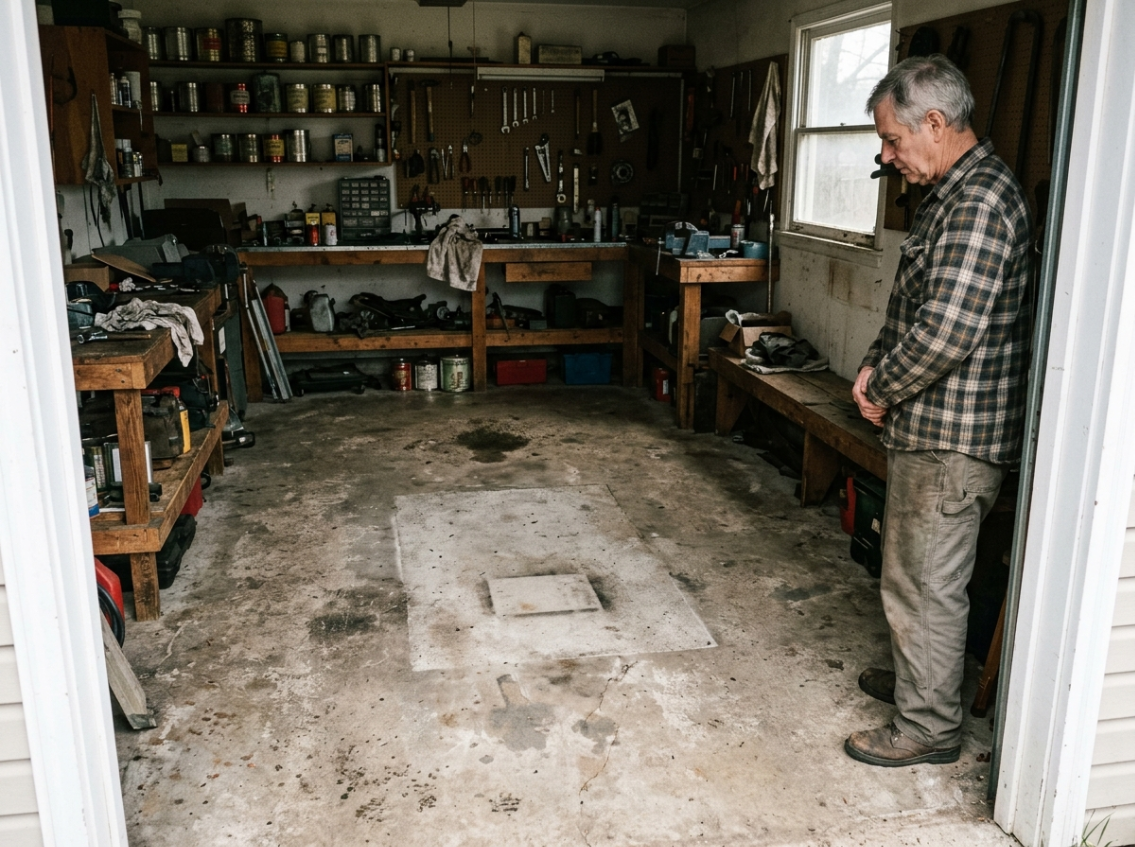
For forty-three years, I’d believed it was simply a wall.
My father had built the workshop himself.
He’d put up the wooden studs.
Hung the insulation.
Installed the electrical wiring.
Painted everything white.
But there had always been one strange thing.
The back wall was thicker than the others.
I remembered asking him about it when I was seventeen.
He’d simply said:
“Some things need extra protection.”
I had forgotten.
Or maybe I had chosen to forget.
Daniel moved toward the wall.
“Your father gave me one instruction before he died.”
“What was it?”
“If Harold ever discovers the door, tell him the truth.”
I stared at him.
“You’ve known about this all along?”
“Not all of it.”
“Then what do you know?”
Daniel took a deep breath.
“Your father and I worked together in 1983.”
“Doing what?”
“Trying to expose a man named Arthur Bell.”
I glanced at the photograph.
“The same Arthur Bell who owned the motorcycle before my father?”
“Yes.”
“Who was he?”
Daniel’s expression hardened.
“A banker.”
“That doesn’t sound very dangerous.”
“He wasn’t dangerous because he was a banker.”
Daniel paused.
“He was dangerous because he controlled people.”
He told me that in the early 1980s, Bell had built a network of businesses across western North Carolina.
Construction companies.
Car dealerships.
Insurance offices.
Small banks.
Storage facilities.
On paper, they were separate.
In reality, they were connected.
Money moved between them.
Records disappeared.
Properties changed hands.
People who asked questions suddenly stopped asking.
“My father was involved?”
“Your father discovered something.”
“What?”
“Names.”
“What names?”
“People who had been paid.”
“Paid to do what?”
Daniel looked at Margaret.
She lowered her eyes.
“Disappear,” he said.
The word hung in the air.
I felt my stomach tighten.
“People disappeared?”
“Some left voluntarily. Some didn’t.”
“And my father found evidence?”
“He found a ledger.”
I looked at the wall.
“Is it in there?”
Daniel nodded.
“The original ledger.”
I stared at him.
“Then why didn’t the police find it?”
“Because your father never gave it to them.”
“Why?”
“Because he didn’t trust them.”
I thought about the newspaper clipping.
The bank fraud investigation.
Arthur Bell’s disappearance.
The names.
The motorcycle.
The keys.
Everything seemed connected.
But there was one thing I couldn’t understand.
“Why did my father give the motorcycle to me?”
Daniel looked almost ashamed.
“Because he knew they would search his house.”
“And the motorcycle?”
“Nobody would search something everyone thought was worthless.”
I closed my eyes.
For thirty-six years, Margaret had called it junk.
For forty-three years, I had polished it.
And somewhere inside that machine, my father had hidden the most important secret of his life.
I opened my eyes.
“Open the door.”
Daniel shook his head.
“No.”
I held up the keys.
“My father left them.”
“He left them because he wanted you to choose.”
“Choose what?”
“Whether you wanted the truth.”
I looked at Margaret.
Then at Daniel.
Then at the wall.
“I’ve spent forty-three years believing I knew my father.”
I put the first key against a tiny hole hidden beneath the workbench.
“But I don’t know him at all.”
I turned the key.
Something clicked.
Then I inserted the second.
Another click.
The wall shuddered.
A section of it moved inward by half an inch.
Dust fell from the ceiling.
Margaret gasped.
Daniel backed away.
“Harold…”
I pushed.
The wall opened.
Behind it was a narrow staircase descending into darkness.
Cold air rose from below.
It smelled like damp stone and old paper.
There was a light switch on the wall.
I flipped it.
A single yellow bulb flickered to life.
The staircase disappeared into the earth.
I looked at Daniel.
“How deep?”
“About twenty feet.”
“How do you know?”
“I’ve been down there once.”
“When?”
“1983.”
I started down.
Margaret grabbed my sleeve.
“Please don’t.”
I looked at her.
“Why?”
Her eyes filled with tears.
“Because I don’t want to lose you.”
I gently removed her hand.
“You should have thought about that before you sold the motorcycle.”
She flinched.
I immediately regretted the words.
But I kept walking.
At the bottom was a small concrete room.
There was a wooden desk.
Two metal filing cabinets.
A chair.
And on the wall—
photographs.
Dozens of them.
I stepped closer.
My father.
Arthur Bell.
Daniel.
Beverly.
I stopped.
Beverly.
My wife’s sister.
Her photograph had been taken in 1983.
She was standing outside a building beside Arthur Bell.
I turned toward Margaret.
“You said Beverly didn’t know anything.”
Margaret began shaking her head.
“I didn’t know.”
“You knew she was involved.”
“No.”
“Then why is she here?”
“I don’t know.”
Daniel walked past us.
He opened one of the filing cabinets.
Inside were hundreds of documents.
Bank statements.
Property records.
Photographs.
Letters.
Receipts.
And names.
He pulled out a thick black ledger.
“This is it.”
I reached for it.
The moment my fingers touched the cover, I felt something strange.
Not fear.
Recognition.
My father had written his initials on the corner.
S.W.
I opened the first page.
Dates.
Amounts.
Names.
Payments.
Then I saw something that made me stop.
A name I knew.
Beverly Harris.
Beside it was a date.
October 14, 1983.
And an amount.
$10,000.
I stared at it.
Margaret whispered:
“No.”
I turned another page.
There it was again.
Beverly.
Another payment.
$15,000.
Then another.
$20,000.
Daniel came closer.
“Your father was tracking every payment.”
“Why was Beverly being paid?”
Daniel didn’t answer.
I looked at Margaret.
“What did your sister do?”
“I don’t know.”
“You’ve known her your entire life.”
“She never told me.”
“Then what did she tell you about the motorcycle?”
Margaret wiped her face.
“She said it was worthless.”
I stared at her.
“That’s what she told you?”
“Yes.”
“And she told you to sell it?”
Margaret nodded.
“Three weeks ago.”
“Why?”
“She said there was a man who wanted it.”
“What man?”
“She didn’t know his name.”
Daniel looked at me.
“She knew.”
We all turned.
Daniel pointed to the ledger.
“Beverly wasn’t being paid to sell the motorcycle.”
“Then what was she being paid for?”
“To make sure the ledger stayed hidden.”
I felt sick.
“How long?”
“Forty-three years.”
I looked at Margaret.
“She knew about the room.”
“Yes.”
“And she knew about my father’s evidence.”
“Yes.”
“And she convinced you to sell the motorcycle because she thought the evidence was still inside it.”
Daniel nodded.
“She didn’t know your father moved it.”
I looked at the ledger.
“Then why did the buyer panic?”
Daniel’s face changed.
“He didn’t.”
“What?”
“The buyer didn’t panic because he discovered the ledger was gone.”
“Then why?”
Daniel looked toward the staircase.
“Because someone called the police.”
I remembered the phone call.
Why are the police in my office?
I looked at the ledger.
“Who called them?”
Daniel didn’t answer.
Then my phone vibrated.
Unknown number.
I answered.
“Hello?”
A woman’s voice.
“Harold?”
I froze.
I knew that voice.
It was Beverly.
“Where are you?”
“That’s not important.”
“You need to listen to me.”
I looked at Margaret.
She was staring at me.
Beverly continued.
“Your wife doesn’t know the whole story.”
“I know.”
“She thinks I wanted the motorcycle sold.”
“Didn’t you?”
“No.”
“Then why did you pay Margaret?”
Silence.
Then Beverly whispered:
“Because I was trying to buy time.”
“For what?”
“To find your father’s second ledger.”
I looked at Daniel.
He went completely still.
“What second ledger?”
Beverly’s breathing became uneven.
“The one your father kept hidden from everyone.”
“Where is it?”
“I don’t know.”
“Then why are you calling me?”
“Because someone else found it.”
My blood ran cold.
“Who?”
Beverly whispered a name.
“Richard Vale.”
I looked at Daniel.
He immediately shook his head.
“No.”
I put the phone on speaker.
Beverly continued.
“Richard isn’t a collector, Harold.”
“Then what is he?”
“He’s Arthur Bell’s son.”
The room went silent.
Daniel’s face went pale.
“That’s impossible,” he whispered.
I looked at him.
“You knew Richard?”
“No.”
Beverly said:
“Your father did.”
I gripped the phone.
“What does Richard want?”
“He wants the second ledger.”
“Why?”
“Because it contains something that could destroy him.”
“What?”
Beverly hesitated.
Then she said:
“His father’s name isn’t Arthur Bell.”
I frowned.
“What?”
“Arthur Bell was an alias.”
Daniel stepped toward me.
“Beverly, stop.”
She ignored him.
“Harold, your father’s greatest secret wasn’t the money.”
“Then what was it?”
“The man who created the entire network wasn’t Arthur Bell.”
She took a shaky breath.
“It was your father.”
I felt as if the floor had disappeared beneath me.
“No.”
“He wasn’t the victim.”
“He was.”
“He wasn’t.”
“Beverly, you’re lying.”
“I wish I were.”
She began crying.
“Your father built the system.”
I looked at the ledger in my hands.
All those names.
All those payments.
All those years.
My father’s initials.
I shook my head.
“No.”
Beverly whispered:
“He became the person he was trying to stop.”
The call ended.
I stared at the phone.
Margaret was crying.
Daniel looked toward the floor.
I couldn’t breathe.
Then I heard footsteps above us.
Slow.
Heavy.
Coming down the staircase.
Daniel turned.
“Someone’s here.”
The footsteps stopped.
A man’s voice echoed through the hidden room.
“Harold.”
I knew that voice.
Richard.
He appeared at the bottom of the stairs.
But he wasn’t alone.
Two men stood behind him.
Richard looked at the ledger in my hands.
Then smiled.
“You found it.”
Daniel stepped in front of me.
Richard shook his head.
“Don’t make this harder than it has to be.”
I looked at him.
“Who was my father?”
Richard’s smile disappeared.
“You really want to know?”
“Yes.”
Richard slowly walked toward me.
“Then you should start with the night your father disappeared.”
“My father died in 1998.”
Richard shook his head.
“That isn’t what I said.”
He stopped directly in front of me.
“I said he disappeared.”
I stared at him.
“What happened to him?”
Richard leaned closer.
“He didn’t die in 1998, Harold.”
My heart stopped.
“He was alive.”
“When?”
Richard looked at the ledger.
“Last year.”
I couldn’t speak.
Then Richard said the words that changed everything.
“Your father is still alive.”
And from somewhere above us, a floorboard creaked.
A voice called down the staircase.
A voice I had not heard in twenty-eight years.
“Harold?”
My knees nearly gave out.
Because I knew that voice.
It was my father.
## Part 3: The Door Behind the Wall
The lights went out.
For several seconds, nobody moved.
The workshop became completely silent.
Not peaceful silence.
The kind of silence that makes you hear your own heartbeat.
Then something clicked behind the wall.
A lock.
Daniel whispered, “Don’t touch it.”
I stood with the two brass keys in my hands.
Seventeen.
Eighteen.
“Why?”
“Because your father didn’t build that door for you to open.”
I looked at him.
“Then who did he build it for?”
Daniel didn’t answer.
Margaret was crying quietly behind me.
I turned toward her.
“You knew about this.”
“I knew there was something behind the wall.”
“When?”
“Three weeks ago.”
“You knew for three weeks?”
She nodded.
“And you said nothing.”
“I was trying to keep you safe.”
I laughed once.
There was no humor in it.
“You sold the motorcycle.”
“I know.”
“You let strangers into my workshop.”
“I know.”
“You took money from them.”
“I know.”
“And now you’re telling me you were protecting me?”
Margaret covered her face.
“I didn’t understand what they wanted.”
“Then tell me what you do understand.”
She lowered her hands.
“I understand that your father was afraid.”
Daniel interrupted.
“Your father wasn’t afraid for himself.”
I looked at him.
“Then who was he afraid for?”
Daniel’s eyes settled on me.
“You.”
A cold feeling spread through my chest.
I looked back at the wall.
For forty-three years, I’d believed it was simply a wall.
My father had built the workshop himself.
He’d put up the wooden studs.
Hung the insulation.
Installed the electrical wiring.
Painted everything white.
But there had always been one strange thing.
The back wall was thicker than the others.
I remembered asking him about it when I was seventeen.
He’d simply said:
“Some things need extra protection.”
I had forgotten.
Or maybe I had chosen to forget.
Daniel moved toward the wall.
“Your father gave me one instruction before he died.”
“What was it?”
“If Harold ever discovers the door, tell him the truth.”
I stared at him.
“You’ve known about this all along?”
“Not all of it.”
“Then what do you know?”
Daniel took a deep breath.
“Your father and I worked together in 1983.”
“Doing what?”
“Trying to expose a man named Arthur Bell.”
I glanced at the photograph.
“The same Arthur Bell who owned the motorcycle before my father?”
“Yes.”
“Who was he?”
Daniel’s expression hardened.
“A banker.”
“That doesn’t sound very dangerous.”
“He wasn’t dangerous because he was a banker.”
Daniel paused.
“He was dangerous because he controlled people.”
He told me that in the early 1980s, Bell had built a network of businesses across western North Carolina.
Construction companies.
Car dealerships.
Insurance offices.
Small banks.
Storage facilities.
On paper, they were separate.
In reality, they were connected.
Money moved between them.
Records disappeared.
Properties changed hands.
People who asked questions suddenly stopped asking.
“My father was involved?”
“Your father discovered something.”
“What?”
“Names.”
“What names?”
“People who had been paid.”
“Paid to do what?”
Daniel looked at Margaret.
She lowered her eyes.
“Disappear,” he said.
The word hung in the air.
I felt my stomach tighten.
“People disappeared?”
“Some left voluntarily. Some didn’t.”
“And my father found evidence?”
“He found a ledger.”
I looked at the wall.
“Is it in there?”
Daniel nodded.
“The original ledger.”
I stared at him.
“Then why didn’t the police find it?”
“Because your father never gave it to them.”
“Why?”
“Because he didn’t trust them.”
I thought about the newspaper clipping.
The bank fraud investigation.
Arthur Bell’s disappearance.
The names.
The motorcycle.
The keys.
Everything seemed connected.
But there was one thing I couldn’t understand.
“Why did my father give the motorcycle to me?”
Daniel looked almost ashamed.
“Because he knew they would search his house.”
“And the motorcycle?”
“Nobody would search something everyone thought was worthless.”
I closed my eyes.
For thirty-six years, Margaret had called it junk.
For forty-three years, I had polished it.
And somewhere inside that machine, my father had hidden the most important secret of his life.
I opened my eyes.
“Open the door.”
Daniel shook his head.
“No.”
I held up the keys.
“My father left them.”
“He left them because he wanted you to choose.”
“Choose what?”
“Whether you wanted the truth.”
I looked at Margaret.
Then at Daniel.
Then at the wall.
“I’ve spent forty-three years believing I knew my father.”
I put the first key against a tiny hole hidden beneath the workbench.
“But I don’t know him at all.”
I turned the key.
Something clicked.
Then I inserted the second.
Another click.
The wall shuddered.
A section of it moved inward by half an inch.
Dust fell from the ceiling.
Margaret gasped.
Daniel backed away.
“Harold…”
I pushed.
The wall opened.
Behind it was a narrow staircase descending into darkness.
Cold air rose from below.
It smelled like damp stone and old paper.
There was a light switch on the wall.
I flipped it.
A single yellow bulb flickered to life.
The staircase disappeared into the earth.
I looked at Daniel.
“How deep?”
“About twenty feet.”
“How do you know?”
“I’ve been down there once.”
“When?”
“1983.”
I started down.
Margaret grabbed my sleeve.
“Please don’t.”
I looked at her.
“Why?”
Her eyes filled with tears.
“Because I don’t want to lose you.”
I gently removed her hand.
“You should have thought about that before you sold the motorcycle.”
She flinched.
I immediately regretted the words.
But I kept walking.
At the bottom was a small concrete room.
There was a wooden desk.
Two metal filing cabinets.
A chair.
And on the wall—
photographs.
Dozens of them.
I stepped closer.
My father.
Arthur Bell.
Daniel.
Beverly.
I stopped.
Beverly.
My wife’s sister.
Her photograph had been taken in 1983.
She was standing outside a building beside Arthur Bell.
I turned toward Margaret.
“You said Beverly didn’t know anything.”
Margaret began shaking her head.
“I didn’t know.”
“You knew she was involved.”
“No.”
“Then why is she here?”
“I don’t know.”
Daniel walked past us.
He opened one of the filing cabinets.
Inside were hundreds of documents.
Bank statements.
Property records.
Photographs.
Letters.
Receipts.
And names.
He pulled out a thick black ledger.
“This is it.”
I reached for it.
The moment my fingers touched the cover, I felt something strange.
Not fear.
Recognition.
My father had written his initials on the corner.
S.W.
I opened the first page.
Dates.
Amounts.
Names.
Payments.
Then I saw something that made me stop.
A name I knew.
Beverly Harris.
Beside it was a date.
October 14, 1983.
And an amount.
$10,000.
I stared at it.
Margaret whispered:
“No.”
I turned another page.
There it was again.
Beverly.
Another payment.
$15,000.
Then another.
$20,000.
Daniel came closer.
“Your father was tracking every payment.”
“Why was Beverly being paid?”
Daniel didn’t answer.
I looked at Margaret.
“What did your sister do?”
“I don’t know.”
“You’ve known her your entire life.”
“She never told me.”
“Then what did she tell you about the motorcycle?”
Margaret wiped her face.
“She said it was worthless.”
I stared at her.
“That’s what she told you?”
“Yes.”
“And she told you to sell it?”
Margaret nodded.
“Three weeks ago.”
“Why?”
“She said there was a man who wanted it.”
“What man?”
“She didn’t know his name.”
Daniel looked at me.
“She knew.”
We all turned.
Daniel pointed to the ledger.
“Beverly wasn’t being paid to sell the motorcycle.”
“Then what was she being paid for?”
“To make sure the ledger stayed hidden.”
I felt sick.
“How long?”
“Forty-three years.”
I looked at Margaret.
“She knew about the room.”
“Yes.”
“And she knew about my father’s evidence.”
“Yes.”
“And she convinced you to sell the motorcycle because she thought the evidence was still inside it.”
Daniel nodded.
“She didn’t know your father moved it.”
I looked at the ledger.
“Then why did the buyer panic?”
Daniel’s face changed.
“He didn’t.”
“What?”
“The buyer didn’t panic because he discovered the ledger was gone.”
“Then why?”
Daniel looked toward the staircase.
“Because someone called the police.”
I remembered the phone call.
Why are the police in my office?
I looked at the ledger.
“Who called them?”
Daniel didn’t answer.
Then my phone vibrated.
Unknown number.
I answered.
“Hello?”
A woman’s voice.
“Harold?”
I froze.
I knew that voice.
It was Beverly.
“Where are you?”
“That’s not important.”
“You need to listen to me.”
I looked at Margaret.
She was staring at me.
Beverly continued.
“Your wife doesn’t know the whole story.”
“I know.”
“She thinks I wanted the motorcycle sold.”
“Didn’t you?”
“No.”
“Then why did you pay Margaret?”
Silence.
Then Beverly whispered:
“Because I was trying to buy time.”
“For what?”
“To find your father’s second ledger.”
I looked at Daniel.
He went completely still.
“What second ledger?”
Beverly’s breathing became uneven.
“The one your father kept hidden from everyone.”
“Where is it?”
“I don’t know.”
“Then why are you calling me?”
“Because someone else found it.”
My blood ran cold.
“Who?”
Beverly whispered a name.
“Richard Vale.”
I looked at Daniel.
He immediately shook his head.
“No.”
I put the phone on speaker.
Beverly continued.
“Richard isn’t a collector, Harold.”
“Then what is he?”
“He’s Arthur Bell’s son.”
The room went silent.
Daniel’s face went pale.
“That’s impossible,” he whispered.
I looked at him.
“You knew Richard?”
“No.”
Beverly said:
“Your father did.”
I gripped the phone.
“What does Richard want?”
“He wants the second ledger.”
“Why?”
“Because it contains something that could destroy him.”
“What?”
Beverly hesitated.
Then she said:
“His father’s name isn’t Arthur Bell.”
I frowned.
“What?”
“Arthur Bell was an alias.”
Daniel stepped toward me.
“Beverly, stop.”
She ignored him.
“Harold, your father’s greatest secret wasn’t the money.”
“Then what was it?”
“The man who created the entire network wasn’t Arthur Bell.”
She took a shaky breath.
“It was your father.”
I felt as if the floor had disappeared beneath me.
“No.”
“He wasn’t the victim.”
“He was.”
“He wasn’t.”
“Beverly, you’re lying.”
“I wish I were.”
She began crying.
“Your father built the system.”
I looked at the ledger in my hands.
All those names.
All those payments.
All those years.
My father’s initials.
I shook my head.
“No.”
Beverly whispered:
“He became the person he was trying to stop.”
The call ended.
I stared at the phone.
Margaret was crying.
Daniel looked toward the floor.
I couldn’t breathe.
Then I heard footsteps above us.
Slow.
Heavy.
Coming down the staircase.
Daniel turned.
“Someone’s here.”
The footsteps stopped.
A man’s voice echoed through the hidden room.
“Harold.”
I knew that voice.
Richard.
He appeared at the bottom of the stairs.
But he wasn’t alone.
Two men stood behind him.
Richard looked at the ledger in my hands.
Then smiled.
“You found it.”
Daniel stepped in front of me.
Richard shook his head.
“Don’t make this harder than it has to be.”
I looked at him.
“Who was my father?”
Richard’s smile disappeared.
“You really want to know?”
“Yes.”
Richard slowly walked toward me.
“Then you should start with the night your father disappeared.”
“My father died in 1998.”
Richard shook his head.
“That isn’t what I said.”
He stopped directly in front of me.
“I said he disappeared.”
I stared at him.
“What happened to him?”
Richard leaned closer.
“He didn’t die in 1998, Harold.”
My heart stopped.
“He was alive.”
“When?”
Richard looked at the ledger.
“Last year.”
I couldn’t speak.
Then Richard said the words that changed everything.
“Your father is still alive.”
And from somewhere above us, a floorboard creaked.
A voice called down the staircase.
A voice I had not heard in twenty-eight years.
“Harold?”
My knees nearly gave out.
Because I knew that voice.
It was my father.
## Part 4: The Truth and the Homecoming
“Harold?”
My father’s voice came down the staircase.
For a moment, I couldn’t move.
I couldn’t breathe.
I couldn’t even convince myself that what I was hearing was real.
Twenty-eight years.
Twenty-eight years since I had stood beside his hospital bed.
Twenty-eight years since I had watched the heart monitor go still.
Twenty-eight years since the funeral.
Twenty-eight years since I had placed a handful of dirt onto his grave.
And now his voice was coming from the darkness above me.
“Dad?”
The word came out like a child’s whisper.
Daniel covered his mouth.
Richard looked away.
Even Margaret stopped crying.
I climbed the stairs.
One step.
Then another.
At the top, a figure stood beneath the workshop light.
He was older.
Much older.
His hair was completely white.
His shoulders had narrowed.
His face was lined with decades I had never seen.
But the eyes were the same.
Blue.
Tired.
Kind.
My father’s eyes.
He looked at me.
I looked at him.
Neither of us spoke.
Then he opened his arms.
I broke.
I walked toward him, and for the first time since I was twenty-one years old, I put my arms around my father.
He was real.
Warm.
Breathing.
His hands shook as he held me.
“I’m sorry, son.”
I couldn’t answer.
I was crying too hard.
He held the back of my head the way he had when I was a boy.
“I wanted to come home.”
I finally pulled away.
“You were dead.”
“I know.”
“You let me believe you were dead.”
“I know.”
“You let me bury you.”
His eyes filled with tears.
“I know.”
I stepped back.
Anger came rushing through the grief.
“Why?”
He lowered his head.
“Because I thought it was the only way to keep you alive.”
I stared at him.
“You could have told me.”
“If I had told you, they would have known where you were.”
“Who?”
He looked toward Richard.
“People like him.”
Richard didn’t move.
My father continued.
“The network I built was real. But I didn’t build it to steal from people.”
He looked at the ledger downstairs.
“I built it to expose people who were already stealing.”
Daniel finally spoke.
“That is what I tried to tell him.”
My father nodded.
“Arthur Bell was the first man we discovered. He was moving money through shell companies and using vulnerable families to hide it.”
“What about the payments?”
“Witnesses.”
My father looked at me.
“I paid people to testify. I paid people to disappear safely. I paid families to leave towns where they were being threatened.”
“And Beverly?”
His expression became sad.
“Beverly was a frightened twenty-year-old girl.”
I turned toward Daniel.
“What happened?”
My father answered.
“She had discovered what Bell was doing. Bell discovered that she knew.”
“She was paid to keep quiet?”
“No.”
He shook his head.
“She was paid to survive.”
I remembered the ledger.
The amounts.
The dates.
The things that had looked like bribes.
They weren’t.
They had been protection.
My father had been keeping records because he knew someday someone might mistake those payments for corruption.
“You could have cleared your name.”
“I tried.”
“Then why disappear?”
He looked at Richard.
“Because Bell found out who my son was.”
Richard’s face hardened.
“My father didn’t threaten Harold.”
“No,” my father said quietly.
“He threatened everyone Harold loved.”
Richard looked away.
The room became silent.
Then my father walked toward the motorcycle.
He placed his hand on the empty space where it had always stood.
“She was never just a motorcycle.”
I smiled through my tears.
“I know.”
He looked at me.
“I gave her to you because I knew you would protect what was hidden inside her.”
“You knew I’d keep her.”
“I knew you would polish her every Sunday.”
I laughed.
It was the first real laugh I’d had all day.
My father smiled.
“You always did have more patience than your mother.”
I wiped my eyes.
“What happened to you?”
He took a breath.
“I spent years helping authorities dismantle what Bell had built.”
“And then?”
“Then I wanted to come home.”
“Why didn’t you?”