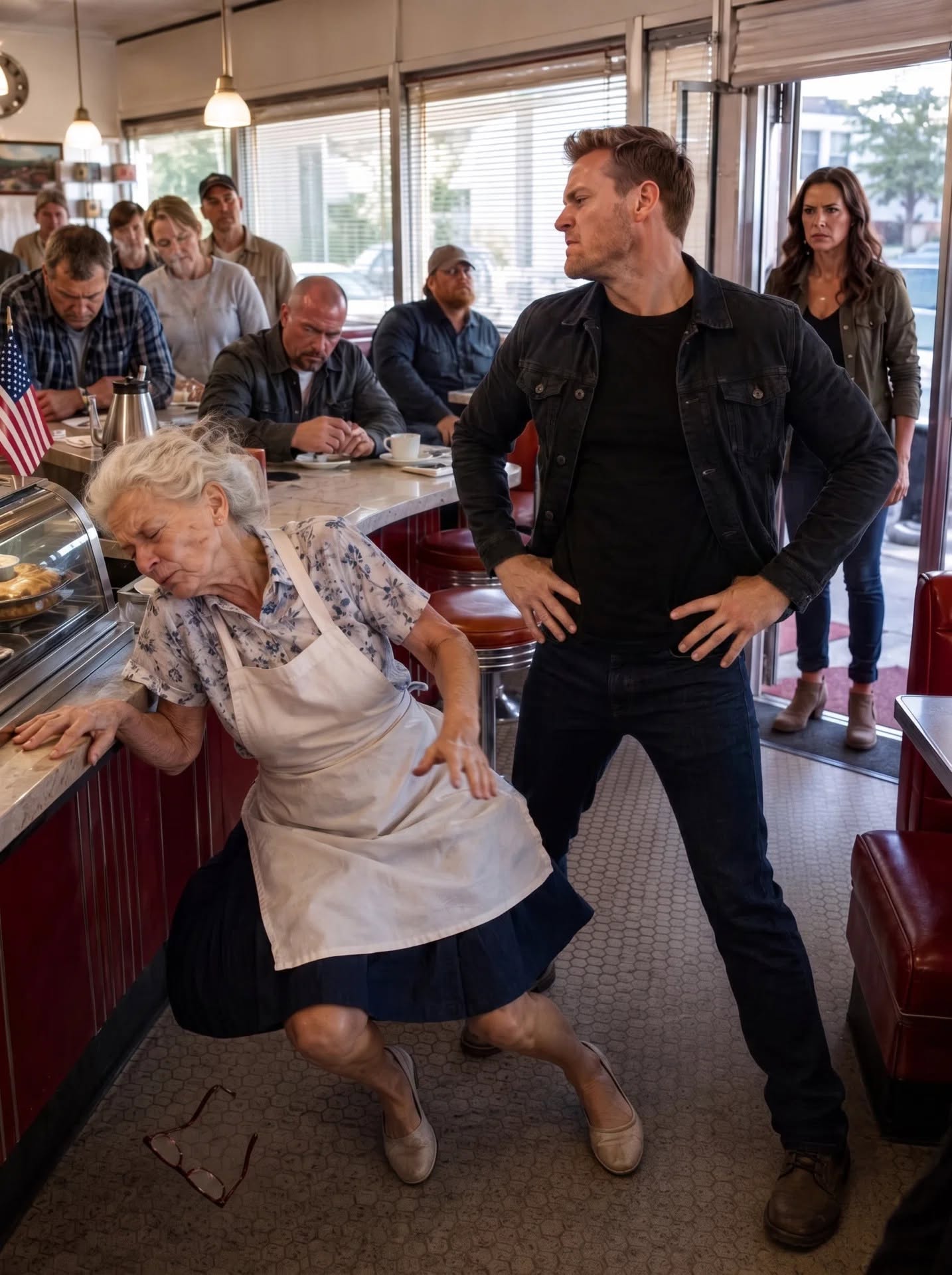
The Rank They Didn’t Know The coffee cup struck the counter and broke into three white pieces. Nobody moved. For several seconds, the only sound in Turner’s Family Diner was the soft ticking of the old wall clock above the pie case. My mother stared at the officer standing in the doorway. Then she looked at me. “Colonel?” I said nothing. Travis Cain’s expression had changed completely. The confidence had drained from his face so quickly that, for the first time since I had returned home, he looked like an ordinary man who had suddenly realized he had made a very expensive mistake.
Sheriff Don Harper recovered first.
He stepped toward the officer.
“This is a local matter.”
The officer didn’t answer him.
He looked at me.
“Colonel Turner, I was instructed to inform you that the convoy is waiting whenever you’re ready.”
Travis swallowed.
“Convoy?”
I finally turned toward him.
“You heard him.”
The sheriff’s eyes narrowed.
“Nicole, whatever game you think you’re playing—”
“It isn’t a game.”
I reached into my jacket and removed my military identification.
I didn’t hold it up dramatically.
I simply placed it on the counter.
The sheriff looked at it.
Then he looked at me.
Then he looked at the two vehicles outside.
His face went pale.
Travis leaned forward.
“What exactly are you?”
I stared at him.
“The person you should have bothered to investigate before putting my mother on the floor.”
Nobody spoke.
My mother lowered her eyes.
I could see her fingers trembling around the coffee pot.
That hurt more than anything Travis had said.
My mother had never been afraid of people.
Not when the diner nearly failed during the recession.
Not when my father died.
Not when the roof collapsed during a winter storm.
She had raised me to believe that bullies were only powerful when everyone around them became quiet.
And now she was quiet.
Because she knew something I didn’t.
Or perhaps something she had been trying desperately to keep from me.
I walked behind the counter.
“Mom.”
She looked at me.
“Tell me what Dad knew.”
Her lips parted.
No words came.
Sheriff Harper stepped between us.
“That’s enough.”
I turned slowly.
“No.”
His jaw tightened.
“You’re interfering with an investigation.”
“You told me yesterday there was no investigation.”
“We’ve received new information.”
“You mean my video.”
He said nothing.
I stepped closer.
“You never asked for the video.”
“I didn’t need to.”
“You didn’t need to?”
I could feel my pulse in my throat.
“My mother was assaulted in front of six witnesses. You called it a fall without examining the footage, interviewing the witnesses properly, or even asking the alleged victim what happened.”
Harper’s expression hardened.
“You don’t understand how this county works.”
“I understand exactly how it works.”
I glanced toward the dining room.
Six customers sat frozen in their booths.
“That’s why everyone is afraid to speak.”
Nobody looked at me.
Nobody except Kayla.
She was standing near the kitchen doorway.
Her eyes were wet.
I caught her gaze.
She slowly nodded.
That was enough.
I turned back to the sheriff.
“Where is the original incident report?”
“Sheriff’s office.”
“Who wrote it?”
“Deputy Mills.”
“Who reviewed it?”
Harper didn’t answer.
“Who authorized the wording about an accidental fall?”
Still nothing.
The officer behind me stepped forward.
“Colonel, perhaps we should move this conversation somewhere more appropriate.”
Harper snapped.
“This is my jurisdiction.”
The officer looked at him calmly.
“I didn’t say it wasn’t.”
That calmness made the sheriff more uncomfortable than an argument would have.
The second SUV door opened outside.
Another officer emerged carrying a black case.
He entered the diner and stopped beside the first man.
“Ma’am.”
He handed me an envelope.
There was no return address.
No department logo.
Nothing that explained what was inside.
I opened it.
A single sheet of paper.
Three lines.
PROPERTY TRANSFER — TURNER FAMILY DINER
ORIGINAL RECORD LOCATED
DO NOT TRUST COUNTY CHANNELS
I read it twice.
My stomach tightened.
I looked at the officer.
“Where did you get this?”
“From your father’s archived files.”
My mother’s coffee pot slipped from her hand.
It hit the counter but didn’t break.
She whispered something I almost didn’t hear.
“Your father burned those.”
I looked at her.
“What?”
“He burned everything.”
Her eyes filled with tears.
“He told me there was nothing left.”
The room seemed to tilt.
I looked at the paper again.
“Mom, what did Dad burn?”
She shook her head.
“I don’t know.”
“You just said he burned everything.”
“I saw him burn papers.”
“What papers?”
“I don’t know.”
Her voice cracked.
“He wouldn’t tell me.”
I crouched beside her.
“Why didn’t you tell me this before?”
“Because you were already carrying too much.”
“I’m your daughter.”
“I know.”
She reached up and touched my cheek.
“You were always the one who thought you could fix everything.”
I almost laughed.
Instead, I felt my eyes burn.
“I couldn’t fix Dad.”
She looked away.
“No.”
The word was barely audible.
“And I couldn’t save you from this.”
My mother gripped my hand.
“You weren’t supposed to come home.”
I froze.
“What do you mean?”
She looked toward the windows.
The blinds were closed.
But through a narrow gap, I could see the black SUVs still waiting outside.
“I called you because I thought you needed to know what happened,” she whispered.
“You didn’t call me.”
She looked confused.
“What?”
“You didn’t call me.”
Carol called me.
My mother stared at me.
For several seconds neither of us spoke.
Then her face changed.
“Carol?”
I nodded.
“She sent the first video.”
My mother slowly shook her head.
“I never asked her to.”
A cold feeling moved through me.
I stood.
“Where is Carol now?”
Nobody answered.
I called her.
Straight to voicemail.
I called again.
Nothing.
The officer beside me looked at his phone.
His expression tightened.
“Colonel.”
I looked at him.
“What?”
He turned the screen toward me.
A message had arrived.
One sentence.
CAROL’S HOUSE IS EMPTY.
My throat went dry.
Travis Cain suddenly laughed.
It wasn’t a nervous laugh.
It was quiet.
Almost amused.
Everyone turned toward him.
He wiped his mouth.
“You people really don’t understand.”
I stared at him.
“What?”
He shook his head.
“You think Wade is the problem.”
I stepped closer.
“What are you saying?”
Travis looked toward his father.
Wade Cain had remained silent throughout the entire confrontation.
He stood near the pie display in his expensive gray suit, exactly as he had in Kayla’s extended recording.
Except now he was smiling.
Not broadly.
Just enough.
“Ask your mother,” Travis said.
“Ask her what?”
He looked directly at Evelyn.
“Ask her why your father kept a second key.”
My mother’s face went white.
I turned toward her.
“Second key?”
She closed her eyes.
For the first time since I had returned home, she looked less frightened of the Cains than she did of the truth.
“Mom?”
Her breathing became shallow.
Then she whispered:
“Under the floor.”
“What?”
“The floor beneath the counter.”
I looked down.
The same counter where my mother had spent fifty years pouring coffee.
The same counter where my father had repaired loose hinges, replaced drawer handles, and carved a tiny T into the underside because he said every good carpenter should leave his initials somewhere nobody could see.
I crouched.
My fingers searched along the wooden trim.
Nothing.
Then I felt it.
A small metal plate.
I pushed it.
A section of flooring clicked.
My mother gasped.
The sheriff moved forward.
“Don’t touch that.”
I looked at him.
“Why?”
His face gave me the answer before his mouth did.
He knew.
I pulled the panel open.
Inside was a narrow metal box.
Old.
Dusty.
Locked.
And attached to the lid was a faded photograph.
I picked it up.
My father stood beside the diner.
He looked younger.
Maybe forty.
Beside him stood Wade Cain.
And between them was another man.
A man I had never seen before.
On the back of the photograph, my father’s handwriting read:
If anything happens to me, find out who he is.
I turned the photograph over again.
The stranger’s face looked strangely familiar.
I stared at it.
Then I realized why.
I had seen him before.
Not in the diner.
Not in my father’s photographs.
Not in town.
I had seen him in an official military briefing photograph three years earlier.
Standing behind a senior government official.
My hands went cold.
The officer beside me noticed my expression.
“Colonel?”
I handed him the photograph.
He studied it.
Then his eyes widened.
“You know him?”
“Yes.”
“Who?”
I looked toward the sheriff.
Then toward Wade Cain.
Then at my mother.
“I don’t know yet.”
Wade’s smile disappeared.
For the first time, he looked afraid.
I stood with the photograph in my hand.
“Open the box.”
The officer produced a small tool.
The sheriff stepped forward again.
“You cannot remove evidence from a local business.”
I turned to him.
“This isn’t your evidence.”
He stared at me.
“Then whose is it?”
I held his gaze.
“That’s what we’re about to find out.”
The lock snapped.
The lid opened.
Inside were six things.
A cassette tape.
A property deed.
A small brass key.
Three photographs.
And a folded piece of paper with my father’s handwriting.
I unfolded it.
Only one sentence had been written.
Nicole — if you are reading this, they finally found out what I knew.
I stopped breathing.
My mother covered her mouth.
Behind me, Travis whispered:
“No.”
I turned.
He was staring at the box.
Not at me.
Not at his father.
At the brass key.
His face had gone completely white.
I held it up.
“What’s this key open?”
Travis backed away.
His father grabbed his arm.
“Enough.”
Travis looked at him.
“You said it was gone.”
The diner became silent again.
I looked between them.
“What was supposed to be gone?”
Wade didn’t answer.
The officer beside me reached for his radio.
Then a voice crackled through it.
“Colonel, we have a situation.”
I pressed the radio button.
“What situation?”
There was a pause.
Then:
“Someone just entered the old Turner property.”
My heart stopped.
“My father’s house?”
“Yes, ma’am.”
“Who?”
Another pause.
“We don’t know.”
I looked at my mother.
She was crying now.
Not loudly.
Just silent tears running down her face.
I squeezed the photograph in my hand.
“Take me there.”
The officer nodded.
I turned toward the door.
Then I heard Wade Cain speak behind me.
“You don’t want to go there.”
I stopped.
Slowly, I looked over my shoulder.
He wasn’t smiling anymore.
His voice had dropped to a whisper.
“Because if you open that door, Colonel Turner, you’ll finally learn what happened to your father.”
I stared at him.
“And you’ll learn,” he continued, “that his accident wasn’t the first time someone tried to kill him.”
He paused.
“It was the second.”
Outside, one of the black SUVs accelerated toward the road.
I followed it.
And for the first time in six years, I began to wonder whether my father’s death had ever been an accident at all.
Here is Part 3, written as the final chapter, bringing the mystery, emotional tension, and justice to a complete ending.
WritingPART 3 — The Door My Father Never Opened
The road to my father’s house was only seven minutes from the diner.
That night, it felt like seven years.
I sat in the back seat of the lead SUV while two officers followed behind us. The photograph was still in my hand.
My father’s face stared back at me.
Young.
Confident.
Alive.
I had spent six years telling myself that grief eventually became smaller.
It didn’t.
You simply learned how to carry it.
But now I knew something I hadn’t known that morning.
My father had been afraid.
And he had left something behind for me.
The house appeared at the end of the road.
The porch light was on.
It hadn’t worked in years.
I stepped out.
“Stay behind me,” the officer said.
I almost smiled.
“I’m a colonel.”
“I know.”
He looked at the dark house.
“That’s why I’m telling you to stay behind me.”
We approached the front door.
It was unlocked.
Inside, the house smelled exactly as I remembered.
Old wood.
Dust.
My father’s aftershave.
For one impossible second, I was twenty years younger.
I expected to hear him from the kitchen.
You’re late, Nicole.
Instead, there was silence.
The officers searched room by room.
Nobody.
Then one of them called from the study.
“Colonel.”
I entered.
A desk drawer had been pulled open.
Papers were scattered across the floor.
The strange thing was that nothing appeared stolen.
The intruder hadn’t searched randomly.
They had searched one specific place.
The wall behind my father’s desk.
I remembered the brass key.
I took it from my pocket.
There was a small keyhole beneath the wooden molding.
I inserted the key.
The wall clicked.
A narrow compartment opened.
Inside was a digital recorder.
A red light blinked.
It had been waiting for me.
I pressed play.
My father’s voice filled the room.
“If you’re hearing this, Nicole, I’m sorry.”
My knees nearly gave out.
I sat down.
His voice continued.
“I discovered that Wade Cain wasn’t simply buying property.”
A pause.
“He was using pressure, threats, forged documents, and people inside local government to force families out.”
I looked at the officers.
Nobody spoke.
My father’s voice continued.
“But that’s not the worst part.”
The recording crackled.
“The sheriff’s office wasn’t merely looking the other way.”
My stomach tightened.
“They were helping.”
The room seemed to become colder.
“Every family that refused to sell was given a problem. A lien. A code violation. A false complaint. Sometimes damage to their property.”
Another pause.
“And when those methods failed, Wade had another solution.”
The recording stopped.
I stared at the device.
“That’s it?”
The officer beside me shook his head.
“There may be another file.”
We searched the compartment.
Behind the recorder was a memory card.
I handed it to him.
He inserted it into a secure device.
There were twenty-three files.
Property records.
Photographs.
Audio recordings.
Names.
Dates.
Payments.
And then I saw my father’s accident report.
Not the sheriff’s version.
The original.
Photographs showed tire marks on the road.
A damaged steering column.
A mechanic’s report.
One sentence had been highlighted.
Brake line failure inconsistent with collision damage.
My hands began shaking.
My father had not lost control of his vehicle.
Someone had tampered with the brakes.
I closed my eyes.
For six years, I had imagined his final moments.
Now I knew he had probably understood what was happening.
And he had still tried to get home.
My father.
The man who had taught me to fix a bicycle chain.
The man who stayed awake when I had my first fever.
The man who stood at the airport the day I left for military training and told me not to become hard just because the world was.
I whispered:
“I’m sorry, Dad.”
Then the door behind us opened.
Everyone turned.
Wade Cain stood in the hallway.
Alone.
No sheriff.
No son.
No smile.
He looked exhausted.
“I came to tell you the truth.”
I stood.
“You’re six years late.”
“Yes.”
He looked down.
“My son shoved your mother.”
“He assaulted her.”
“Yes.”
“And you watched.”
His eyes closed.
“Yes.”
“Why?”
He looked at the floor.
“Because I was afraid of my own family.”
I said nothing.
Wade slowly sat in the chair across from me.
“My father built the company. He taught me that people were obstacles. Land was leverage. Fear was cheaper than lawsuits.”
“And you became him.”
“I tried to.”
His voice cracked.
“Until your father found out.”
He told us everything.
My father had discovered the scheme years earlier.
He had confronted Wade privately.
Wade had warned him to stay quiet.
My father refused.
Then Wade’s father ordered someone to sabotage the car.
Wade claimed he didn’t know the exact plan until afterward.
But he knew enough.
And he had remained silent.
“Why didn’t you confess?”
I asked.
Wade looked at me.
“Because I was a coward.”
That answer was almost worse than a lie.
I stood.
“Where is your father?”
Wade looked toward the window.
“Gone.”
“Where?”
“I don’t know.”
Then his face changed.
“He left the county yesterday.”
“Why?”
“Because he knew you were coming.”
Behind us, the officer’s radio suddenly crackled.
“Colonel, we have confirmation.”
I turned.
“What?”
“The county courthouse server has been accessed.”
“By whom?”
“We traced the login.”
The officer looked at me.
“It came from the sheriff’s office.”
Everything became clear.
Harper wasn’t trying to protect Travis.
He wasn’t protecting the town.
He was destroying records.
I picked up my phone.
“Send everything.”
“To whom?”
“State investigators. Federal investigators. Every agency authorized to receive evidence.”
The officer nodded.
Then I added:
“And send the videos.”
My mother’s assault.
The forty-seven seconds.
The property records.
My father’s files.
Everything.
No more quiet folders.
No more private conversations.
No more trusting people because they wore a badge.
The next morning, the county woke to sirens.
State investigators arrived before sunrise.
The sheriff’s office was sealed.
Deputy Mills surrendered his computer.
The mayor resigned before noon.
Kayla gave a formal statement.
Then the other witnesses came forward.
One by one.
People who had been silent for years finally spoke.
A farmer brought receipts.
A widow brought letters.
A mechanic brought photographs.
An elderly couple brought a recording of a meeting with Wade Cain.
The story wasn’t about one diner anymore.
It was about an entire town that had been taught to keep its eyes down.
My mother watched from the doorway of Turner’s Family Diner as investigators carried boxes from the sheriff’s vehicles.
She still wore her faded apron.
The Ohio-shaped stain was still there.
Her arm was still in a sling.
But she was standing.
That mattered.
Weeks later, charges were filed.
Travis was charged for assaulting my mother.
Several officials faced corruption and evidence-related charges.
The investigation into my father’s death was reopened.
Wade Cain testified.
His cooperation exposed records that had been hidden for years.
It didn’t erase what he had done.
It didn’t bring my father back.
But truth doesn’t have to bring someone back to matter.
Sometimes truth is the first thing that lets the living breathe again.
Three months later, I stood behind the diner counter with my mother.
The morning sun came through the windows.
Kayla poured coffee for the regulars.
The same men who had stared at their plates that day now looked at my mother when they spoke to her.
One of them approached quietly.
“I owe you an apology, Evelyn.”
My mother looked at him.
He lowered his head.
“I should have stood up.”
She was silent for a moment.
Then she said:
“Yes.
“You should have.”
He nodded.
There was no dramatic forgiveness.
No easy ending.
Just the truth.
Sometimes that’s enough.
My mother turned toward me.
“You going back?”
I looked at the uniform hanging over the chair.
“Yes.”
“When?”
“Soon.”
She smiled.
“You always did like leaving.”
I laughed.
“No.”
I looked around the diner.
“I just needed to know this place was safe before I left.”
She reached across the counter and squeezed my hand.
“You saved me.”
I shook my head.
“No, Mom.”
I looked toward the front window.
Outside, the sign above the door read:
TURNER’S FAMILY DINER
The same sign my father had painted himself.
“The truth saved you.”
She smiled.
Then the brass bell above the door rang.
A young girl entered holding her father’s hand.
She looked at my mother.
“Are you the lady who makes the best pancakes?”
My mother laughed.
“I used to be.”
The girl frowned.
“Used to?”
My mother straightened her apron.
“Let me show you.”
She walked toward the kitchen.
I stood behind the counter and watched her go.
For the first time in years, the diner sounded normal again.
Plates clinking.
Coffee pouring.
People talking.
Someone laughing.
Life.
I reached beneath the counter and touched the tiny carved letter my father had left in the wood.
T.
I closed my eyes.
“I’m home, Dad.”
Then I heard my mother’s voice from the kitchen.
“Nicole! Stop standing around and come help me!”
I smiled.
“Yes, Mom.”
And I went.
Because some battles are fought in briefing rooms.
Some are fought on roads.
Some are fought in courtrooms.
But the battles that matter most sometimes begin with one frightened person finally deciding:
I will not look away.
And that morning, nobody in Turner’s Family Diner lowered their eyes.