Grandma’s voice came through the phone again.
“You need to call that doctor and tell them she misunderstood me.” For a moment, I couldn’t speak. I looked at my daughter sitting beside me on the edge of the bed. She was ten years old. Ten. Her face was pale from treatment, her hair thinner than it had been months ago, and her small hands were still wrapped around the sleeve of her sweatshirt.
She was watching me carefully.
Not Grandma.
Me.
Waiting to see what I would do.
I lowered the phone slightly.
“Why?” I asked.
Grandma sighed sharply.
“Because she is confused. She has been through a lot. You know how medication can affect children. She took something I said completely the wrong way.” My daughter’s fingers tightened around mine. I noticed.
And for the first time, I realized how many times I had probably missed those tiny signals.
The hesitation.
The silence.
The sudden change of subject.
The way she would look at the floor whenever Grandma entered the room. I had always thought she was tired. I had blamed the treatments. I had blamed the long hospital days. I had told myself that after everything she was going through, of course she wasn’t acting like herself.
But now I understood something.
She hadn’t been unable to explain what was happening.
She had been afraid to explain it.
I raised the phone again.
“My daughter told her doctor what was happening here.”
“She misunderstood.”
“She specifically told her doctor.”
“She’s ten.”
“And she is my daughter.”
Silence.
Then Grandma’s voice became colder. “You’re making a terrible mistake.” I looked at my daughter. She was staring at me with tears gathering in her eyes. Not crying. Just waiting.
I stood.
“We’re leaving.”
Grandma immediately protested.
“You can’t just take her without talking to me!”
“I can.”
“You’re overreacting.”
“No.”
I picked up my daughter’s small bag.
“This time, I’m listening.”
I ended the call.
My daughter looked up at me.
“Are you mad at me?”
The question broke something inside me.
I knelt in front of her.
“Never.”
“But Grandma said—”
“I don’t care what Grandma said.”
“She said I caused trouble.”
“You didn’t.”
“She said I was confused.”
“You weren’t.”
My daughter swallowed.
Then, very quietly, she asked, “Are we going home?”
I nodded.
“Yes.”
She looked down.
A tiny breath escaped her.
Almost like she had been holding it for weeks.
“Okay.”
I helped her put on her jacket.
As we walked out of the room, I noticed the hospital appointment card still in her hand.
She hadn’t let go of it.
I didn’t ask her to.
Instead, I took her hand and walked beside her.
For the first time in months, she wasn’t walking toward another treatment.
She was walking away from something.
And I promised myself I would never make her walk back into it.
—
The drive home was quiet.
My daughter slept for most of the way.
I kept checking the rearview mirror.
Every few minutes, I expected her to wake up.
She didn’t.
Her face looked peaceful.
That alone told me how exhausted she had been.
When we reached home, I carried her bag inside.
She stood in the doorway of her bedroom and looked around.
Her stuffed animals were still on the shelf.
Her drawings were still taped to the wall.
Her favorite blanket was folded at the end of the bed.
Nothing had changed.
And yet everything had changed.
She walked to the bed and sat down.
“This feels different,” she whispered.
“What does?”
“Being home.”
I sat beside her.
“Different how?”
She thought for a moment.
“Safe.”
I closed my eyes.
I had spent so much time trying to make sure she received the best medical care.
Appointments.
Scans.
Medications.
Specialists.
Treatment schedules.
Questions.
Insurance.
Paperwork.
I had become obsessed with keeping her physically safe.
But I hadn’t realized that safety was bigger than medicine.
A child needed to feel safe enough to speak.
Safe enough to say no.
Safe enough to admit fear.
Safe enough to tell an adult when something was wrong.
And my daughter hadn’t felt that way.
That was my failure to fix now.
Not hers.
—
The next morning, I called her doctor.
I explained everything.
Not just what happened that day.
Everything.
The sudden silence.
The changes in her behavior.
Her reluctance to stay with Grandma.
The appointment card.
The statement she had made.
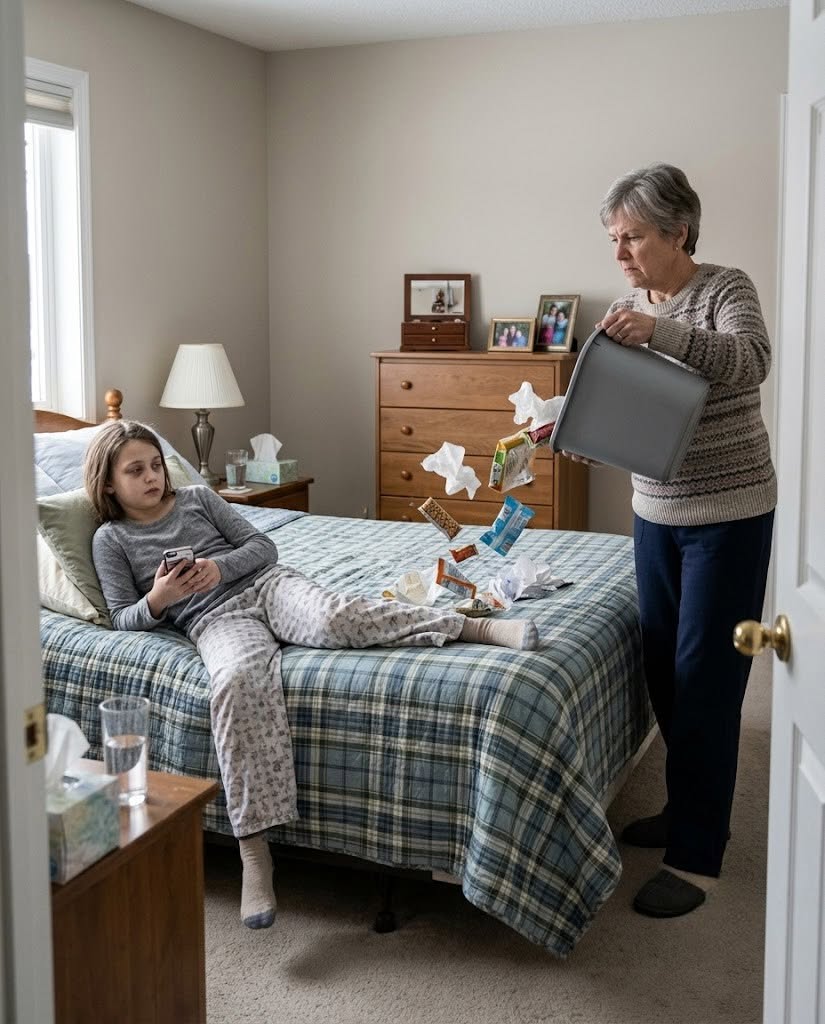
The trash covering her bed.
The phone call.
The fact that Grandma had immediately known what my daughter had told the doctor.
The doctor listened without interrupting.
Then she said something I will never forget.
“I’m glad she told us.”
I closed my eyes.
“So am I.”
“Has your daughter told you exactly what happened?”
“Not everything.”
“Don’t pressure her.”
“I won’t.”
“Let her know she is believed. Let her know she can speak. And we’ll make sure the appropriate people are involved.”
I knew what she meant.
This was bigger than a family disagreement.
This wasn’t about whether Grandma had been too strict.
It wasn’t about whether my daughter had misunderstood a comment.
It wasn’t about a messy bedroom.
It was about a vulnerable child telling a medical professional that she was afraid.
The doctor arranged for us to come in.
And this time, I didn’t go into the appointment as the mother who thought she had all the answers.
I went as the mother who was finally ready to listen.
—
My daughter sat between me and the doctor.
The doctor didn’t rush her.
She didn’t bombard her with questions.
She simply said, “You don’t have to tell us everything at once. You can take your time.”
My daughter looked at me.
I nodded.
“You can tell the truth,” I said.
Her eyes filled with tears.
“I was scared Grandma would be mad.”
The doctor nodded.
“I’m sorry you felt scared.”
My daughter looked down.
“She said Mommy wouldn’t believe me.”
My heart sank.
“She told you that?”
My daughter nodded.
“She said you would think I was trying to get attention because I’m sick.”
I felt my stomach twist.
I wanted to interrupt.
I wanted to defend myself.
I wanted to say that I would never think that.
But the doctor gently raised a hand.
Let her finish.
So I stayed quiet.
My daughter continued.
“She got angry when I told her I wanted to go home.”
“What happened then?” the doctor asked.
My daughter hesitated.
“She said I was being difficult.”
Her voice became smaller.
“Then she threw the trash on my bed.”
The doctor remained calm.
“And how did that make you feel?”
“Like I wasn’t supposed to talk.”
I felt tears running down my face.
My daughter saw them.
“Mommy?”
I reached for her hand.
“You’re okay.”
She looked at me.
“I thought you would be angry.”
“I am angry.”
Her eyes widened.
“Not at you.”
I squeezed her hand.
“Never at you.”
—
The hospital did not treat the situation as a simple family disagreement.
There were conversations.
Documentation.
Professionals involved.
Questions asked carefully and appropriately.
People whose job was to protect children became involved.
And for the first time, I realized how important it was that my daughter had kept that appointment card.
It wasn’t dramatic.
It wasn’t some secret recording or elaborate plan.
It was simply a small piece of paper.
A reminder of where she had been seen.
A reminder that she had told someone.
A reminder that she had tried to get help.
She had been ten years old and afraid.
Yet she had still found a way to speak.
I couldn’t stop thinking about that.
—
Grandma called repeatedly.
I didn’t answer at first.
Then she left a voicemail.
Then another.
Then a message.
Finally, she sent one sentence.
“You are destroying this family.”
I stared at the screen.
For years, that sentence might have worked.
I might have felt guilty.
I might have apologized.
I might have convinced myself that family problems should stay inside the family.
But something had changed.
My daughter was sitting at the kitchen table doing a puzzle.
She looked up.
“Who is it?”
“Grandma.”
Her face immediately changed.
The fear was so quick that I almost missed it.
But I didn’t.
I put the phone face down.
“You don’t have to talk to her.”
My daughter nodded.
Then she asked, “Did I ruin everything?”
I walked over and sat beside her.
“No.”
“But Grandma is angry.”
“Adults are responsible for their own choices.”
She looked at me.
“So I didn’t ruin the family?”
“No.”
“You promise?”
“I promise.”
She went back to her puzzle.
I watched her for a moment.
Then I realized something.
Children shouldn’t have to carry the emotional consequences of adults’ behavior.
That burden belonged with us.
Not her.
—
Two days later, Grandma showed up at my house.
I knew she was coming because my daughter saw her through the window.
“Mommy.”
Her voice was barely audible.
I turned.
She was standing in the hallway.
“She came.”
I walked toward her.
“You stay here.”
“Are you going to talk to her?”
“Yes.”
“Are you going to send me away?”
“No.”
I opened the front door.
Grandma stood on the porch.
She looked exhausted.
But instead of asking about my daughter, she said, “We need to talk.”
“We are talking.”
“Privately.”
“No.”
Her eyebrows lifted.
“Excuse me?”
“If this conversation concerns my daughter, I’m not hiding anything from her.”
Grandma’s expression hardened.
“You’re turning her against me.”
“No.”
“You’re letting her believe things that aren’t true.”
“I am letting her tell me what happened.”
“She is a child.”
“Yes.”
“That means she doesn’t understand everything.”
“That doesn’t mean we ignore her.”
Grandma looked past me.
“Where is she?”
“Inside.”
“I want to see her.”
“No.”
“You can’t keep my granddaughter from me.”
“I can when I believe she isn’t safe.”
Grandma stared at me.
“You’re making an accusation.”
“I’m protecting my child.”
“You’ve always been dramatic.”
I took a breath.
Then I said the sentence I had been afraid to say for years.
“You don’t get access to her just because you’re family.”
Silence.
Grandma looked stunned.
Perhaps she had expected me to argue.
Perhaps she expected me to apologize.
Perhaps she expected the daughter she knew to bend.
But I didn’t.
Because this wasn’t about winning.
It was about protecting a ten-year-old girl who had finally found the courage to speak.
—
Grandma’s voice softened.
“I love her.”
“I know you say you do.”
“I would never intentionally hurt her.”
“I hope that’s true.”
“It is.”
“Then you should understand why I have to take this seriously.”
She looked away.
“She misunderstood me.”
“Then the professionals can determine what happened.”
“You’re involving strangers in a family matter.”
“No.”
I shook my head.
“You made it a family matter. My daughter made it a safety matter.”
Grandma didn’t answer.
I closed the door.
My hands were shaking.
But for once, I wasn’t ashamed of that.
—
The weeks that followed were difficult.
There were meetings.
More medical appointments.
More questions.
There were days when my daughter seemed fine and days when she became unusually quiet.
I learned not to demand explanations.
Instead, I gave her choices.
“Do you want to talk?”
“No.”
“Okay.”
“Do you want me to sit here?”
“Yes.”
So I sat.
Sometimes we watched movies.
Sometimes we colored.
Sometimes she fell asleep with her head against my shoulder.
Healing wasn’t one dramatic moment.
It was a hundred small moments.
A child learning that adults could keep promises.
A mother learning to listen before assuming.
A family learning that silence wasn’t peace.
Sometimes silence was fear.
—
One evening, several weeks later, my daughter asked me a question while we were making hot chocolate.
“Mommy?”
“Yeah?”
“Was Grandma always mean?”
I turned off the stove.
“No.”
She looked confused.
“She wasn’t?”
“People can do things that are wrong even if they have also done good things.”
“So does that mean she’s bad?”
I sat beside her.
“I don’t want you to have to decide whether someone is good or bad.”
“Why?”
“Because that’s an adult question.”
She stirred her cup.
“Then what do I decide?”
I smiled.
“You decide how someone makes you feel.”
She thought about that.
“If someone makes me scared, I can tell you?”
“Always.”
“If someone says I can’t tell you?”
“Especially then.”
She looked at me.
“What if they’re family?”
“Still.”
“What if they say I’m being disrespectful?”
“Still.”
“What if they get angry?”
“Still.”
She nodded.
Then she smiled.
“Okay.”
That single word felt like a victory.
Not because everything was fixed.
But because she finally understood that her voice belonged to her.
—
Months passed.
Her treatment continued.
There were good days.
There were difficult days.
There were appointments that left all of us exhausted.
But my daughter became more open.
She started telling me little things again.
What she wanted for breakfast.
Which teacher made her laugh.
Which book she wanted next.
What song she liked.
Which stuffed animal was her favorite.
Ordinary things.
Beautiful things.
The things I had missed while I was so focused on keeping her alive that I had forgotten to notice the little ways she was living.
One afternoon, she came home from school carrying a piece of paper.
“Mommy!”
“What?”
“Look!”
She handed it to me.
It was a drawing.
There were three figures.
One was her.
One was me.
And one was a doctor.
Above them she had written:
WE TELL THE TRUTH.
I hugged her.
She laughed.
“Mom!”
“Sorry.”
“You’re squeezing me.”
“I know.”
She laughed again.
And for a moment, everything felt normal.
—
Then Grandma sent another letter.
This one wasn’t angry.
It was an apology.
She wrote that she had been overwhelmed.
That she had made mistakes.
That she had handled things badly.
That she regretted frightening my daughter.
She asked to see her.
I read the letter twice.
Then I put it away.
I didn’t immediately answer.
Because an apology doesn’t automatically restore trust.
Trust isn’t a switch.
You don’t turn it off one day and turn it back on the next.
It is rebuilt slowly.
Through behavior.
Through accountability.
Through respecting boundaries.
I eventually agreed to let Grandma communicate through a supervised arrangement determined by the adults and professionals involved.
Not because she demanded it.
Not because I was afraid of upsetting her.
Because my daughter deserved a process that centered her safety.
And when my daughter heard about it, I didn’t tell her what she had to feel.
I asked what she wanted.
She was quiet for a long time.
Then she said, “I don’t want to see her yet.”
“Okay.”
“Maybe someday.”
“Okay.”
“Is that allowed?”
I smiled.
“Yes.”
She nodded.
That was enough.
—
A year after the day I found her sitting on that bed, we returned to the hospital for another appointment.
The same hallway.
The same elevators.
The same waiting room.
But my daughter was different.
She was stronger.
Not because everything had been easy.
Because she had learned something important.
Her voice mattered.
She sat beside me while we waited.
Then she leaned over.
“Mommy?”
“Yeah?”
“Do you remember when I called you?”
“I remember.”
“I thought you wouldn’t come.”
My heart tightened.
“I will always come.”
She smiled.
“You came.”
“Yes.”
“And you believed me.”
I looked at her.
“I should have listened sooner.”
She shook her head.
“You listened when I told you.”
“No.”
I took her hand.
“I should have noticed when you were trying to tell me before.”
She thought about that.
Then she said, “You know now.”
I smiled.
“Yes.”
The nurse called her name.
My daughter stood.
She looked at me.
Ready.
Not fearless.
Ready.
We walked into the appointment together.
—
Later that evening, I found the old appointment card.
The one she had pulled from beneath her pillow.
The corners were bent.
The ink was fading.
I kept it in a small box with photographs and other memories.
Not because I wanted to remember the worst day.
Because I wanted to remember the moment my daughter found her voice.
That little card represented something bigger than evidence.
It represented courage.
She had been sick.
She had been frightened.
She had been told, directly or indirectly, that her words didn’t matter.
And she spoke anyway.
She spoke to the doctor.
She spoke to me.
She asked to come home.
And eventually, people listened.
I used to think being a good mother meant having all the answers.
Now I know better.
Sometimes being a good mother means admitting you don’t know.
Sometimes it means asking questions.
Sometimes it means believing your child before you have every detail.
And sometimes it means standing in a doorway and saying:
“No.”
No, you don’t get to frighten my child.
No, you don’t get to silence her.
No, you don’t get to decide that her fear is inconvenient.
No, you don’t get to call her confused simply because she told the truth.
And no, being family does not give anyone permission to cross a child’s boundaries.
—
Years later, my daughter would barely remember the details of that room.
She wouldn’t remember every wrapper.
Every box.
Every word.
But I hoped she would remember something else.
That she called.
And I came.
That she spoke.
And I listened.
That she was afraid.
And someone believed her.
That she was never responsible for protecting adults from the consequences of their choices.
And most importantly—
that she never had to earn the right to be safe.
The night after her treatment, she fell asleep beside me on the couch.
I covered her with a blanket.
For a long time, I simply watched her breathe.
Then she stirred.
“Mommy?”
“I’m here.”
“Don’t go.”
“I won’t.”
She closed her eyes again.
I stayed.
Because sometimes the biggest promises aren’t the ones we make in speeches.
They’re the ones we keep quietly.
Night after night.
Appointment after appointment.
Hard day after hard day.
Until a child who once whispered, “Can you come get me?” eventually becomes a young woman who knows she can walk away from anyone who makes her afraid.
And if she ever wonders whether her voice matters, I hope she remembers that little girl.
The one who was sick and scared.
The one who reached beneath a pillow and pulled out a crumpled appointment card.
The one who whispered the truth.
The one who waited to see whether her mother would believe her.
I did.
And from that day forward, I made sure she never had to wonder again.
Because my daughter wasn’t a burden.
She wasn’t difficult.
She wasn’t confused.
She wasn’t trying to destroy a family.
She was a child asking for help.
And finally—
someone listened.