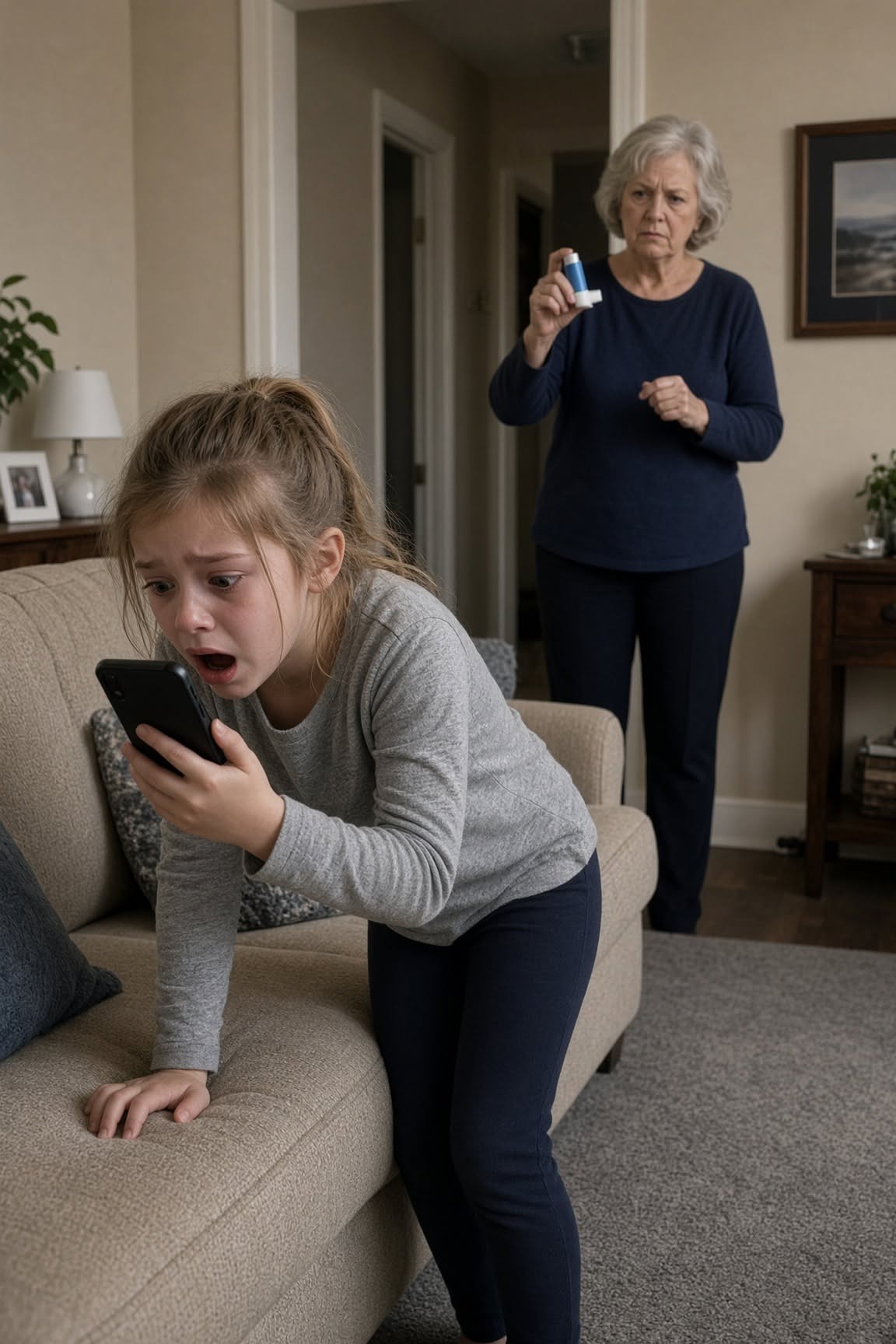
The answer came so softly that for half a second I wondered if I had heard Elaine correctly. “I told her to sit down and stop performing.” The paramedic beside Lily looked up.Ảnh bài viết The officer did not move.
Neither did I.
My seven-year-old daughter sat on the edge of the ambulance stretcher with a nebulizer mask covering her mouth and nose, her small chest still rising too fast beneath her pink T-shirt.
Elaine stood ten feet away in her church cardigan, facing an officer whose body camera was recording every word.
“You believed she was pretending she couldn’t breathe?” he asked.
Elaine crossed her arms.
“She gets worked up when she doesn’t get her way.”
The officer glanced toward Lily.
“Did she tell you she needed her prescribed inhaler?” “Yes.” “And you knew where it was?” Elaine’s eyes flicked toward the clear evidence bag in the second officer’s hand.
“Yes.”
“Yet you refused to give it to her?”
Elaine’s jaw tightened.
“I was teaching her respect.”
For nearly twenty minutes, I had been moving too fast to feel anything properly. At 3:17 p.m., Lily had called me gasping. By 3:29, police were on the way. At 3:31, the ambulance had been dispatched.
At 3:36, I had turned onto our street and seen flashing red and blue lights washing over our windows. Now I was finally standing still.
That was when the fear became anger.
Not loud anger.
Something colder.
The kind that arrives when the person who endangered your child keeps explaining why she believes she was entitled to do it.
The paramedic adjusted Lily’s mask.
“Slow breaths for me, sweetheart.”
Lily nodded.
Her eyes found mine.
I moved close enough that she could touch my wrist without removing either hand from the mask. “You’re okay,” I whispered. “Mommy’s right here.” Her eyes immediately filled with tears.
Then she tried to speak.
The paramedic gently stopped her.
“Save your breath.”
Lily nodded again.
And then, impossibly, she gave me the look I had seen hundreds of times after spilled juice, forgotten homework, or a broken crayon.
The look that said she was sorry.
My daughter was sitting inside an ambulance struggling to breathe, and some part of her still believed she might be the one who had caused trouble.
That nearly broke me.
Behind us, Elaine said, “See? She does this. Everything becomes dramatic.”
I turned.
The officer beat me to it.
“Ma’am, I need you to stop speaking about the child while she is being treated.”
Elaine blinked.
Nobody in Elaine’s family told her to stop.
That had always been part of the problem.
My husband, Daniel, was forty years old and still changed when his mother used a certain tone.
She would say, “Daniel Michael,” and his shoulders would tighten.
She would sigh after he disagreed with her, and within minutes he would start explaining himself.
He apologized before conflicts even existed.
For years, I had thought it was simply his personality.
Then I started noticing that he did it most around Elaine.
She called it respect.
I had gradually learned another word for it.
Fear.
Elaine had often told stories about raising Daniel as though childhood were basic training.
She took doors off hinges when he slammed them.
She threw away toys when he argued.
She sent him to bed hungry when she thought he needed an attitude adjustment.
Every story ended the same way.
“And he turned out fine.”
Daniel usually smiled when she said it.
But never with his eyes.
That afternoon, standing beside an ambulance while my daughter breathed medication through a plastic mask, I finally understood why that sentence had always bothered me.
Survival was the evidence Elaine used to excuse whatever came before it.
The second officer carried the inhaler toward his cruiser.
Elaine watched him.
“Why are you taking that?”
“It’s being documented.”
“It belongs to my granddaughter.”
The first officer looked at her.
“She needed it twenty minutes ago.”
For once, Elaine had no answer.
The paramedic asked me about Lily’s medical history.
“Moderate persistent asthma,” I said.
“Any hospitalizations?”
“Once when she was four. Nothing recently.”
“Known triggers?”
I answered each question.
Exercise.
Respiratory infections.
Sometimes seasonal allergies.
Then the paramedic asked the question that made my voice catch.
“How long was she without access to the rescue inhaler after asking for it?”
I looked at Elaine.
She stared at the porch railing.
“I don’t know exactly,” I said. “Lily called me at 3:17.”
The officer turned toward Elaine.
“When did you take it?”
“I wasn’t looking at a clock.”
“Approximately.”
Elaine hesitated.
“Maybe a few minutes before that.”
A few minutes.
She said it like time was small simply because the number was.
The officer asked, “And after the child called her mother?”
Elaine’s face hardened.
“She had no business calling anyone after I told her to sit down.”
The silence that followed was so complete I could hear the low mechanical hiss of Lily’s nebulizer.
The neighbor with the grocery bags was still standing near the sidewalk.
She lowered them slowly to the pavement.
Elaine noticed her watching and flushed.
That seemed to bother her more than anything else had.
“Rachel,” she said, “you need to tell them this has been blown completely out of proportion.”
I stared at her.
“My daughter couldn’t breathe.”
“She could breathe.”
“She called me gasping.”
“She was upset.”
“She needed medication.”
“She needed to stop challenging adults.”
The officer stepped closer.
“Mrs. Elaine, do not approach the ambulance.”
“I’m talking to my daughter-in-law.”
“You’re being told to remain there.”
That was the first moment Elaine looked genuinely frightened.
Not when Lily wheezed.
Not when the ambulance arrived.
Not when the police found the inhaler hidden inside the kitchen.
When someone finally told Elaine that her authority had a boundary.
The front of my house looked almost offensively ordinary.
The small American flag beside the porch barely moved.
Our mailbox still had yesterday’s grocery flyer sticking out.
Lily’s sidewalk chalk was scattered near the driveway.
Everything looked like the same home I had left that morning.
It wasn’t.
A family can change without furniture moving an inch.
My phone rang.
Daniel.
I had texted him only three words while driving.
LILY. AMBULANCE. HOME.
He was supposed to be across town.
When I answered, he was breathless.
“Is she okay?”
It was the first question he asked.
Not what happened.
Not what had his mother done.
“Paramedics are treating her,” I said.
“I’m coming.”
I looked at Elaine.
“Your mother took Lily’s inhaler away because she thought Lily was disrespectful.”
Silence.
“She what?”
“She hid it while Lily was having trouble breathing.”
Another silence.
Then Daniel said, “Put Mom on.”
“No.”
I surprised myself with how quickly I answered.
“No?”
“She’s speaking to the police. Get here safely.”
I ended the call.
That was another small thing that changed that day.
For years, when Elaine created a conflict, everybody handed it to Daniel.
Explain your mother.
Calm your mother.
Talk to your mother.
Translate what your mother really meant.
Not anymore.
Elaine had created this situation herself.
She could answer for herself.
A paramedic told me Lily’s breathing was improving but that they wanted her evaluated because of the severity of the episode and the delay in receiving her rescue medication.
I climbed into the ambulance beside her.
Elaine immediately moved forward.
“I’m coming too.”
The officer blocked her path.
“No, ma’am.”
“I am her grandmother.”
“And her mother is accompanying her.”
Elaine looked at me.
“Rachel.”
I had heard that tone before.
Cold.
Warning.
Designed to make everyone else feel twelve years old.
It did nothing to me now.
“You’re not coming near her.”
Her mouth opened.
I continued.
“You are never supervising Lily alone again.”
Elaine went white.
“You don’t mean that.”
“I do.”
“You’re angry.”
“I’m terrified.”
“I would never hurt her.”
I looked at the inhaler sealed inside the clear bag.
“You already did.”
Daniel arrived before the ambulance left.
He parked badly, half a tire over the curb, and ran toward us.
Elaine called his name first.
“Daniel!”
He stopped.
For one second, I saw the old reflex move through him.
His mother called.
He turned.
Then Lily coughed behind her mask.
Daniel looked toward the ambulance.
And he chose his daughter.
He climbed inside without answering Elaine.
She stared after him.
I cannot know what that moment felt like to her.
I know what it looked like.
Like the first consequence she could not argue away.
At the hospital, Lily’s breathing gradually settled.
Her color returned.
Her hands stopped trembling around the mask.
When the treatment finally ended, she leaned against me, exhausted.
Daniel sat beside the bed.
He had barely spoken since arriving.
Then Lily whispered, “Daddy?”
He moved closer.
“Right here.”
“Am I in trouble?”
Daniel closed his eyes.
I watched his face collapse.
“No.”
His voice cracked.
“No, baby. Never for asking for your medicine.”
Lily looked between us.
“Grandma said I was rude.”
Daniel took her hand.
“You can be angry. You can disagree. You can even be rude sometimes, and we’ll deal with that separately.”
He swallowed.
“But nobody gets to take away medicine you need to breathe.”
She thought about that.
Then came the question I had feared.
“Is Grandma mad at me?”
Daniel stared at the floor for several seconds.
When he answered, his voice was steadier.
“Grandma’s feelings are not your job.”
I looked at him.
So did Lily.
I had never heard him say anything like that before.
Later, while Lily slept, Daniel told me things he had never described plainly.
How Elaine used to lock up things he loved when she was angry.
How she called fear “respect.”
How every punishment became his responsibility because if he had behaved better, according to her, she would not have needed to punish him.
“I thought that was normal,” he said.
I reached across the hospital chair and took his hand.
“It was familiar.”
He nodded.
“That’s not the same thing.”
No.
It wasn’t.
The police documented what happened, including Elaine’s statements, Lily’s account, the recovered inhaler, and the paramedics’ observations.
I did not pretend to know that evening what every official consequence would eventually be.
I knew the consequence inside our family.
Elaine no longer had unsupervised access to Lily.
She no longer had a key to our house.
She no longer handled Lily’s medication.
And until Daniel and I decided otherwise based on Lily’s safety, there would be no visits at all.
Those were not threats.
They were decisions.
When Daniel told his mother, she cycled through every argument we expected.
She had raised children before.
She knew what she was doing.
Lily had exaggerated.
I had overreacted.
The police had embarrassed her.
The neighbors would gossip.
Daniel finally interrupted.
“Mom.”
Elaine stopped.
His voice shook, but he continued.
“My daughter called Rachel because she couldn’t breathe.”
“You don’t understand what happened.”
“I understand you had her inhaler.”
Elaine said nothing.
“And you decided obedience mattered more than giving it back.”
“That is not fair.”
Daniel looked exhausted.
Maybe he had been exhausted by that argument his entire life.
Then he said the sentence that ended it.
“You don’t get to teach my daughter the same lesson you taught me.”
Elaine stared at him.
“What lesson?”
“That being scared is safer than asking for help.”
No one spoke after that.
Weeks passed.
Lily recovered physically much faster than the rest of us did.
Her inhaler stayed where she could reach it.
We put backups exactly where her asthma plan required.
Every adult allowed to care for her knew the rule.
Medication was never discipline.
Breathing was never negotiable.
One evening, I found Lily sitting at the kitchen table coloring.
Her rescue inhaler was beside her pencil case.
She saw me notice it.
“Mommy?”
“Yes?”
“If I need it at Grandma’s someday, can I still use it even if she says no?”
I pulled out the chair beside her.
“You will never be alone somewhere that an adult can tell you no.”
She studied my face.
“And if anyone ever tries?”
“You call me.”
“Even if I’m being rude?”
“Especially if you need help.”
That finally made her smile.
Elaine had wanted Lily to learn respect.
Instead, my daughter learned something I wish Daniel had been taught at seven.
An adult’s authority ends where a child’s safety begins.
The inhaler Elaine hid for “ten minutes” became the object that changed our family because those minutes exposed everything underneath her idea of discipline.
My irreversible choice was simple: Lily would never again be taught that obedience mattered more than breathing, medicine, fear, or asking for help.
Daniel made his own choice too.
He stopped treating survival as proof that his mother’s parenting had been harmless.
And Elaine faced the consequence she had spent decades insisting children should understand: choices can cost you access, trust, and the right to decide what happens next.
Months later, Lily called me from the backyard because she wanted permission to turn on the sprinkler.
Her voice came through the phone clear and breathless only from laughing.
For half a second, the sound of her call took me back to 3:17 p.m.
Then she laughed again.
This time, I could hear all the air she needed.