0 views
“Mr. Hart,” Judge Elena Morris asked, “when did you first learn that your mother intended to shave your daughter’s head?”
Dustin’s hand remained on Judith’s shoulder.
He looked at the judge, then at his attorney, as if the answer might be hidden somewhere between them.
“I didn’t know she was going to shave it,” he said.
The judge glanced down at the message printed in the file.
“You wrote, ‘Do whatever you think is best. She needs to learn.’ Did you send that message?”
“Yes, but I meant discipline. I didn’t mean—”
“You didn’t mean for your mother to remove your eight-year-old daughter’s hair?”
“No.”
“Did you ask what discipline she intended?”
He opened his mouth, then closed it.
Beside him, Judith’s fingers tightened around the edge of her purse.
The judge looked at her.
“Mrs. Vance, did you tell your son what you planned to do before you used the clippers?”
Judith lifted her chin.
“I told him Meadow needed consequences.”
“That was not my question.”
“I didn’t think I needed permission to correct a child in my own home.”
The courtroom went so quiet that I could hear the soft hum of the ceiling vents.
Judge Morris placed the photograph on the bench.
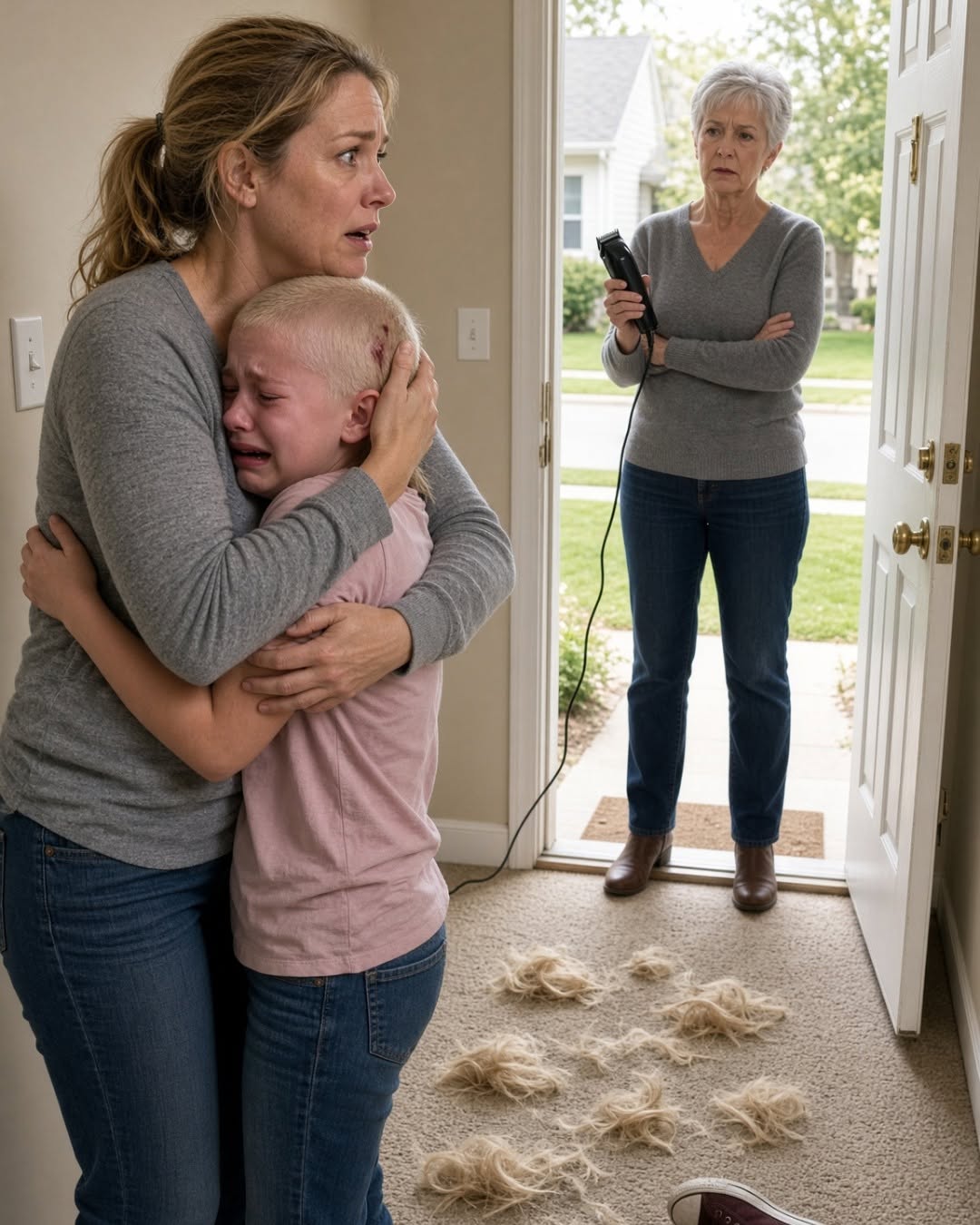
“This child was in your care. You used electric clippers on her head without her parent’s consent, caused visible irritation near her ear, and prevented her mother from leaving with her. Do you understand why the court is concerned?”
Judith’s expression hardened.
“Her mother is emotional. She has always overreacted.”
The judge’s eyes moved back to me.
“Mrs. Hart, did you give Mrs. Vance permission to cut Meadow’s hair?”
“No.”
“Did you know she intended to do it?”
“No.”
“Did you attempt to leave with your daughter?”
“Yes.”
“What happened?”
I looked at Meadow. Her pink hat covered most of her face, but I could see her fingers wrapped around the purple elephant in her lap.
“Judith stood in front of the door. She told me I wasn’t taking Meadow anywhere while I was acting upset.”
“Did she touch you?”
“No. She blocked the doorway and held the clippers.”
The judge nodded slowly. She did not need me to exaggerate what had happened. The facts were already severe enough.
Then she turned to Dustin.
“Why did you sit beside your mother today?”
His face changed.
Until that moment, he had tried to look like a man caught in an unfortunate family disagreement. The judge’s question removed the comfortable version of the story.
“She’s my mother,” he said.
“That explains your relationship. It does not explain your choice.”
He glanced at Judith.
She leaned toward him and whispered something I couldn’t hear.
The judge saw it.
“Mrs. Vance, you will not coach the witness while he is answering the court.”
Judith sat back.
Meadow’s shoulders rose beneath her sweater. I placed my hand over hers beneath the table. She squeezed once, then tucked the purple elephant closer.
Judge Morris returned to the file.
“I have the pediatrician’s photographs, the medical notes, the mandatory report, the text message authorizing unspecified discipline, and a statement from the child describing what happened. I also have evidence that your mother attempted to prevent the child from leaving with her mother.”
She looked at Dustin.
“What part of this do you believe is a misunderstanding?”
Dustin’s lawyer stood.
“Your Honor, my client believed his mother was disciplining Meadow within the family’s traditional boundaries. He did not anticipate the haircut or intend harm.”
“Intent matters,” the judge said. “So does responsibility.”
The attorney tried to continue, but Judge Morris raised one hand.
“I am not deciding the final custody arrangement today. I am deciding whether the current arrangement is safe while the court investigates.”
She turned a page.
“And based on what I have seen, unsupervised contact between Meadow and Mrs. Vance cannot continue.”
Judith shot to her feet.
“You can’t keep me from my granddaughter because her mother is fragile!”
“Sit down,” the judge said.
Judith sat.
“Temporary orders will be entered immediately. Meadow will remain with her mother. Mr. Hart’s parenting time will be supervised at an approved location until the court receives the family assessment. Mrs. Vance will have no direct contact with Meadow unless authorized by a later order.”
Dustin stared at the judge.
“Your Honor, I’m her father.”
“Then act like one.”
The words landed harder than any speech I could have made.
The judge continued.
“Mr. Hart, you will not remove Meadow from the state, change her school, or make decisions about her medical care without notice to the court. You will communicate through the approved parenting application. Mrs. Vance will not enter the child’s school, medical office, or temporary residence.”
Judith began shaking her head.
“This is outrageous.”
“One more interruption,” the judge said, “and I will have the bailiff clear the room.”
Judith closed her mouth.
The judge turned toward Meadow.
Her voice softened.
“Meadow, you don’t have to speak today. You may leave with your mother when court is finished.”
Meadow didn’t look up.
But her hand stopped trembling.
***
The first week after the hearing was harder than I expected.
I had believed that once the order was signed, my body would understand that we were safe. It didn’t.
Every time a car slowed near the apartment, I looked through the blinds. Every unknown number made my heart race. I checked the locks twice before bed and kept Meadow’s school bag beside the door in case we had to leave quickly.
Francine reminded me that fear did not disappear because a judge had used the right words.
“You are still waiting for the next thing,” she said.
“What if there is a next thing?”
“Then you will handle that with the people who are helping you. You don’t have to predict every danger to protect her.”
Meadow saw a trauma counselor named Dr. Priya Shah twice a week. The first time, she refused to remove her pink hat.
Dr. Shah didn’t ask her to.
She sat on the floor near the art table and let Meadow choose the crayons. Meadow drew a house with a red door. Then she drew another house with no door at all.
Dr. Shah asked what the pictures meant.
Meadow pressed the purple crayon too hard until the tip snapped.
“That one keeps people in,” she whispered.
Dr. Shah didn’t look at me. She kept her attention on Meadow.
“And what does the other house do?”
Meadow chose a blue crayon.
“It lets people leave.”
That was the longest sentence she had spoken since Tuesday.
I held my breath until she finished.
At home, I didn’t ask her to repeat it.
I learned to stop treating every word as evidence of recovery. Meadow was a child, not a witness I needed to prepare. Some days she talked about cartoons. Some days she only nodded. Some days she wanted me to sit outside the bathroom while she washed her hair, even though she wore the pink hat until the water touched her shoulders.