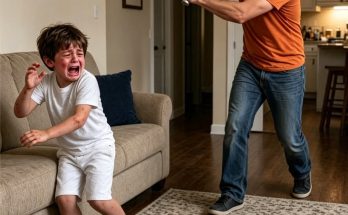
I turned around. My mother seemed to realize what she had said a fraction too late.
Dad closed his eyes.
My daughter tightened both hands around my shirt. I did not ask her who had told her to keep quiet.
Not there.
Not with the person she was suddenly hiding from standing ten feet away. I put the backpack over my shoulder.
“We’re leaving.”
Mom stepped forward.
“You’re twisting my words.”
Dad moved between us again.
“No.”
She stared at him.
“No what?”
“No following them. No explaining this away in the driveway. Let them go.”
For the first time, I wondered how many times Dad had watched something happen and convinced himself it wasn’t serious enough to challenge.
Then he looked at my daughter.
“I’m sorry, sweetheart.”
She did something that hurt more than if she’d cried.
She answered automatically.
“It’s okay.”
Dad’s face folded.
“No,” he said softly. “It isn’t.”
In the car, I didn’t start questioning her.
I turned on the heat because her sleeves were still wet and placed her backpack beside her.
Halfway home, she reached for it.
“Can I check?”
“Check what?”
She unzipped the front pocket.
Inside were a granola bar, a small juice box, two crayons, and a folded pair of socks.
Nothing dramatic.
Nothing a six-year-old should have needed to explain.
“Why are those in there?”
She stared down at the bag.
“In case.”
“In case of what?”
Her fingers closed around the socks.
Then she whispered:
“In case Grandpa can’t make Grandma stop.”
I kept both hands on the steering wheel.
That was harder than it sounds.
Every part of me wanted to pull over and ask twenty questions at once.
Stop what?
How often?
What had Grandma done?
What had Grandpa seen?
Why had nobody called me?
Why had my six-year-old apparently begun preparing for visits to my parents’ house like she needed emergency supplies?
But she was staring at the contents of her backpack as though she had already said too much.
So I didn’t interrogate her.
“Okay,” I said.
She looked at me.
“Okay?”
“Yes.”
“Are you mad?”
“No.”
“At Grandma?”
I took a second before answering.
“I’m upset about what I saw today.”
That was true.
It was also all she needed from me.
“You aren’t in trouble.”
Her fingers loosened around the socks.
I drove the rest of the way home without asking another question.
When we got there, she carried the backpack inside herself.
Normally she dropped it beside the entryway.
That afternoon she kept it on.
She followed me into the kitchen wearing both straps.
I noticed.
I did not tell her to take it off.
“Want something warm?”
She nodded.
I made what she liked and put it on the table.
She climbed into her chair.
Then she looked at the bowl.
“Do I have to finish all of it?”
“No.”
She stared at me.
“Really?”
“Really.”
She ate quietly.
Halfway through, she spilled a little.
Her entire body stiffened.
“Sorry.”
I grabbed a towel.
“It’s okay.”
“I can clean it.”
“We can clean it.”
“No, I can.”
The urgency in her voice stopped me.
She slid from the chair and grabbed the towel with both hands.
“I’ll do it right.”
I crouched.
“You don’t have to prove anything.”
She looked confused.
That hurt.
At six years old, she understood being corrected.
She understood being told to do something again.
She understood apologizing.
But the idea that a mistake did not require repayment seemed unfamiliar.
I helped her wipe the spill.
Then we threw the towel in the laundry.
That was it.
No lesson.
No speech.
No punishment.
When we returned to the table, she touched the edge of her bowl.
“Am I still good?”
The question landed harder than my mother’s insult had.
I pulled out the chair beside her.
“You don’t become bad because you spill something.”
She looked down.
“Grandma says good girls don’t make extra work.”
There it was.
Not a dramatic revelation.
A sentence.
One that sounded ordinary enough to pass unnoticed if you weren’t listening for what it taught a child about herself.
“What happens when you make extra work?”
She shrugged.
I waited.
She took another bite.
Then she asked whether she could watch her favorite show.
I let the question change.
That evening, I called Dad.
Not Mom.
He answered on the second ring.
“Is she okay?”
“She is home.”
A pause.
“Good.”
“What did you mean?”
He knew exactly what I was asking.
“I should’ve said something sooner.”
“Yes.”
No argument.
No excuse.
That frightened me more than defensiveness would have.
“What have you seen?”
Dad breathed into the phone.
“Nothing like what you’re imagining.”
“I haven’t told you what I’m imagining.”
He went quiet.
I had heard almost that exact kind of sentence before.
People defended themselves against accusations you had not made when they were afraid of where the facts might lead.
I forced myself to slow down.
“What did you actually see?”
Dad began carefully.
He had noticed my daughter becoming anxious before visits.
Sometimes she asked whether he would be home.
Sometimes she carried her backpack from room to room instead of leaving it by the door.
Once, he found her sitting near the hallway with her shoes already on long before I was due to pick her up.
“Why?”
“She said she wanted to be ready.”
“For me?”
“Yes.”
“Did you ask why?”
“I did.”
“And?”
“She said Grandma gets mad when things take too long.”
I closed my eyes.
“What things?”
“Little things. Cleaning up toys. Putting shoes away. Finishing food.”
“Dishes?”
Dad was quiet.
“Dad.”
“Yes.”
“How often?”
“I don’t know.”
That answer mattered.
He did not know.
Neither did I.
I could not turn uncertainty into certainty simply because I was furious.
“What did you personally see?”
He described corrections.
Harsh words.
Mom insisting my daughter repeat simple tasks until they were done the way she wanted.
A toy bin emptied because it had not been organized correctly.
A cup made to be carried back to the kitchen because it had been left in the living room.
Things that could sound like ordinary household rules when listed without tone, context, repetition, or the age of the child involved.
Then he said something that made the pattern clearer.
“She apologizes before your mother even says anything now.”
I looked toward the living room.
My daughter sat on the couch.
The backpack was beside her.
Not across the room.
Beside her.
“Why didn’t you call me?”
Dad didn’t answer immediately.
“I kept thinking your mother would ease up.”
“That isn’t what I asked.”
“I know.”
“Why didn’t you tell me?”
His voice dropped.
“Because I knew what would happen.”
“What?”
“You’d stop bringing her over.”
I went completely still.
There it was.
Not cruelty.
Not conspiracy.
Cowardice.
Dad had noticed enough to worry.
But he also knew that telling me might cost him access to his granddaughter.
So he waited for Mom to change instead.
My daughter paid the price for his waiting.
“Dad.”
“I know.”
“No. I don’t think you do.”
He didn’t fight me.
“I wanted to keep seeing her.”
“And she wanted you there because she thought you could make Mom stop.”
Silence.
I heard his breath catch.
I hated saying it.
He needed to hear it.
So did I.
We had both interpreted his presence as comfort.
My daughter had apparently interpreted it as protection.
Those were different things.
“I failed her,” he said.
I didn’t reassure him.
Not because I wanted to punish him.
Because automatic reassurance was part of how my family survived uncomfortable truths.
Someone caused harm.
Someone else named it.
Then everybody rushed to make the adult feel better.
My daughter was done paying for that pattern.
“What happens now?” Dad asked.
“For now, she isn’t going back there.”
He exhaled.
“I understand.”
“No unsupervised visits.”
“I understand.”
“Mom doesn’t call her directly.”
Another pause.
“Okay.”
“And don’t ask her to explain this to you.”
“I wouldn’t.”
“You already let her carry it.”
That hurt him.
I could tell.
Still true.
After we hung up, I sat on the couch beside my daughter.
She leaned against me.
For several minutes we watched television.
Then she unzipped her backpack.
“Want to see?”
“Sure.”
She took everything out.
Granola bar.
Juice box.
Socks.
Two crayons.
Then from the larger section she removed a small paperback book and a toy rabbit missing one plastic eye.
“Why the rabbit?”
She shrugged.
“He sleeps with me.”
“You sleep at Grandma’s?”
“Sometimes when you work late.”
I knew that.
Of course I knew that.
I had arranged it.
I had thanked my parents for helping.
I had driven away relieved that my daughter was with family instead of a sitter.
Trust had filled the spaces where questions should have been.
“Why the socks?”
“In case mine get wet.”
“Did that happen?”
“One time.”
“How?”
She started to answer.
Then stopped.
I saw her face change.
So I let it go.
“You don’t have to tell me right now.”
She looked surprised.
“Never?”
“Right now.”
That distinction mattered.
I wasn’t promising we would never talk about what happened.
I was telling her she did not have to produce every answer on demand.
She picked up the rabbit.
“Grandpa says I can wait in his room if Grandma gets mad.”
I kept my expression steady.
“Does that happen a lot?”
She shrugged.
There was no reliable number inside that shrug.
I did not manufacture one.
Instead I asked:
“Do you feel safe going there?”
Her answer came instantly.
“If Grandpa’s home.”
That was enough.
Not proof of every fear I had.
Not a complete history.
Enough to tell me what boundary came next.
“You’re not going there without me.”
Her eyes widened.
“Grandma will be mad.”
“That is for me to handle.”
“Really?”
“Yes.”
“She’ll say I told.”
“You are allowed to tell me things.”
My daughter studied my face.
Then she leaned against my arm.
“Even bad things?”
“Especially things that make you scared.”
She thought about that.
“What if they’re about Grandma?”
“Yes.”
“What if Grandpa says not to make trouble?”
That question surprised me.
“Did Grandpa say that?”
She hesitated.
I stopped.
“You don’t have to answer now.”
She relaxed.
I was learning.
Slowly.
The next morning, Mom called.
I let it ring.
She called again.
Then a text appeared.
You’re blowing this completely out of proportion.
Another.
Children need structure.
Then:
Your father is making this worse because he’s afraid of you.
I did not respond immediately.
A few hours later, Dad called.
“She’s furious.”
“I assumed.”
“She says you’re cutting us off.”
“I said no unsupervised visits.”
“I told her.”
“How did that go?”
A humorless laugh.
“You know your mother.”
Yes.
I did.
That was becoming the problem.
I knew her so well that I had normalized things I would have recognized immediately in someone else.
I remembered standing on a chair in that same kitchen.
Different dishes.
Different decade.
Same voice.
Do it again.
Stop crying.
You always make everything harder.
Why can’t you do one thing right?
As an adult, I had renamed those memories.
Strict parenting.
Different generation.
She did her best.
Every family has issues.
Then I walked into the kitchen and heard:
“You useless little girl—you can’t do anything right!”
The words had survived intact.
They had simply found a smaller target.
That afternoon, my daughter asked if she could help me make dinner.
My first instinct was to say no.
Not because she couldn’t help.
Because I suddenly feared turning any chore into something connected to my mother.
Then I realized avoiding every responsibility would teach the wrong lesson too.
Helping wasn’t the problem.
Humiliation was.
“Want to wash the tomatoes?”
She nodded.
I brought a small stool.
A stable one.
I placed a bowl in the sink.
No oversized plates.
No hard-running faucet.
She washed one tomato.
Then another.
One slipped from her hand.
It rolled into the basin.
She froze.
I picked it up.
“Slippery.”
She looked at me.
“That’s all?”
“That’s all.”
She smiled.
Not the nervous one.
I knew the difference now.
We finished dinner together.
She lost interest halfway through and went to color.
I let her.
Responsibility at six could be taught without making love conditional on performance.
That shouldn’t have felt revolutionary.
In my family, apparently it was.
Three days later, Dad came over alone.
My daughter hid behind me when she first saw him.
Dad noticed.
He stopped several feet inside the doorway.
“Hi, sweetheart.”
She peeked around my side.
“Hi.”
“I brought your book.”
He held up something she had left at their house.
He did not approach.
He waited.
My daughter looked at me.
I nodded.
She walked over and took it.
“Thank you.”
Dad’s eyes filled.
He did not ask for a hug.
That mattered.
He sat in the living room while she played.
For nearly twenty minutes, he said almost nothing.
Then my daughter brought him a toy cup.
“Tea.”
Dad accepted it solemnly.
“Thank you.”
She brought another.
Then another.
Soon he had five plastic cups lined beside him.
She laughed.
Dad laughed too.
For a moment, they were simply grandfather and granddaughter.
Then she knocked one over.
Her face changed.
Dad saw it.
I saw him see it.
“Sorry,” she said quickly.
Dad picked up the empty plastic cup.
“No harm done.”
She stared at him.
Then continued playing.
Dad looked at me.
He didn’t need to say anything.
Later, after she went to her room, he whispered:
“I didn’t realize how often she does that.”
“Neither did I.”
That was important to admit.
It would have been easy to turn Dad into the only adult who failed to notice.
I had missed things too.
The difference was what we did after noticing.
Dad rubbed his face.
“Your mother wants me to bring her over.”
“No.”
“I already told her no.”
I looked at him.
He nodded.
“She said I was choosing sides.”
There it was again.
Families like mine loved that language.
Side.
Loyalty.
Betrayal.
As if protecting a six-year-old from being demeaned were an attack on an adult.
“What did you say?”
Dad looked toward the hallway.
“I said there shouldn’t be sides when one person is six.”
For the first time since the kitchen, some of the anger I felt toward him loosened.
Not disappeared.
Loosened.
Trust did not repair itself because of one sentence.
Neither did courage.
But he had finally done something while I wasn’t there to force him.
That mattered.
Weeks passed.
My daughter stopped keeping the backpack beside her at home.
First it moved from the couch to the floor.
Then to the hallway.
One Saturday, she forgot it in the car entirely.
I noticed before she did.
I nearly cried.
Not because a forgotten backpack was meaningful by itself.
Because for weeks she had treated that bag like an emergency kit.
Food.
Drink.
Socks.
Comfort toy.
Things she could control when adults felt unpredictable.
Now she had forgotten it because she expected to come back for it.
That was what safety looked like in her language.
Not a speech.
Not a promise.
A backpack left in the car.
Mom continued trying to contact me.
Her messages changed.
First angry.
Then injured.
Then nostalgic.
She sent old photographs.
She reminded me of vacations.
Birthdays.
Everything she had done for me.
None of that answered the question.
Could she be around my daughter without calling her names, frightening her, or turning ordinary mistakes into judgments about who she was?
Until that answer changed, the boundary didn’t.
Dad understood.
Maybe for the first time in his marriage, he stopped asking me to make Mom’s feelings easier.
One afternoon he called.
“She’s asking what she has to do.”
I waited.
“Does she know?”
“I told her to start with what happened in the kitchen.”
“And?”
“She says she shouldn’t have used the word useless.”
I looked across the room.
My daughter was drawing.
“That’s a start.”
“She wants to apologize.”
“To me?”
“To her.”
I thought carefully.
An apology could be useful.
It could also become another situation where a six-year-old was expected to comfort an adult.
“Not yet.”
Dad accepted it.
No argument.
A month later, my daughter helped me unload the dishwasher.
She carried two plastic cups to the cabinet.
Then she reached for a plate.
“Two hands,” I said.
She used two hands.
The plate made it safely to the counter.
She grinned.
“I did it.”
“You did.”
Then she looked at me.
“Was it right?”
I knew what she meant.
Not whether the plate was in the right place.
Whether she was.
I crouched.
“You can do something wrong and still be okay.”
She frowned.
Children prefer concrete answers.
I tried again.
“If you drop the plate, what happens?”
“It breaks.”
“And then?”
“We clean it?”
“Yes.”
“And I’m not bad?”
“No.”
She thought.
“What if it’s your favorite?”
“I might be sad about the plate.”
“But not hate me?”
My chest tightened.
“No.”
She nodded.
Then she picked up another.
Two hands.
Slow steps.
Onto the counter.
Nothing dramatic happened.
That was the point.
Months later, I drove past my parents’ street with my daughter in the back seat.
She recognized the turn.
“Are we going to Grandma’s?”
“No.”
“Okay.”
No panic.
No questions.
Just okay.
A minute later, she asked if we could get pancakes.
That was when I realized how much had changed.
The old version of me would have measured healing by whether the family reconciled.
Whether Mom apologized.
Whether Dad forgave himself.
Whether holidays eventually looked normal again.
My daughter had given me a different measurement.
Could she make a mistake without believing she was worthless?
Could she say she wanted to go home?
Could she leave her emergency backpack behind?
Could she help with dishes because helping felt ordinary rather than frightening?
Could she hear an adult’s disappointment without believing love had been withdrawn?
Those were the questions that mattered.
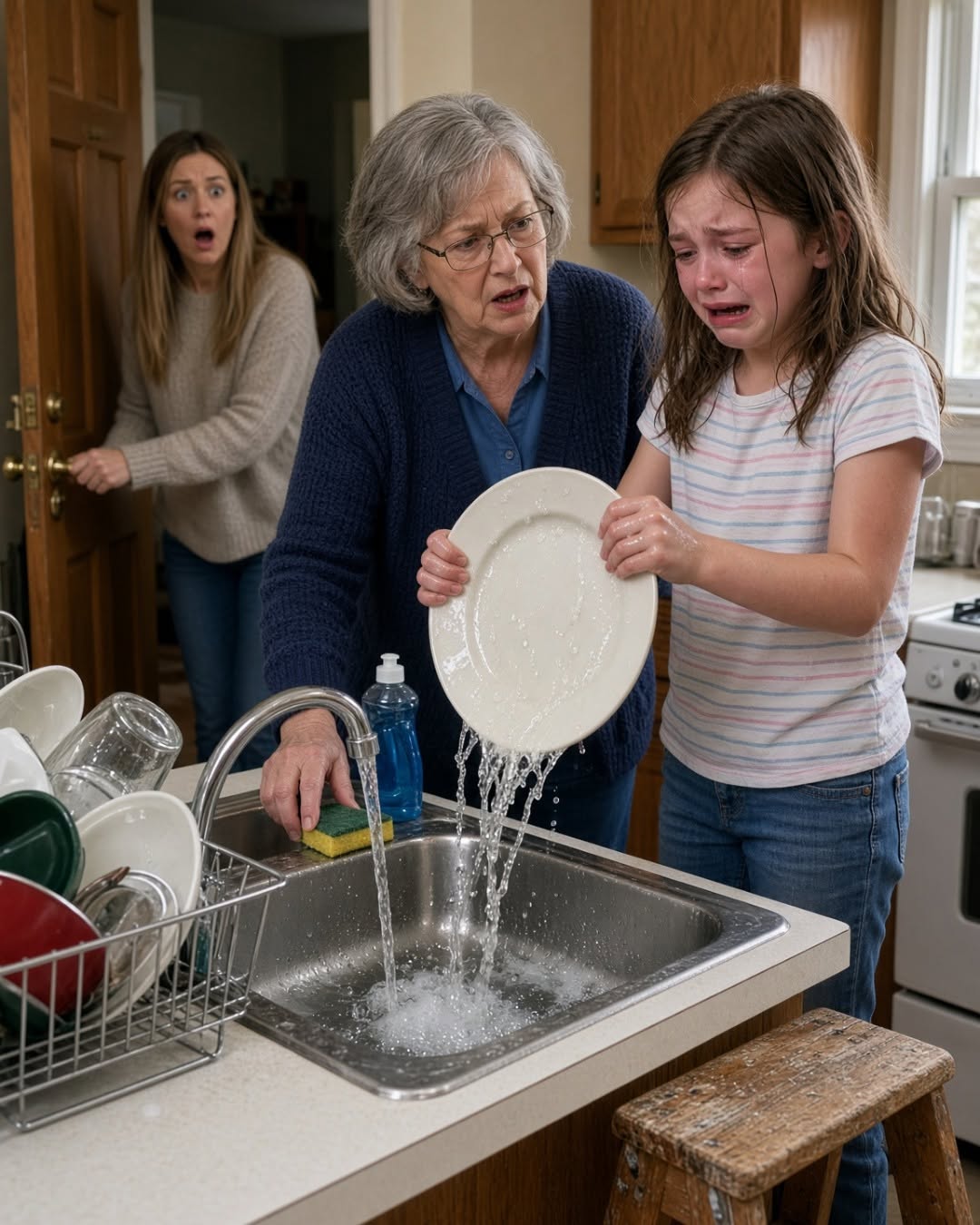
I still remember the kitchen exactly as it looked that afternoon.
The wooden crate.
The oversized plates.
The faucet running.
Pink little hands.
Wet sweatshirt sleeves.
My mother saying she was teaching responsibility.
And my daughter whispering:
“I wasn’t finished.”
She thought stopping required permission.
Now, sometimes, she decides she’s finished with something and simply says so.
“I’m done coloring.”
“I’m done eating.”
“I’m tired of this game.”
Ordinary sentences.
I love every one.
Because children need responsibilities.
They need boundaries.
They need to learn that their actions have consequences.
But they should never have to earn the right to be treated like human beings.
One evening, she helped me rinse two dinner plates.
When the second was clean, she turned off the faucet herself.
“I’m finished.”
I looked at her.
She waited.
Not fearfully.
Just waiting.
I smiled.
“Okay.”
She hopped down from the stool and ran toward the living room.
Halfway there, she turned around.
“Love you!”
“Love you too.”
Then she disappeared around the corner, leaving one tiny wet handprint on the cabinet.
I didn’t wipe it away until morning.