0 views
We followed her pace.
The doctor prescribed ointment for the irritated skin near her ear and gave us instructions for monitoring it. The cuts healed within days. The fear lasted longer.
The hair began to grow back unevenly.
Meadow hated looking in the mirror. When relatives sent messages saying hair grew back, I deleted them before she saw them.
The words had been true and useless at the same time.
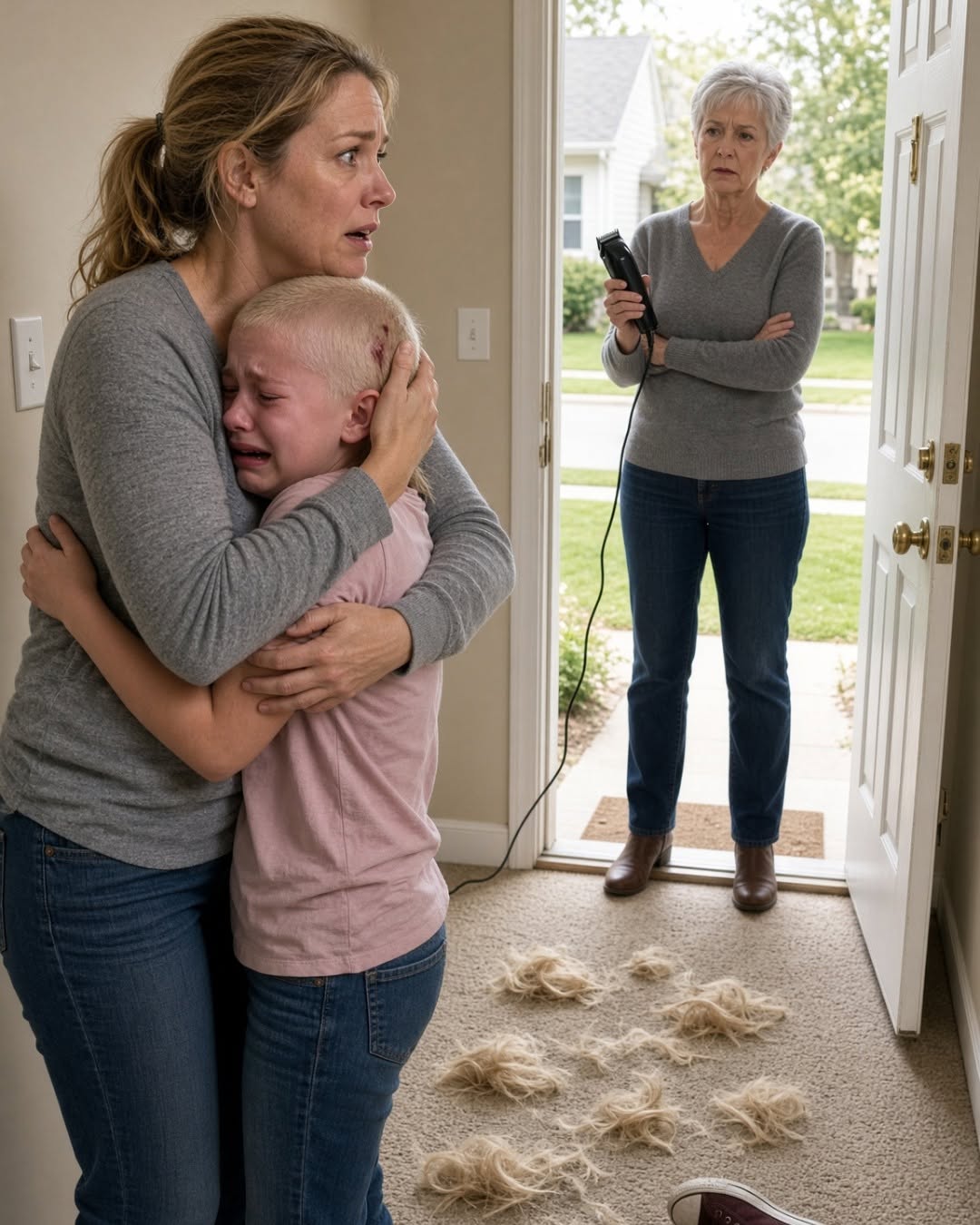
Hair growing back did not return the moment Judith had taken. It did not make Meadow feel safe in the chair. It did not undo the sound of clippers beside her ear or the belief that an adult who loved her could decide what happened to her body while her father approved from a phone.
***
Dustin’s first supervised visit happened at a family services center on a rainy Saturday.
He arrived twelve minutes early carrying a stuffed rabbit, a coloring book, and a bag of Meadow’s favorite chocolate cookies.
I arrived with Meadow ten minutes late because she had stopped in the parking lot and said she couldn’t make her feet move.
The supervisor, Ms. Alvarez, met us at the entrance.
“We can take as much time as she needs,” she said.
Dustin stood in the visitation room when we entered. His face softened when he saw Meadow.
“There’s my girl.”
Meadow moved behind my leg.
His smile fell.
“I brought you something.”
He held up the rabbit.
Meadow stared at it, then at him.
“Did you know?” she asked.
Dustin looked at me.
“Know what?”
“About the clippers.”
His shoulders dropped.
“No, sweetheart. I didn’t know she was going to cut your hair.”
“You said she knows best.”
He glanced at Ms. Alvarez.
“I was wrong.”
Meadow’s fingers tightened around my coat.
“You said it after.”
The room went quiet.
Dustin had probably expected the story to remain between adults. He had not expected Meadow to remember the exact sentence he had given Judith as permission.
“I was scared,” he said. “I didn’t know what to do.”
Meadow looked at him.
“You could have said stop.”
He lowered his head.
“Yes. I could have.”
It was the first correct answer he had given in months.
But it wasn’t enough to make her walk toward him.
She stayed beside me for the entire hour. Dustin colored a page from the book and slid it across the table. Meadow didn’t touch it until we were leaving.
In the car, she placed the drawing on her lap.
It showed a rabbit standing beside a little girl. Between them was a thick black line.
“Do you want to keep it?” I asked.
She nodded.
“Why?”
“Because Daddy said sorry.”
I didn’t tell her that an apology was only the beginning. I let her decide what it meant.
***
The family investigator interviewed everyone.
She spoke with me, Dustin, Judith, Meadow’s teacher, the pediatrician, Dr. Shah, and the supervisor from the visitation center. She requested phone records and reviewed the messages between Dustin and Judith.
One message changed the direction of the case.
It had been sent by Judith the night before the haircut.
Tomorrow I’m finally dealing with the mirror obsession. Don’t interfere when I call you.
Dustin had replied:
Do whatever you think is best. She needs to learn.
The wording was not an accident. Judith had told him what she intended to do. He had not asked for details. He had not told her to use reasonable discipline. He had not said to stop if Meadow became afraid.
He had surrendered his responsibility to his mother and then defended her after seeing the result.
The investigator also found the call records from that afternoon. Judith had called Dustin twice during the haircut. Each call lasted more than a minute.
The second call came after Meadow began crying.
Dustin answered it.
He had not been unaware of the situation.
His phone contained no recording, but Judith’s later text did.
She had written:
She finally stopped fighting once I reminded her that you agreed.
Dustin answered:
Good. She’ll remember next time.
When Francine showed me the message, I had to sit down.
It was one thing to hear Meadow repeat Daddy said Grandma knows best.
It was another to see that Dustin had celebrated her surrender.
That evening, he called me through the court-approved application.
“I know what the messages look like,” he said.
“They look like you knew.”
“I knew she was going to discipline her. I didn’t know she would shave her head.”
“You knew Meadow was crying.”
He went silent.
“Dustin, did you tell your mother to stop?”
“No.”
“Why not?”
“I thought it would be over.”
That answer stayed with me.
He hadn’t believed the act was acceptable. He had believed it would be easier to let it continue than to challenge his mother.
Meadow had paid for his convenience.
***
The custody hearing resumed three months later.
By then, Meadow had started second grade at a new school. Her hair had grown into a short, uneven crop that Dr. Shah helped her name “the brave haircut” when Meadow chose the words herself.
She stopped wearing the pink hat indoors but still kept it in her backpack.
The judge reviewed the investigator’s report in silence.
Dustin’s attorney argued that the incident had been isolated and that my decision to leave had damaged the marriage.
My attorney placed the messages on the screen.
Judith’s attorney insisted that no one had intended serious harm.
Judge Morris looked over her glasses.
“The court is not required to wait for catastrophic injury before recognizing a danger.”
The room became still.
She read the text about Meadow stopping her resistance after being reminded of Dustin’s approval. Then she read the doctor’s description of Meadow’s trauma response and the child’s repeated fear of being unable to leave.
“This was not a haircut,” the judge said. “It was an unauthorized act of control against a child, followed by an adult’s attempt to prevent the child’s parent from removing her from the situation.”
Judith looked down.
“Mrs. Vance will have no custody or visitation rights. She will not communicate with Meadow directly or indirectly. Any future request for contact must be made through counsel and supported by evidence that contact would serve the child’s interests.”
Judith began to cry.
I felt no satisfaction when I saw it.
The judge turned to Dustin.
“Mr. Hart, you will receive supervised parenting time for six months, followed by a review. You must complete a parenting course, individual counseling, and a course addressing family boundaries and coercive discipline. You will not leave Meadow in your mother’s care.”
Dustin nodded.
“Do you understand?”
“Yes.”
“More than that,” the judge said. “Do you accept responsibility?”
His eyes moved to Meadow’s empty chair beside me.
“Yes.”
It was the first time he had said it without adding a defense.
The judge signed the order.
My marriage ended legally six months later.
The divorce settlement was complicated. Dustin wanted the house. I wanted stability for Meadow. Judith tried to pressure him into fighting over every expense, but the messages in the file made it difficult for her to present herself as a neutral grandmother.