0 views
My daughter sat on the couch.
The backpack was beside her.
Not across the room.
Beside her.
“Why didn’t you call me?”
Dad didn’t answer immediately.
“I kept thinking your mother would ease up.”
“That isn’t what I asked.”
“I know.”
“Why didn’t you tell me?”
His voice dropped.
“Because I knew what would happen.”
“What?”
“You’d stop bringing her over.”
I went completely still.
There it was.
Not cruelty.
Not conspiracy.
Cowardice.
Dad had noticed enough to worry.
But he also knew that telling me might cost him access to his granddaughter.
So he waited for Mom to change instead.
My daughter paid the price for his waiting.
“Dad.”
“I know.”
“No. I don’t think you do.”
He didn’t fight me.
“I wanted to keep seeing her.”
“And she wanted you there because she thought you could make Mom stop.”
Silence.
I heard his breath catch.
I hated saying it.
He needed to hear it.
So did I.
We had both interpreted his presence as comfort.
My daughter had apparently interpreted it as protection.
Those were different things.
“I failed her,” he said.
I didn’t reassure him.
Not because I wanted to punish him.
Because automatic reassurance was part of how my family survived uncomfortable truths.
Someone caused harm.
Someone else named it.
Then everybody rushed to make the adult feel better.
My daughter was done paying for that pattern.
“What happens now?” Dad asked.
“For now, she isn’t going back there.”
He exhaled.
“I understand.”
“No unsupervised visits.”
“I understand.”
“Mom doesn’t call her directly.”
Another pause.
“Okay.”
“And don’t ask her to explain this to you.”
“I wouldn’t.”
“You already let her carry it.”
That hurt him.
I could tell.
Still true.
After we hung up, I sat on the couch beside my daughter.
She leaned against me.
For several minutes we watched television.
Then she unzipped her backpack.
“Want to see?”
“Sure.”
She took everything out.
Granola bar.
Juice box.
Socks.
Two crayons.
Then from the larger section she removed a small paperback book and a toy rabbit missing one plastic eye.
“Why the rabbit?”
She shrugged.
“He sleeps with me.”
“You sleep at Grandma’s?”
“Sometimes when you work late.”
I knew that.
Of course I knew that.
I had arranged it.
I had thanked my parents for helping.
I had driven away relieved that my daughter was with family instead of a sitter.
Trust had filled the spaces where questions should have been.
“Why the socks?”
“In case mine get wet.”
“Did that happen?”
“One time.”
“How?”
She started to answer.
Then stopped.
I saw her face change.
So I let it go.
“You don’t have to tell me right now.”
She looked surprised.
“Never?”
“Right now.”
That distinction mattered.
I wasn’t promising we would never talk about what happened.
I was telling her she did not have to produce every answer on demand.
She picked up the rabbit.
“Grandpa says I can wait in his room if Grandma gets mad.”
I kept my expression steady.
“Does that happen a lot?”
She shrugged.
There was no reliable number inside that shrug.
I did not manufacture one.
Instead I asked:
“Do you feel safe going there?”
Her answer came instantly.
“If Grandpa’s home.”
That was enough.
Not proof of every fear I had.
Not a complete history.
Enough to tell me what boundary came next.
“You’re not going there without me.”
Her eyes widened.
“Grandma will be mad.”
“That is for me to handle.”
“Really?”
“Yes.”
“She’ll say I told.”
“You are allowed to tell me things.”
My daughter studied my face.
Then she leaned against my arm.
“Even bad things?”
“Especially things that make you scared.”
She thought about that.
“What if they’re about Grandma?”
“Yes.”
“What if Grandpa says not to make trouble?”
That question surprised me.
“Did Grandpa say that?”
She hesitated.
I stopped.
“You don’t have to answer now.”
She relaxed.
I was learning.
Slowly.
The next morning, Mom called.
I let it ring.
She called again.
Then a text appeared.
You’re blowing this completely out of proportion.
Another.
Children need structure.
Then:
Your father is making this worse because he’s afraid of you.
I did not respond immediately.
A few hours later, Dad called.
“She’s furious.”
“I assumed.”
“She says you’re cutting us off.”
“I said no unsupervised visits.”
“I told her.”
“How did that go?”
A humorless laugh.
“You know your mother.”
Yes.
I did.
That was becoming the problem.
I knew her so well that I had normalized things I would have recognized immediately in someone else.
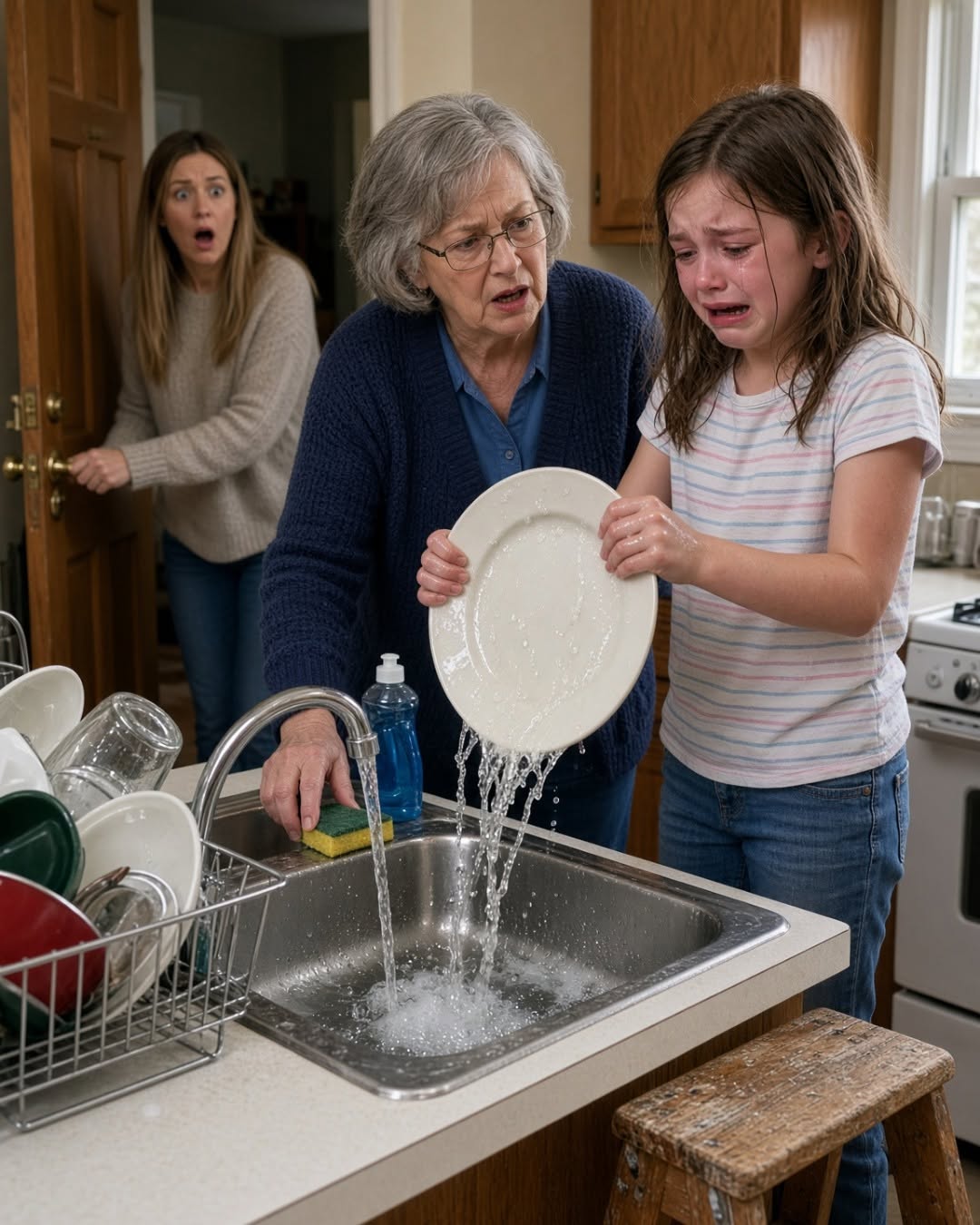
I remembered standing on a chair in that same kitchen.
Different dishes.
Different decade.
Same voice.
Do it again.
Stop crying.
You always make everything harder.
Why can’t you do one thing right?
As an adult, I had renamed those memories.
Strict parenting.
Different generation.
She did her best.
Every family has issues.
Then I walked into the kitchen and heard:
“You useless little girl—you can’t do anything right!”
The words had survived intact.
They had simply found a smaller target.
That afternoon, my daughter asked if she could help me make dinner.
My first instinct was to say no.
Not because she couldn’t help.
Because I suddenly feared turning any chore into something connected to my mother.
Then I realized avoiding every responsibility would teach the wrong lesson too.
Helping wasn’t the problem.
Humiliation was.
“Want to wash the tomatoes?”
She nodded.
I brought a small stool.
A stable one.
I placed a bowl in the sink.
No oversized plates.
No hard-running faucet.
She washed one tomato.
Then another.
One slipped from her hand.
It rolled into the basin.
She froze.
I picked it up.
“Slippery.”
She looked at me.
“That’s all?”
“That’s all.”
She smiled.
Not the nervous one.
I knew the difference now.
We finished dinner together.
She lost interest halfway through and went to color.
I let her.
Responsibility at six could be taught without making love conditional on performance.
That shouldn’t have felt revolutionary.
In my family, apparently it was.
Three days later, Dad came over alone.
My daughter hid behind me when she first saw him.
Dad noticed.
He stopped several feet inside the doorway.
“Hi, sweetheart.”
She peeked around my side.
“Hi.”
“I brought your book.”
He held up something she had left at their house.
He did not approach.
He waited.
My daughter looked at me.
I nodded.
She walked over and took it.