0 views
“Thank you.”
Dad’s eyes filled.
He did not ask for a hug.
That mattered.
He sat in the living room while she played.
For nearly twenty minutes, he said almost nothing.
Then my daughter brought him a toy cup.
“Tea.”
Dad accepted it solemnly.
“Thank you.”
She brought another.
Then another.
Soon he had five plastic cups lined beside him.
She laughed.
Dad laughed too.
For a moment, they were simply grandfather and granddaughter.
Then she knocked one over.
Her face changed.
Dad saw it.
I saw him see it.
“Sorry,” she said quickly.
Dad picked up the empty plastic cup.
“No harm done.”
She stared at him.
Then continued playing.
Dad looked at me.
He didn’t need to say anything.
Later, after she went to her room, he whispered:
“I didn’t realize how often she does that.”
“Neither did I.”
That was important to admit.
It would have been easy to turn Dad into the only adult who failed to notice.
I had missed things too.
The difference was what we did after noticing.
Dad rubbed his face.
“Your mother wants me to bring her over.”
“No.”
“I already told her no.”
I looked at him.
He nodded.
“She said I was choosing sides.”
There it was again.
Families like mine loved that language.
Side.
Loyalty.
Betrayal.
As if protecting a six-year-old from being demeaned were an attack on an adult.
“What did you say?”
Dad looked toward the hallway.
“I said there shouldn’t be sides when one person is six.”
For the first time since the kitchen, some of the anger I felt toward him loosened.
Not disappeared.
Loosened.
Trust did not repair itself because of one sentence.
Neither did courage.
But he had finally done something while I wasn’t there to force him.
That mattered.
Weeks passed.
My daughter stopped keeping the backpack beside her at home.
First it moved from the couch to the floor.
Then to the hallway.
One Saturday, she forgot it in the car entirely.
I noticed before she did.
I nearly cried.
Not because a forgotten backpack was meaningful by itself.
Because for weeks she had treated that bag like an emergency kit.
Food.
Drink.
Socks.
Comfort toy.
Things she could control when adults felt unpredictable.
Now she had forgotten it because she expected to come back for it.
That was what safety looked like in her language.
Not a speech.
Not a promise.
A backpack left in the car.
Mom continued trying to contact me.
Her messages changed.
First angry.
Then injured.
Then nostalgic.
She sent old photographs.
She reminded me of vacations.
Birthdays.
Everything she had done for me.
None of that answered the question.
Could she be around my daughter without calling her names, frightening her, or turning ordinary mistakes into judgments about who she was?
Until that answer changed, the boundary didn’t.
Dad understood.
Maybe for the first time in his marriage, he stopped asking me to make Mom’s feelings easier.
One afternoon he called.
“She’s asking what she has to do.”
I waited.
“Does she know?”
“I told her to start with what happened in the kitchen.”
“And?”
“She says she shouldn’t have used the word useless.”
I looked across the room.
My daughter was drawing.
“That’s a start.”
“She wants to apologize.”
“To me?”
“To her.”
I thought carefully.
An apology could be useful.
It could also become another situation where a six-year-old was expected to comfort an adult.
“Not yet.”
Dad accepted it.
No argument.
A month later, my daughter helped me unload the dishwasher.
She carried two plastic cups to the cabinet.
Then she reached for a plate.
“Two hands,” I said.
She used two hands.
The plate made it safely to the counter.
She grinned.
“I did it.”
“You did.”
Then she looked at me.
“Was it right?”
I knew what she meant.
Not whether the plate was in the right place.
Whether she was.
I crouched.
“You can do something wrong and still be okay.”
She frowned.
Children prefer concrete answers.
I tried again.
“If you drop the plate, what happens?”
“It breaks.”
“And then?”
“We clean it?”
“Yes.”
“And I’m not bad?”
“No.”
She thought.
“What if it’s your favorite?”
“I might be sad about the plate.”
“But not hate me?”
My chest tightened.
“No.”
She nodded.
Then she picked up another.
Two hands.
Slow steps.
Onto the counter.
Nothing dramatic happened.
That was the point.
Months later, I drove past my parents’ street with my daughter in the back seat.
She recognized the turn.
“Are we going to Grandma’s?”
“No.”
“Okay.”
No panic.
No questions.
Just okay.
A minute later, she asked if we could get pancakes.
That was when I realized how much had changed.
The old version of me would have measured healing by whether the family reconciled.
Whether Mom apologized.
Whether Dad forgave himself.
Whether holidays eventually looked normal again.
My daughter had given me a different measurement.
Could she make a mistake without believing she was worthless?
Could she say she wanted to go home?
Could she leave her emergency backpack behind?
Could she help with dishes because helping felt ordinary rather than frightening?
Could she hear an adult’s disappointment without believing love had been withdrawn?
Those were the questions that mattered.
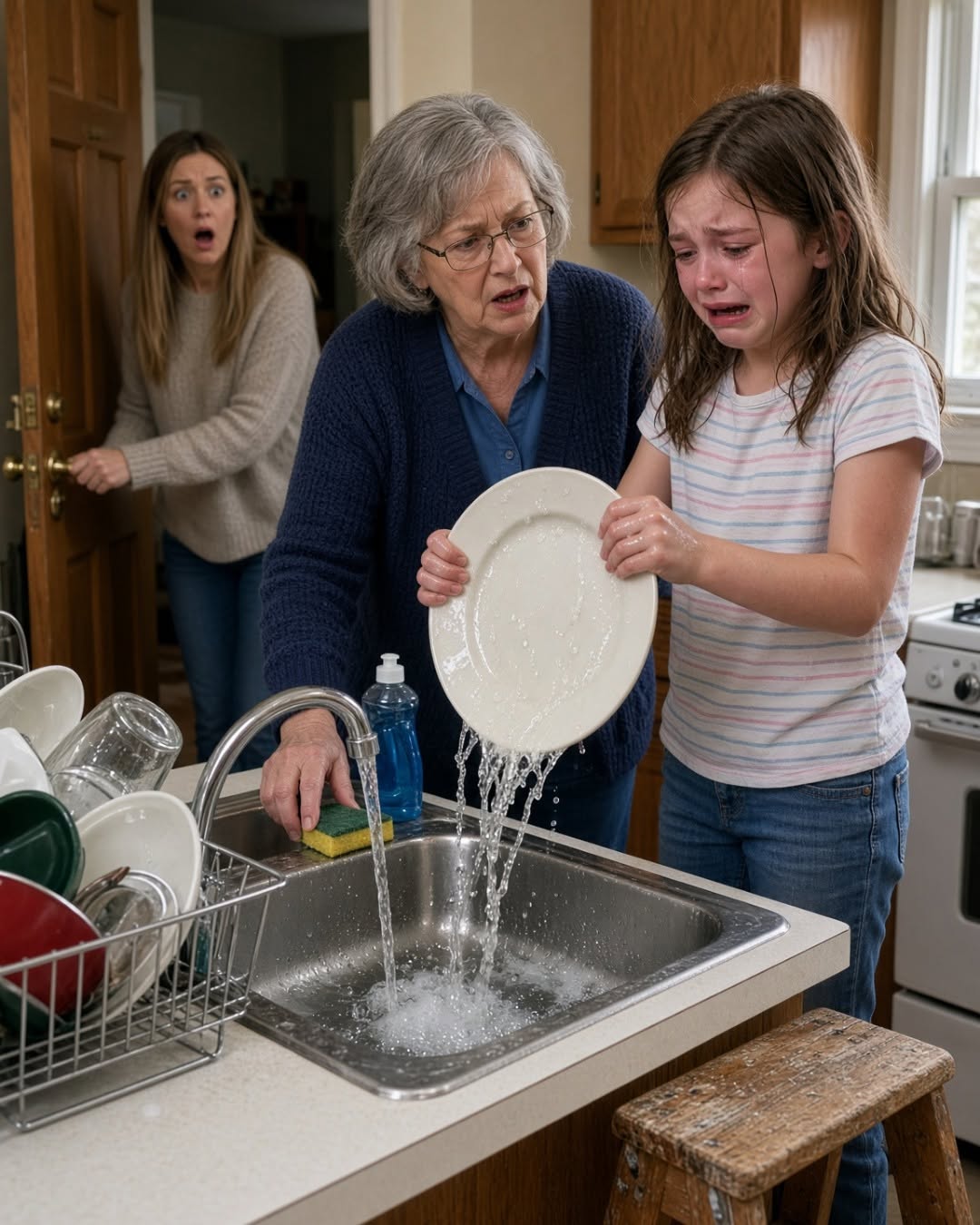
I still remember the kitchen exactly as it looked that afternoon.
The wooden crate.
The oversized plates.
The faucet running.
Pink little hands.
Wet sweatshirt sleeves.
My mother saying she was teaching responsibility.
And my daughter whispering:
“I wasn’t finished.”
She thought stopping required permission.
Now, sometimes, she decides she’s finished with something and simply says so.
“I’m done coloring.”
“I’m done eating.”
“I’m tired of this game.”
Ordinary sentences.
I love every one.
Because children need responsibilities.
They need boundaries.
They need to learn that their actions have consequences.
But they should never have to earn the right to be treated like human beings.
One evening, she helped me rinse two dinner plates.
When the second was clean, she turned off the faucet herself.
“I’m finished.”
I looked at her.
She waited.
Not fearfully.
Just waiting.
I smiled.
“Okay.”
She hopped down from the stool and ran toward the living room.
Halfway there, she turned around.
“Love you!”
“Love you too.”
Then she disappeared around the corner, leaving one tiny wet handprint on the cabinet.
I didn’t wipe it away until morning.