At 6:47 p.m. on a Thursday evening, my headset crackled. I had thirteen minutes left in my shift.
Thirteen minutes between me and the parking lot. Between another ordinary night and another drive home in a car that had been threatening to fall apart for almost a month.
I adjusted my headset, glanced at the clock above the dispatch floor, and answered.
“911, what’s your emergency?” At first, all I heard was breathing.
Fast.
Shaky.
Terrified.
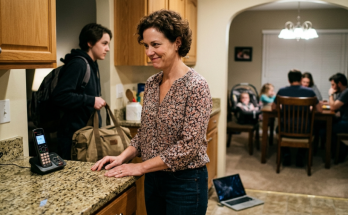
Then a little boy whispered, “My mom fell down.” I straightened in my chair. “Okay. I can help you. Tell me your address.” “I—I don’t know.” “That’s okay. Look at the front of your house. There should be a number.” “I have to go outside?” “Yes, sweetheart. Take your phone with you. Stay on the line with me.” I heard a door open.
Footsteps.
A gust of wind.
Then the boy read the numbers slowly.
I entered the address into my system.
“Good job. What’s your name?”
“Malik.”
“How old are you, Malik?”
“Nine.”
My stomach tightened.
Nine.
I had been a dispatcher for eleven years. I had heard every kind of emergency a person could imagine. I had listened to people scream during car crashes, mothers cry over sick babies, elderly people whisper because they were afraid someone was breaking into their homes.
But there was something different about a child calling 911.
Children weren’t supposed to be the ones asking for help.
They were supposed to be the ones adults protected.
“Malik,” I said gently, “where is your mom?”
“In the kitchen.”
“Is she awake?”
“No.”
“Can you tell if she’s breathing?”
There was silence.
“I don’t think so.”
I dispatched the call.
“Paramedics are coming to you right now. I need you to stay with me.”
He began crying.
“I don’t want my mom to die.”
My hand tightened around the edge of my desk.
“Listen to me, Malik. We’re going to help your mom. You’re not alone. I’m right here.”
I could hear him walking.
“I’m next to her.”
“Okay. Look at her chest. Is it moving up and down?”
“No.”
“All right. I need you to listen carefully.”
I pulled up the CPR instructions.
“Put the heel of your hand in the middle of her chest.”
“I can’t.”
“You can.”
“She’s too big.”
“I know it feels scary. But you can do this.”
“I don’t want to hurt her.”
“Malik, right now, helping her is the most important thing. Push hard and fast.”
He sniffled.
“Like this?”
“Yes.”
I heard a thump.
“Good. Again.”
Another.
“Again.”
Another.
I started counting.
“One.”
“Two.”
“Three.”
His breathing became faster.
“Four.”
“Five.”
“Six.”
He was crying now.
I kept counting.
“Seven. Eight. Nine. Ten.”
The dispatch screen showed the ambulance still moving.
Then the radio crackled.
“Unit responding.”
I looked at the clock.
6:52.
Eight minutes left in my shift.
I kept counting.
“Twenty-seven. Twenty-eight. Twenty-nine.”
Malik suddenly shouted, “She’s moving!”
I leaned forward.
“She’s breathing?”
“I don’t know. Her mouth moved.”
“Keep going until the paramedics get there.”
Then something happened that still makes me angry when I remember it.
The responding ambulance stopped moving.
I saw the vehicle icon disappear from the expected route.
I radioed the unit.
“Unit 312, status?”
A pause.
Then:
“We’re at the location, but we don’t see the house.”
My heart dropped.
I checked the address.
They were on the correct street.
But they had entered the wrong building number.
“Unit 312, verify the address.”
The paramedic repeated it.
Wrong.
Fourteen minutes.
Fourteen minutes because they had gone to the building next door.
I corrected them.
“Proceed to the house with the blue mailbox.”
“Copy.”
I turned back to Malik.
“Help is coming.”
“I’m tired.”
“I know.”
“My arms hurt.”
“I know, sweetheart.”
“I can’t do it anymore.”
“Yes, you can.”
I kept counting.
“Forty-three. Forty-four. Forty-five.”
My relief dispatcher appeared behind me.
“Carla, you’re done.”
I held up one finger.
She waited.
Dana Whitfield, my supervisor, was standing farther back on the floor.
She glanced at my screen.
Then at the clock.
Then at me.
I knew that look.
Dana believed in numbers.
Average handle time.
Call volume.
Dispatch efficiency.
Every week she posted statistics on a board where everyone’s names were listed.
My average handle time was usually good.
But I had one weakness.
I didn’t like hanging up.
Especially when someone was scared.
And especially when the person was a child.
“Sixty,” I counted.
“Sixty-one.”
“Carla,” my relief dispatcher whispered.
I shook my head.
“Sixty-two.”
The front door at Malik’s house suddenly opened.
“We’re here!” a man shouted.
Malik cried out.
“Help!”
I finally exhaled.
“Good job, Malik. Let them help your mom.”
The paramedic came onto the line.
“We’ve got her.”
“Is she breathing?”
“She’s got a pulse.”
I closed my eyes.
For the first time in fourteen minutes, I allowed myself to breathe.
Then the clock caught my attention.
7:01.
I had stayed fourteen minutes past my shift.
I took off my headset.
Dana was waiting.
“Carla,” she said.
“Yes?”
“Come see me tomorrow morning.”
I knew exactly what that meant.
—
The next morning, Dana slid a document across her desk.
FINAL WRITTEN WARNING.
I stared at it.
“Excessive call duration,” she said.
I looked up.
“He was nine.”
“I understand.”
“He was performing CPR on his mother.”
“I understand.”
“The ambulance went to the wrong building.”
Dana folded her hands.
“The circumstances don’t change the protocol.”
I laughed once.
Not because anything was funny.
Because sometimes your body doesn’t know what else to do.
“Fourteen minutes,” I said.
“Fourteen minutes past your shift.”
“I was counting chest compressions with a nine-year-old.”
“Our target average handle time is four and a half minutes.”
I looked at the paper again.
“My average isn’t even close to four and a half.”
“This was an unusually long call.”
“Because someone was dying.”
Dana’s expression didn’t change.
“We have procedures.”
“And I followed them.”
“You extended the call beyond what was necessary.”
I pushed the paper back toward her.
“No.”
Her eyebrows lifted.
“No?”
“I stayed because he was nine.”
Dana sighed.
“Carla, this isn’t personal.”
I almost smiled.
That’s what people say when something is very personal but they don’t want to admit it.
Then she said the part that hurt most.
“I’m also pulling your quarterly performance bonus.”
I stopped breathing for a second.
“That bonus was already calculated.”
“It’s discretionary.”
“That’s nine hundred dollars.”
“I know.”
“My transmission is failing.”
Dana didn’t respond.
“I need that money to repair my car.”
“I’m sorry.”
“No, you’re not.”
The words came out before I could stop them.
Dana’s face hardened.
“You’re receiving a final written warning. I suggest you focus on your job instead of arguing about it.”
I picked up the paper.
I walked out.
And I didn’t cry until I reached my car.
—
My transmission had been slipping for weeks.
The mechanic had warned me.
“Nine hundred, maybe a little more.”
I had told him I needed time.
He said, “Don’t wait too long.”
I had been waiting for my bonus.
Now I was staring at a dashboard light that looked like a small orange accusation.
I sat in the parking lot with both hands on the steering wheel.
My phone buzzed.
A text from my younger sister.
“You okay?”
I typed:
“Just tired.”
I didn’t tell her about the write-up.
I didn’t tell her about the bonus.
And I certainly didn’t tell her that I had spent the previous night wondering whether I’d made a mistake.
That was the question that followed me into bed.
Should I have handed the call over?
Should I have let someone else count?
Should I have followed the clock instead of the child?
At 2:13 in the morning, I finally whispered into the darkness:
“No.”
I knew the answer.
No.
I would do it again.
—
Three days later, I heard through the dispatch floor that the child had survived.
A supervisor from the medical response team mentioned it casually.
“The woman from that CPR call?”
My heart jumped.
“Renee?”
“Yes.”
“She made it?”
“She did.”
I sat down.
The woman I had never met was alive.
Her son was still going to school.
That should have been enough.
But I couldn’t stop thinking about Malik.
Whether he slept at night.
Whether he remembered the sound of my voice.
Whether he blamed himself.
Whether he thought he had saved his mother or whether he understood that he had simply done what he needed to do.
I never got to ask.
Dispatchers rarely get endings.
We answer.
We send help.
Then we move on to the next call.
—
Two weeks passed.
My transmission got worse.
I started leaving home twenty minutes earlier because the car sometimes refused to shift properly.
I stopped using the air conditioner.
I stopped buying lunch at work.
I packed leftovers in a plastic container.
My supervisor barely spoke to me.
Then, one Tuesday afternoon, her assistant appeared beside my desk.
“Carla?”
“Yes?”
“Dana wants you in her office.”
My stomach dropped.
“Now?”
“Now.”
I followed her down the hallway.
I assumed the worst.
Another complaint.
Another warning.
Maybe termination.
I opened the door.
And stopped.
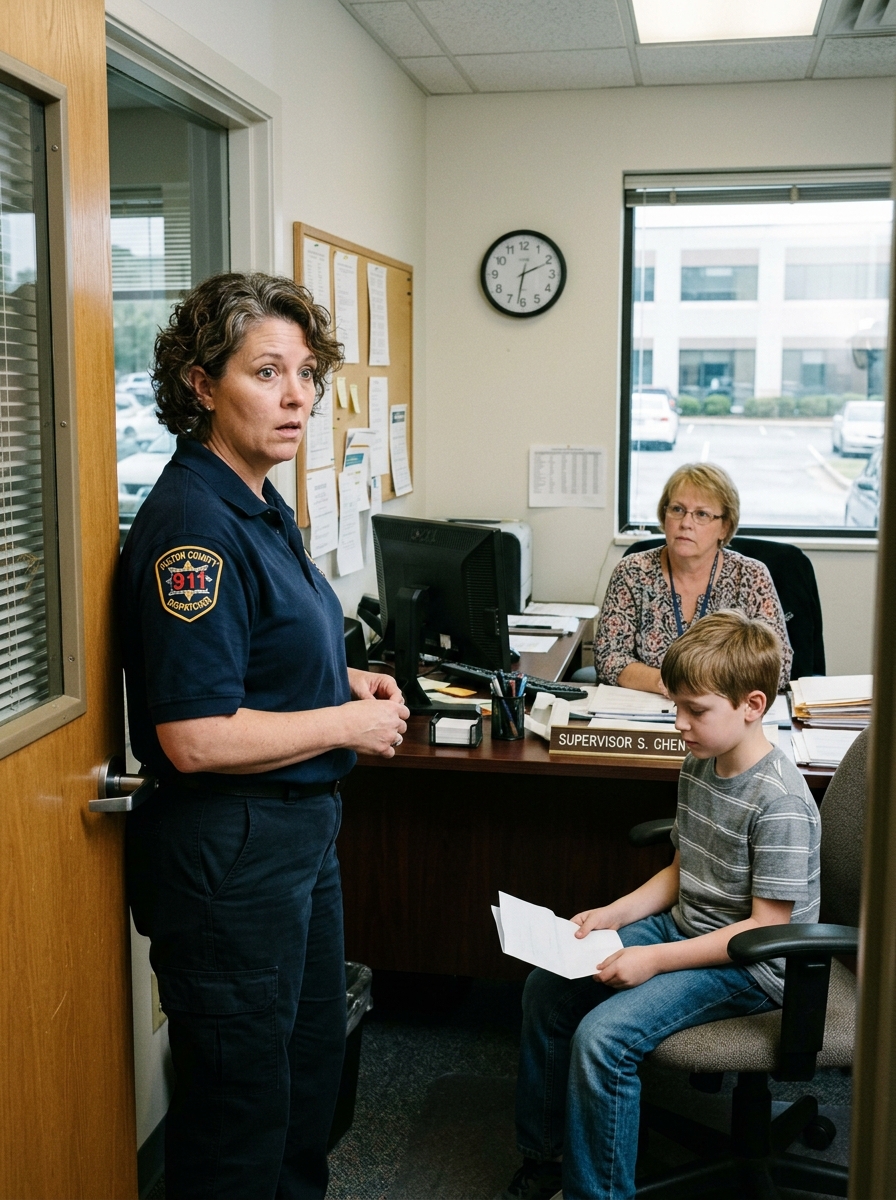
There was a woman sitting in one chair.
A little boy sat beside her.
The woman looked healthier than I remembered from the information I’d heard.
The boy was smaller than I had imagined.
But I recognized him immediately.
Malik.
He was holding a folded piece of paper with both hands.
He looked at me.
His eyes widened.
“You’re her.”
I swallowed.
“Hi, Malik.”
He smiled.
His mother stood.
“I’m Renee.”
I nodded.
“I know.”
She laughed softly.
“I know that’s strange.”
“No. I understand.”
She stepped toward me.
“I’ve wanted to meet you.”
My throat tightened.
“Are you okay?”
She nodded.
“I am because of him.”
She looked at Malik.
“And because of you.”
I didn’t know what to say.
Renee sat back down.
“Do you remember what happened?”
“Yes.”
“I don’t remember much.”
She looked down at her hands.
“But the doctors explained it.”
Malik stared at the paper.
Renee continued.
“They said my son started CPR almost immediately.”
I nodded.
“He did an incredible job.”
“He told them you taught him.”
I looked at Malik.
“You did the hard part.”
He shook his head.
“No.”
I smiled.
“You did.”
He finally unfolded the paper.
“My teacher gave us homework.”
He looked embarrassed.
“It says, ‘Someone Brave.’”
I smiled.
“That’s a good assignment.”
He nodded.
“I wrote about you.”
My eyes stung.
He began reading.
“Someone brave is the lady on the phone.”
His voice trembled.
“She counted with me so I wouldn’t be scared.”
He looked up.
Then back at the paper.
“I counted to one thousand.”
I laughed through my tears.
“You did.”
Malik smiled.
“I kept counting after the ambulance came.”
I looked at Renee.
She was crying now.
“He told me later that he thought if he stopped counting, you’d disappear.”
Something inside me broke.
I crouched beside his chair.
“I wasn’t going anywhere.”
He looked at me seriously.
“You promise?”
“I promise.”
—
Dana had been silent the entire time.
Finally, she cleared her throat.
“Carla.”
I stood.
She reached into her desk drawer.
Pulled out my written warning.
She placed it on the desk.
Then she tore it in half.
I stared at her.
She tore it again.
And again.
Then she dropped the pieces into the trash.
“I reviewed the call.”
I didn’t speak.
“I also reviewed the ambulance response.”
Renee looked at Dana.
Dana continued.
“There was a routing error.”
I nodded.
“And Carla’s continued presence on the call was consistent with the emergency circumstances.”
I almost laughed.
“Consistent?”
Dana looked uncomfortable.
“I could have phrased that better.”
Malik giggled.
For the first time, I saw Dana smile.
Then she reached for another folder.
“Your bonus paperwork.”
She pushed it toward me.
“I’ll fix it.”
I stared at the folder.
“You’re restoring it?”
“Yes.”
“Why?”
Dana looked at Malik.
“Because apparently sometimes fourteen minutes is more important than four and a half.”
The room went quiet.
Then Dana added:
“Don’t make a habit of it.”
I smiled.
“I won’t.”
I glanced at Malik.
“Unless I have to.”
Dana shook her head.
“That’s what I was afraid you’d say.”
We laughed.
—
The next morning, I drove straight to the mechanic.
I had the nine hundred dollars.
My car needed the repair.
But somehow, that wasn’t the part of the story I kept thinking about.
It was Malik.
His little hands.
His shaking voice.
The way he had counted because I told him to.
That night, I went home and found the copy of his homework folded inside my purse.
I had asked if I could keep it.
He had said yes.
I placed it beside a photograph of my father.
My father had died when I was twenty-seven.
He used to tell me something whenever I was afraid of making the wrong choice.
“You don’t always get to choose the outcome,” he’d say.
“You choose what kind of person you are while you’re getting there.”
I had forgotten that for a while.
Maybe working emergency calls does that to you.
After enough years, you start thinking in numbers.
How many calls?
How many seconds?
How many units?
How many minutes?
How many complaints?
You forget that every number belongs to somebody.
A mother.
A father.
A child.
A frightened person sitting alone in a dark room.
The next Monday, Dana called a staff meeting.
She stood in front of the room.
“Our call-duration guidelines are being reviewed.”
Everyone looked surprised.
She continued.
“We are not eliminating efficiency standards. But we are clarifying that emergency circumstances may require extended contact.”
Someone behind me whispered, “What changed?”
I knew.
Dana looked at me for half a second.
Then continued.
“We need to remember that the person on the other end of the headset isn’t a statistic.”
The room went quiet.
I looked down.
I didn’t need credit.
I didn’t need recognition.
I just wanted the people answering those phones after me to know they weren’t wrong for caring.
—
Months later, I received an envelope at work.
No return address.
Inside was another drawing.
It showed a woman wearing a headset.
Beside her was a little boy.
Above them, in enormous crooked letters:
“THE LADY WHO COUNTED.”
I laughed.
At the bottom, Malik had written:
“Mom is okay.”
I pinned the drawing above my desk.
It stayed there for years.
People asked about it.
Sometimes I told them.
Sometimes I didn’t.
Because the truth was, the story wasn’t really about me.
It wasn’t about a dispatcher breaking a rule.
It wasn’t about a supervisor tearing up a warning.
It wasn’t even about a nine-year-old boy performing CPR.
It was about what happens when someone refuses to leave another person alone during the worst moment of their life.
Years passed.
I eventually became a training supervisor.
The first lesson I taught new dispatchers was simple.
“Learn the protocols.”
They wrote that down.
“Know your geography.”
They wrote that down too.
“Stay calm.”
More notes.
Then I looked at them.
“And remember something no manual can teach you.”
They waited.
“There will be moments when the person on the other end of your headset doesn’t need a perfect dispatcher.”
I paused.
“They need a human being.”
I told them about Malik.
I told them about the fourteen minutes.
I told them about the wrong building.
I told them about the little boy who thought counting kept people from disappearing.
And I told them about the piece of paper he brought into Dana’s office.
I didn’t tell them that my hands had shaken when I first held it.
I didn’t tell them that I still kept a copy.
I simply said:
“Sometimes the most important thing you do all day won’t show up in your statistics.”
One trainee raised her hand.
“What happened to the boy’s mother?”
“She lived.”
“And Malik?”
I smiled.
“He’s older now.”
“Do you still hear from him?”
“Sometimes.”
The trainee smiled.
“What does he say?”
I looked at the drawing above my desk.
“He always asks me the same thing.”
“What?”
“Whether I still count.”
I nodded.
“And I tell him the truth.”
“What truth?”
“That I never stopped.”
—
Five years after the original call, my phone rang at home.
I almost didn’t answer.
Unknown number.
“Hello?”
A familiar voice said:
“Hi, Ms. Carla.”
I sat upright.
“Malik?”
He laughed.
“Yeah.”
His voice was deeper now.
He was fourteen.
Almost fifteen.
“How are you?”
“Good.”
“How’s your mom?”
“Good too.”
I smiled.
“That makes me happy.”
There was a pause.
Then he said:
“I wanted to tell you something.”
“Okay.”
“I think I want to become a paramedic.”
I closed my eyes.
“That’s wonderful.”
“I want to help people like you did.”
I shook my head even though he couldn’t see me.
“You already helped someone.”
“My mom?”
“Exactly.”
He was quiet.
Then he said:
“I remember that night.”
“So do I.”
“I was really scared.”
“I know.”
“I thought she was going to die.”
“I know.”
“But you kept counting.”
I smiled.
“You kept pushing.”
He laughed.
“You were bossy.”
“I was.”
“You told me I could do it.”
“You could.”
Another silence.
Then he said:
“Ms. Carla?”
“Yes?”
“Thanks for staying.”
My eyes filled with tears.
“You’re welcome, Malik.”
We talked for another few minutes.
When we hung up, I sat in my living room for a long time.
The clock on the wall read 6:47.
Exactly the same time the call had come in all those years ago.
I looked at the clock.
Then at the old photograph of my father.
Then at the little drawing still tucked inside a frame.
“The lady who counted.”
I smiled.
I had spent eleven years believing my job was to answer phones.
But that night taught me something different.
Sometimes your job is to be the voice that tells someone:
Stay with me.
Keep going.
You’re not alone.
And sometimes, fourteen minutes after everyone else thinks your day should be over, those words become the most important thing you’ve ever said.
I never regretted staying.
Not for one second.
Not when the warning came.
Not when the bonus disappeared.
Not when I wondered whether my supervisor was going to fire me.
Because somewhere in College Park, a little boy had learned that when the world suddenly becomes terrifying, you don’t always need to understand everything.
Sometimes you just need someone to count with you.
One.
Two.
Three.
And keep going.
Until help arrives.