My husband, Travis Hale, laughed when he told me he had removed me from our accounts. “I earn it, June. I decide who touches it. You just spend.” I remember the exact sound of his voice.
Not angry. Not defensive.
Amused. As if he had finally discovered the secret to controlling me and couldn’t wait to watch me panic. Instead, I looked across the street at the courthouse.
“Okay,” I said.
Then I hung up.
Travis was ninety miles offshore, surrounded by steel machinery, diesel fumes, and men who probably assumed he was the provider of a comfortable Louisiana household.
He had no idea what I was about to do.
For nine years, Travis had treated our marriage like a business in which he owned the company and I was an unpaid employee.
He earned approximately $141,000 a year working twenty-one days on and seven days off at an offshore drilling facility in the Gulf.
I stayed home.
But “stayed home” never meant sat around. I managed eleven acres of property. I paid bills.
I dealt with insurance companies. I scheduled plumbers, electricians, roofers, pest control, septic maintenance, and tree removal.
I mowed the acreage.
I repaired fences.
After hurricanes, I was the one standing outside in the rain taking photographs for insurance adjusters while Travis called from offshore and asked how much the damage would cost.
Then, when everything was finally repaired, he would come home and say, “See? We got through another one.”
We.
That word used to mean something to me.
It didn’t anymore.
Four days into Travis’s latest offshore hitch, I discovered that our parish tax records had been changed.
My email and phone number had been removed from the billing profile.
Everything had been redirected to Travis.
Then I discovered our joint checking account had been closed.
The money had been transferred elsewhere.
So had my access to another account.
By the time I called Travis, I was standing alone in a courthouse parking lot.
He laughed.
I said okay.
And then I walked inside.
The first person who helped me wasn’t an attorney.
It was a clerk named Denise.
She had pulled up the property records when I asked for a copy of the deed.
“You’re the only person listed as owner,” she said.
I stared at the screen.
“I am?”
“Yes.”
She printed it.
My name appeared alone.
June Parker.
The name I had carried before I married Travis.
My father’s name had been Raymond Parker.
He died in 2013, less than a year before Travis and I married.
Daddy left me the house, eleven acres, workshop, pond, and everything permanently attached to the property.
I remembered the attorney explaining it during probate.
“This property passes directly to you.”
At twenty-six, I had barely listened.
I was grieving.
I was planning a wedding.
And Travis had been standing beside me, holding my hand.
I had trusted him.
Now, nine years later, I was sitting in my car staring at the same deed.
Something inside me became very quiet.
I drove home.
The house looked exactly the same.
White siding.
Green shutters.
Old oak trees lining the driveway.
The workshop Daddy had built himself.
The pond beyond the pasture.
For nine years, Travis had called it our house.
But legally, it had never stopped being mine.
I went inside and started opening drawers.
Not frantically.
Methodically.
I found the original probate paperwork in a locked filing cabinet Daddy had left behind.
Then I found the marriage certificate.
Insurance documents.
Tax records.
Receipts for major repairs.
Bank statements.
And something else.
A notebook.
Daddy’s handwriting covered the first several pages.
He had listed repairs and maintenance dates going back years.
At the bottom of one page, he’d written:
“June knows this place better than anybody. Make sure it stays hers.”
I sat there for a long time.
Then I cried.
Not because I was sad.
Because for the first time in years, I realized how much of myself I had given away.
I called an attorney the next morning.
Her name was Rebecca Sloan.
I brought her everything I had.
She listened while I explained what Travis had done.
When I finished, she didn’t immediately tell me what would happen.
Instead, she asked questions.
“When was the account closed?”
“About three weeks ago.”
“Did you authorize it?”
“No.”
“Do you have proof that your husband transferred the funds?”
“I think so.”
“Do you have access to the property?”
“Yes.”
“Is your name on the deed?”
“Yes.”
She looked at the copy.
“Only your name?”
“Only mine.”
She nodded.
Then she leaned back.
“June, your husband may earn more money than you do. That doesn’t automatically give him the right to control everything.”
I swallowed.
“I don’t want revenge.”
“Good.”
“I want security.”
“That is much more useful.”
She asked me another question.
“Has he ever threatened to leave you without money?”
I thought about it.
Then I remembered dozens of little comments.
“You’d never manage without me.”
“You don’t understand finances.”
“You should be grateful I provide.”
“If something happened to me, you’d be lost.”
“He knows exactly how much I depend on him,” I said.
Rebecca’s expression changed slightly.
“Then we need to make sure he understands how much you have contributed too.”
That sentence stayed with me.
For the next several days, I gathered everything.
Every repair receipt.
Every insurance claim.
Every grocery bill.
Every property tax payment.
Every email showing me arranging contractors.
Every text where Travis asked me to handle something because he was offshore.
I printed photographs.
Thousands of them.
The roof after Hurricane Ida.
The broken fence.
The flooded workshop.
The damaged trees.
The new water heater.
The septic repair.
The tractor repair.
The contractor invoices.
The receipts for materials I had bought myself.
I had spent nine years thinking those things were invisible.
They weren’t.
They were evidence.
Then Rebecca discovered something I hadn’t known.
Travis had opened a separate account in his own name shortly before closing our joint checking account.
Money had been transferred there.
A lot of money.
But not all of it came from his offshore wages.
Some of the transfers came directly from the joint account.
Rebecca told me we needed documentation before drawing conclusions.
So I gave her permission to investigate everything relevant to our finances.
Meanwhile, I changed the locks on the house.
That was the hardest thing I had ever done.
Not because I was afraid of Travis.
Because changing those locks felt like admitting my marriage had already ended.
I put his old key in an envelope.
Then I wrote one sentence on the front.
“Return of property.”
I didn’t send it.
Not yet.
Seven days passed.
Then ten.
Travis called every evening.
At first, he sounded irritated.
“Why aren’t you answering?”
“I am answering.”
“You sound weird.”
“I’ve been busy.”
“Doing what?”
“Taking care of things.”
He laughed.
“June, don’t make this dramatic.”
I looked at the filing cabinet beside me.
“I’m not.”
“Good. Because I’m coming home in eleven days.”
“I know.”
“You need to have the account situation sorted out by then.”
“What situation?”
“The money.”
I almost laughed.
Instead, I said, “We’ll discuss it when you get home.”
He hung up.
He thought he had won.
He had no idea that three days earlier, Rebecca had filed paperwork on my behalf.
The exact legal process depended on facts I wasn’t qualified to interpret myself, but the practical result was simple:
Travis was no longer going to be able to make decisions about our financial life without consequences.
And there was another thing Rebecca had told me.
“Don’t threaten him.”
“I wasn’t planning to.”
“Don’t announce what we’re doing.”
“I won’t.”
“Don’t drain accounts.”
“I won’t.”
“Don’t hide assets.”
“I won’t.”
“Just document everything.”
So I did.
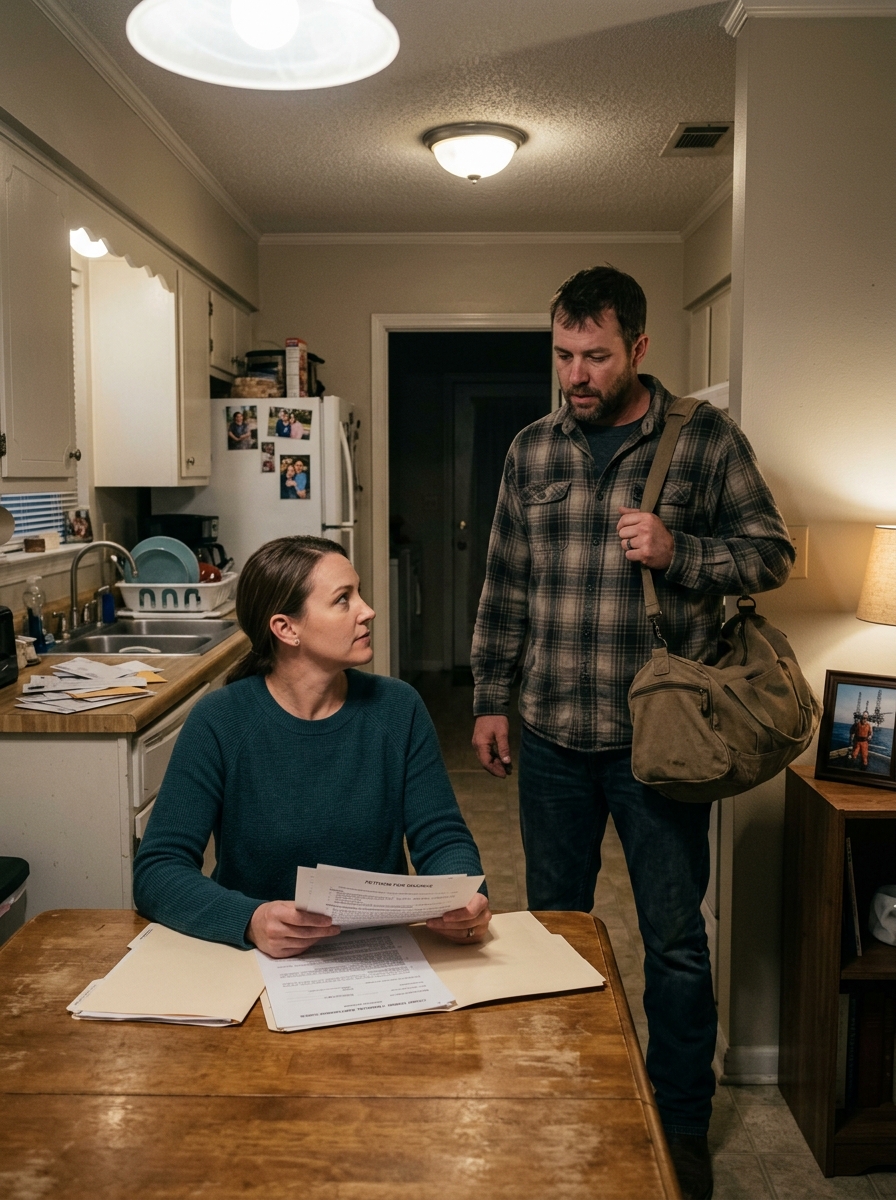
On the seventeenth day, Travis came home.
His truck rolled down the gravel driveway just before sunset.
I was sitting on the front porch.
He stepped out wearing his offshore boots, sunglasses, and a new watch I had never seen before.
He carried a duffel bag in one hand.
He looked at the house.
Then he looked at me.
“Why is the front door locked?”
I didn’t answer immediately.
He walked closer.
“June?”
“Your key doesn’t work anymore.”
He stared at me.
Then he laughed.
“Very funny.”
He tried again.
Nothing.
His expression changed.
“Open the door.”
“No.”
“June, open the door.”
“I need you to leave.”
He looked genuinely confused.
“This is my house.”
I stood up.
“No.”
He blinked.
“What?”
“This is my house.”
He stared at me.
For the first time in nine years, I watched Travis Hale look at the house and realize that his assumption wasn’t the same thing as ownership.
He stepped closer.
“Don’t start this.”
“I didn’t start anything.”
“You’re acting crazy.”
“No.”
“You’ve lost your mind.”
“No.”
He pointed toward the house.
“My paycheck paid for half the things here.”
“You paid household expenses.”
“I paid for the roof.”
“After the insurance claim.”
“I bought the tractor.”
“With money from our joint account.”
He stared at me.
I continued.
“You paid for things because you lived here.”
“You can’t just lock me out.”
“I didn’t.”
“You just said you did.”
“I changed the locks.”
“That is the same thing.”
“No. It’s different.”
He looked toward the road.
Then back at me.
“Where’s my stuff?”
“Inside.”
“I’m taking it.”
“You can arrange a time with my attorney.”
His face went pale.
“Your attorney?”
“Yes.”
“What attorney?”
“Rebecca Sloan.”
Silence.
He stared at me as though I’d spoken another language.
Then he laughed.
“Rebecca Sloan?”
“Yes.”
“You hired a lawyer?”
“Yes.”
“Over a bank account?”
“No.”
I held up the deed.
“Over everything.”
He took one step toward me.
I didn’t move.
“June, you don’t understand what you’re doing.”
“I understand perfectly.”
“You don’t have the money to fight me.”
“I don’t need to fight you.”
He frowned.
“What does that mean?”
“It means I’m not fighting you.”
I handed him an envelope.
“I’m protecting myself.”
He opened it.
Inside was a copy of the deed.
His eyes moved across the page.
Then stopped.
I watched him read my name.
Once.
Twice.
Three times.
“You knew this?” he asked.
“Yes.”
“You knew this whole time?”
“Yes.”
“Then why didn’t you ever say anything?”
I looked at him.
“Because I trusted you.”
He had no answer.
That sentence landed harder than anything else I could have said.
He walked away.
Then came back ten minutes later.
“Where am I supposed to go?”
I almost answered automatically.
Then I stopped.
For nine years, I would have solved that problem for him.
Hotel.
Friend.
Brother.
Something.
Instead, I said, “I don’t know.”
He stared at me.
“You’re really doing this.”
“You did this first.”
“I closed an account.”
“You removed me from our financial life.”
“Because I earn the money!”
“And I maintained the life that money was supposed to support.”
He looked away.
I could see the anger rising.
But beneath it was something else.
Fear.
Not fear of me.
Fear of losing control.
He had spent years believing money gave him authority.
Now he was discovering that money wasn’t the only thing that mattered.
He left.
That night, he stayed at a hotel.
The next morning, Rebecca called me.
“Did he contact you?”
“Yes.”
“Any threats?”
“No.”
“Good.”
Then she paused.
“We found another issue.”
My stomach tightened.
“What?”
“Your husband transferred more money than we originally thought.”
“How much?”
Rebecca gave me the figure.
I sat down.
It was enough to make my hands shake.
“Where did it go?”
“Several places.”
“Why?”
“We don’t know yet.”
Then she said something that changed everything.
“One transfer went to a company.”
“What company?”
“An LLC.”
I knew the name.
Travis had mentioned it once.
He said it was “just a small investment.”
I had forgotten about it.
Rebecca hadn’t.
“Did I sign anything?”
“No.”
“Was marital money used?”
“That’s what we’re investigating.”
For the next week, my life became paperwork.
Rebecca contacted financial institutions.
Documents were requested.
Statements were reviewed.
Dates were compared.
And gradually, a picture emerged.
Travis had been planning to separate our finances months before he told me.
The February billing change wasn’t accidental.
The account closure wasn’t spontaneous.
The separate account wasn’t new.
He had been moving money quietly while telling me money was tight.
That was why he had refused to replace the washing machine.
That was why he told me the air conditioner could wait.
That was why he complained about groceries.
He wasn’t struggling.
He was preparing.
For what, I didn’t know.
Then Rebecca found an email.
It had been sent to Travis by someone involved with his investment company.
The subject line was:
“Once the transfer is complete.”
I read it twice.
There was nothing illegal or dramatic in the message itself.
But it made one thing clear.
Travis had been planning his financial independence while making me believe I was the one spending too much.
I felt something inside me break.
Not my heart.
Something else.
The last excuse I had made for him.
I couldn’t tell myself anymore that he was just stressed.
Or tired.
Or bad with communication.
He had made choices.
Repeatedly.
And he had expected me to absorb the consequences.
Three weeks after he came home, Travis asked to meet.
Rebecca advised me to meet in a public place.
So I did.
We sat across from each other at a small café.
He looked different.
Less confident.
More tired.
“I want to fix this,” he said.
I stirred my coffee.
“What does that mean?”
“I want my marriage back.”
I looked at him.
“Do you?”
“Yes.”
“Or do you want your life back?”
He frowned.
“What’s the difference?”
“The life where I handled everything while you controlled the money.”
He didn’t answer.
“I didn’t appreciate you enough,” he finally said.
“That’s true.”
“I was under a lot of pressure.”
“I know.”
“I thought I was protecting us.”
“You weren’t.”
“I was scared.”
I looked at him.
“Of what?”
“Losing everything.”
I almost smiled.
“You were afraid of losing everything, so you tried to make sure I had nothing.”
He looked down.
For several seconds, neither of us spoke.
Then he said, “I didn’t think you’d actually leave.”
“I didn’t leave.”
His head came up.
“I stopped letting you decide whether I could stay.”
That was the moment I knew our marriage was over.
Not because he had moved money.
Not because he had laughed.
Not because he had humiliated me.
Because even now, sitting across from me, he was talking about my leaving as though I had been a possession that could be returned.
I stood.
“Travis, I hope you become a better man.”
His eyes filled.
“But it can’t be with me.”
I walked out.
The legal process took time.
There were meetings.
Documents.
Negotiations.
Arguments over money.
Disagreements over property.
There were days I wanted to give up simply because I was exhausted.
But every time I doubted myself, I remembered Daddy’s notebook.
“Make sure it stays hers.”
The house stayed mine.
The property stayed mine.
The workshop stayed mine.
And more importantly, I stayed mine.
Eventually, the financial issues were resolved through the proper legal process.
I didn’t become rich.
I didn’t need to.
I simply stopped being financially invisible.
I opened accounts in my own name.
I created a household budget I controlled.
I updated insurance information.
I made sure every important document had my contact information.
And I replaced the broken washing machine.
That might sound ridiculous.
After everything that had happened, why would a washing machine matter?
Because for nine years, every time it rattled, I had heard Travis saying:
“Wait.”
“Not yet.”
“We can’t afford it.”
“It’s still working.”
So one Saturday morning, I drove to the store.
I bought the machine.
I paid for delivery.
I stood in the kitchen while the installers removed the old one.
Then I watched the new machine begin its first cycle.
I laughed.
For the first time in years, I laughed without feeling guilty.
The upstairs air conditioner came next.
Then the fence.
Then the workshop roof.
Then the gravel driveway.
One repair at a time, I stopped postponing my own life.
Months later, I was standing beside Daddy’s pond at sunset when my phone rang.
It was Travis.
I almost didn’t answer.
But I did.
“Hello?”
There was a long pause.
“I drove past the house today.”
I said nothing.
“It looks different.”
“It needed work.”
“I know.”
Another pause.
“Do you ever miss me?”
I looked across the water.
“I miss who I thought you were.”
He breathed out slowly.
“I’m sorry.”
“I believe you.”
“Can we ever be friends?”
“Maybe someday.”
“But not now?”
“Not now.”
He accepted that.
Then he said goodbye.
I put the phone away.
The sun was disappearing behind the trees.
I walked back toward the house.
For years, I had thought my greatest achievement was keeping everything together while Travis was offshore.
I had been wrong.
My greatest achievement was finally understanding that keeping a marriage alive wasn’t the same thing as keeping myself alive inside it.
Travis had believed money made him powerful.
He believed because he earned more, he could decide who touched it.
He believed the house was his because he had lived there.
He believed I needed him because he was the one with the bigger paycheck.
And for a while, I believed him too.
Until one ordinary afternoon, I walked into a courthouse and asked for a copy of a deed.
That single piece of paper reminded me of something I had forgotten.
My father had trusted me with his home.
I had trusted Travis with my life.
Only one of those decisions had been made wisely.
Seventeen days after Travis removed me from our accounts, he came home expecting to find the same woman who had spent nine years apologizing for needing anything.
Instead, he found the woman who had finally read the fine print of her own life.
The woman who knew where every document was.
The woman who knew exactly what she owned.
The woman who no longer confused sacrifice with love.
And the woman who had finally stopped asking permission.
I never celebrated Travis’s downfall.
There was nothing satisfying about watching a marriage collapse.
But I did celebrate something else.
One morning, almost a year after that phone call offshore, I stood on the porch holding a cup of coffee.
The oak trees moved gently in the wind.
The pond reflected the morning sky.
The workshop door was open.
The new air conditioner hummed upstairs.
The washing machine was running.
The house was quiet.
Peaceful.
Mine.
I thought about Travis’s words.
“I earn it, so I decide who touches it.”
Then I looked around at everything I had spent nine years maintaining.
The land.
The house.
The bills.
The repairs.
The life.
And I finally understood the difference between earning money and building a home.
Travis had earned the money.
I had built the life.
And when he tried to use the first to take control of the second, he discovered something he should have understood from the beginning.
Power isn’t always sitting in a bank account.
Sometimes it’s buried in an old deed.
Sometimes it’s written in a father’s handwriting.
Sometimes it’s eleven acres of Louisiana land beneath your feet.
And sometimes, after years of being told you’re powerless, power is simply the moment you look someone in the eye and say:
“Okay.”
Then you walk away and start taking your life back.
That was what I did.
I didn’t destroy Travis.
I didn’t need to.
I simply stopped allowing him to destroy me.