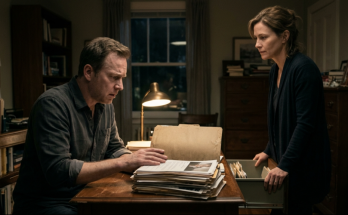
Reid remained standing beside me, his arms folded across his chest. The man looked down at his expensive watch. “I understand you’re angry.” “I’m not asking whether you understand my feelings,” I replied. “I’m asking where you were.”
He sighed. “I didn’t know about the situation.” I almost laughed.
“You didn’t know your daughter was in foster care?”
“I knew she existed. The circumstances were complicated.”
“Complicated?”
I opened the folder again.
“Your daughter spent four years being moved from one temporary home to another. She learned not to ask for anything because she was afraid of being sent away. She apologized whenever she needed help. She used to hold my sleeve because she thought I might disappear if she let go.”
He said nothing.
“And now you’re here because you have an interview scheduled?”
His jaw tightened.
“That’s not fair.”
“Neither was what happened to her.”
For the first time, he looked genuinely uncomfortable.
Then he leaned forward.
“I made mistakes. I’m trying to make them right.”
Reid finally spoke.
“Then start by telling the truth.”
The man rubbed his forehead.
“Look, my career took off. My agent advised me to keep my personal life private. I wasn’t in a position to raise a child.”
“And we were?” Reid asked.
The question hung in the air.
The man looked at him.
“You two have no idea what my life is like.”
Reid gave a small, bitter smile.
“You’re right. We don’t. But we know what it means to show up for a child every single day.”
Before the man could answer, footsteps sounded on the stairs.
“Dad?”
Willa appeared in the kitchen doorway.
She was wearing Reid’s old gray hoodie, her hair tied into a loose ponytail.
“Who is that?”
Nobody answered immediately.
The man stood.
“Willa?”
She tilted her head.
“Do I know you?”
He took a step forward.
“I’m your biological father.”
Willa didn’t move.
For several seconds, she simply stood there, one hand resting against the doorframe.
Then she asked a question I will never forget.
“Are you the reason I was in foster care?”
His face went pale.
“I didn’t know how to explain everything.”
“That’s not what I asked.”
He swallowed.
“Yes. I suppose I am.”
Willa nodded slowly.
Then she turned toward Reid.
“Dad, can you come here?”
Reid immediately crossed the kitchen.
She reached for his hand.
“Can we talk upstairs?”
“Of course, sweetheart.”
As they walked away, the man called after her.
“Wait. I came here because I want to give you opportunities. I can pay for your college. I can give you things your parents can’t.”
Willa stopped.
She turned her head slightly.
“Which parents?”
The man blinked.
She continued.
“The ones who stayed, or the one who just arrived?”
Nobody spoke.
Then Willa went upstairs.
I looked at the man.
“That is your answer for today.”
He gathered his folder, but before leaving, he placed a business card on the table.
“Please think about the offer. I really do want a relationship with her.”
After he left, Reid found me sitting at the kitchen table.
He picked up the folder.
“Why did you say an interview might be possible?”
I looked toward the staircase.
“Because I saw something on that last page.”
I opened the folder again and showed him the question his team had left unanswered.
It read:
What does being a father mean to you?
Underneath it was a blank space.
I touched the paper.
“I want him to answer that question honestly. In front of Willa. Without a script. Without cameras telling him what to say.”
Reid stared at me.
“And if he can’t?”
“Then our daughter will finally know that the problem was never her.”
That night, Willa came into our bedroom.
She sat on the edge of the bed, holding her stuffed rabbit.
She hadn’t played with it in years, but she still kept it beside her.
“Can I ask something?”
“Anything,” I said.
“Did you and Dad know this might happen when you adopted me?”
I took her hand.
“No, sweetheart.”
“Would you still have adopted me if you knew?”
Reid sat up.
He didn’t hesitate.
“We would have fought even harder to bring you home.”
Willa started crying.
And for the first time in a long time, she didn’t apologize for it.
PART 3: The Truth Behind His Offer
Three days passed before Willa agreed to hear from her biological father again.
She made one condition of her own.
“No surprises. No cameras. And nobody gets to tell me what to say.”
We agreed.
Her biological father, whose name was Adrian Cole, called on Sunday afternoon.
He sounded different from the man who had sat in our kitchen.
Less confident.
Less polished.
He asked whether Willa would be willing to meet him at a quiet restaurant.
She agreed, provided Reid and I could come.
When we arrived, Adrian was already waiting.
He stood when he heard us approaching.
“Willa.”
“Hello.”
He pulled out a chair for her.
She found it herself and sat down.
For several minutes, nobody knew what to say.
Finally, Adrian cleared his throat.
“I brought something for you.”
He placed a small box on the table.
Willa didn’t reach for it.
“What is it?”
“A necklace. Your mother bought it before you were born.”
Willa slowly extended her hand.
He placed the box in her palm.
Inside was a delicate silver necklace with a small star pendant.
She touched it carefully.
“Thank you.”
Adrian smiled.
Then he made a mistake.
“I knew you’d love it. Your mother always said you would be a little star.”
Willa’s fingers stopped moving.
“My mother?”
Adrian looked uncomfortable.
“Your biological mother. She and I were together for a while.”
Willa leaned back.
“Did she want me?”
His face changed.
“Of course she did.”
“Then why didn’t she raise me?”
Adrian looked down.
“She died shortly after you were born.”
The restaurant suddenly felt very quiet.
Willa swallowed.
“Did you love her?”
“Yes.”
“Did you love me?”
He took a breath.
“I thought I was doing what was best at the time.”
Willa’s voice remained calm.
“That’s not an answer.”
He rubbed his hands together.
“I was young. I was starting my career. I was afraid that having a child would destroy everything I’d worked for.”
I watched Willa carefully.
She didn’t cry.
She simply nodded.
“So you chose your career.”
Adrian looked at her.
“I thought I could come back later.”
“Later?”
He didn’t answer.
Willa placed the necklace box on the table.
“Do you know what I remember about being four?”
He shook his head.
“I remember asking people not to leave. I remember listening for footsteps because I didn’t know whether the next person coming into my room was going to help me or move me somewhere else.”
Adrian’s eyes filled.
“I am sorry.”
Willa continued.
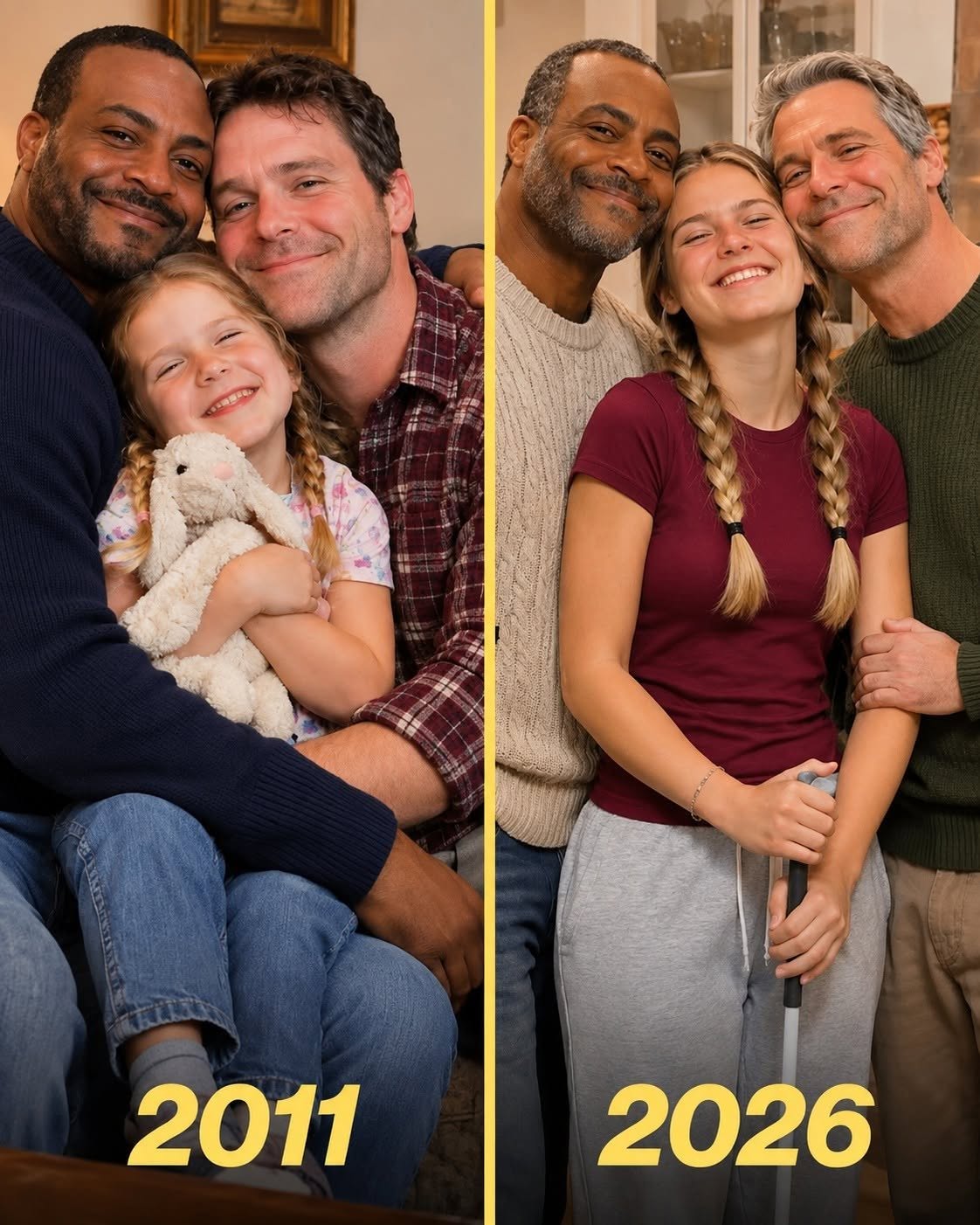
“I remember my first night with Dad Reid and Dad Daniel. I asked if I could wake them up if I had a nightmare.”
She smiled faintly.
“Dad Reid told me I could wake him up even if I wasn’t having a nightmare.”
Reid reached across the table and squeezed her hand.
“That’s what parents are supposed to do,” he said.
Adrian looked at us.
“I want to be part of her life.”
Willa turned toward him.
“Then why did you need me to move in next month?”
He hesitated.
And that hesitation told us everything.
Finally, he admitted it.
“My production company is releasing a documentary about my life. The producers wanted a more personal story. I mentioned having a daughter.”
“And then?”
“They became interested in meeting you.”
Willa’s expression hardened.
“So this is about your documentary?”
“Not entirely.”
“Did they know I was blind?”
“Yes.”
“Did they know I was adopted by two fathers?”
He looked away.
“They wanted to tell the story of our family.”
Willa gave a small, humorless laugh.
“Our family?”
Adrian reached for her hand.
She pulled hers back.
“Please don’t.”
He looked devastated.
For the first time, I believed some of his sadness was genuine.
But genuine sadness didn’t automatically make someone a father.
Then Willa asked the question that changed everything.
“Did you tell them I wanted to meet you?”
Adrian didn’t respond.
“Did you tell them I agreed to move in with you?”
He stared at the table.
“Yes.”
Willa stood.
“Then you lied.”
Adrian stood too.
“I was trying to create an opportunity for us.”
“No,” she replied. “You created a story about me before you even asked me what I wanted.”
She reached for Reid’s arm.
“Can we go home?”
We left.
That evening, our lawyer called.
Adrian’s production company had contacted him about obtaining permission to film Willa.
They had apparently already prepared a publicity campaign.
There was one more detail.
The proposed documentary included a segment about Willa’s adoption.
The description referred to us as two men who had “stepped in temporarily” when no traditional family would accept her.
Reid read that sentence twice.
Then he put the paper down.
“Temporarily?”
I shook my head.
“They really don’t know our daughter.”
But the next morning, something unexpected happened.
Willa received a message from an unknown number.
It was a voice message from Adrian.
She listened to it twice.
Then she handed me her phone.
His voice was quiet.
“Willa, I know I have no right to ask for anything. But there’s something you should know. I didn’t come to your house only because of the documentary. There’s a reason I waited twelve years, and I think you deserve to hear it from me.”
He paused.
“I have something that belonged to your mother. Something I should have given you years ago.”
Willa sat silently.
Then she asked me to call him.
“Tell him I’ll meet him one more time.”
PART 4: The Full Ending — The Family That Stayed
The following Saturday, Adrian arrived at our house carrying a small wooden box.
This time, there was no folder.
No proposal.
No assistant waiting in the car.
He sat across from Willa in our living room.
Reid sat beside her.
I stayed nearby, close enough that she could reach for my hand if she needed it.
Adrian placed the wooden box on the coffee table.
“Your mother made this for you.”
Willa ran her fingers over the smooth surface.
“What is inside?”
“Letters. A few photographs. And something she recorded before you were born.”
Willa opened the box.
Inside were several envelopes, carefully tied together with a faded ribbon.
There was also an old audio recorder.
Adrian explained that Willa’s biological mother, Elena, had known about her condition before she was born.
“She wanted to learn Braille,” he said. “She bought books. She talked about making the house safe for you. She had so many plans.”
Willa touched the first envelope.
“Why didn’t you give these to me before?”
Adrian’s eyes filled.
“Because I couldn’t face what I’d done.”
He took a shaky breath.
“After Elena died, I was overwhelmed. I was frightened. I had people around me telling me that I couldn’t raise a child alone while building a career. I convinced myself that placing you in care temporarily was the responsible thing to do.”
“Temporarily?” Willa repeated.
“That’s what I told myself.”
“But you never came back.”
“No.”
He looked directly at her.
“I don’t have an excuse.”
Willa opened the first letter.
The handwriting was delicate and slightly uneven.
She couldn’t read it herself, so she asked me to read it aloud.
The letter was dated two months before her birth.
It said:
My little girl,
I don’t know what your eyes will see when you arrive in this world. But I know what I want you to feel.
I want you to feel wanted.
I want you to know that you will never have to earn your place in our home.
If you need help, I will help you. If you need patience, I will give you patience. And if the world is unkind, I will remind you that you are not the problem.
You are my daughter, and I already love you more than I know how to explain.
I couldn’t continue reading.
Willa was crying.
Reid wrapped an arm around her shoulders.
Adrian lowered his head.
For a long time, nobody spoke.
Then Willa asked to hear the recording.
Adrian pressed the button.
A woman’s voice filled the room.
It was soft, warm, and full of laughter.
“Hello, my little star. If you’re listening to this, I hope you’re already making everyone around you smile.”
There was a pause.
“I don’t know what your life will look like. I don’t know what challenges you’ll face. But I want you to remember something. You are not broken. You are not a burden. And you are never too much for the people who truly love you.”
Willa covered her mouth.
The recording continued.
“I hope you grow up surrounded by people who let you be yourself. People who don’t make you feel small. People who understand that love isn’t about having a perfect family. It’s about showing up.”
Then Elena laughed softly.
“And if your father is listening to this, please make sure you remember that too.”
The recording ended.
Adrian was openly crying now.
“I should have been that person,” he whispered.
Willa held the recorder against her chest.
“Yes,” she said. “You should have.”
He nodded.
“I know.”
For a moment, I thought she might forgive him immediately.
But she didn’t.
And that was okay.
Instead, she asked him something else.
“Are you still doing the documentary?”
Adrian looked up.
“No. I called them yesterday and withdrew my proposal.”
“Why?”
“Because I realized I was trying to make you fit into a story I wanted people to believe.”
Willa was quiet.
He continued.
“I told my team that I had misrepresented our relationship. I also told them that you had two parents who raised you, and that they deserved to be respected.”