Marigold — Mari, we called her — had taken the sheet of paper home on a Tuesday, and by Thursday morning she had filled it with six crayon figures, each one labeled in her careful, oversized kindergarten script. She’d used the good markers,
the ones she wasn’t supposed to touch without asking, and she’d pressed so hard that the colors bled through to the kitchen table.
I didn’t scold her. The drawing was so earnest, so deliberately composed, that I felt the correction would be like criticizing a cathedral for the way it caught the light.
There was me, in purple — my favorite color, which she knew. There was Daniel, in blue. And there was Mari herself, small and joyful between us, rendered in a yellow so bright it looked like a shout.
And then there were three more.
I almost didn’t notice them at first. They were off to the right side, grouped together in a way that felt intentional, not accidental.
A woman with gray hair done in careful loops. A girl about Mari’s height with red marker pigtails. And the smallest — barely more than a circle with stick legs — labeled in Mari’s wobbly hand: baby Lucas.
“Sweetie,” I said, keeping my voice easy, light. “Who are the extra people?”
She didn’t look up from her cereal. She pointed without lifting her spoon. “That’s Daddy’s other mommy. And Emma. And baby Lucas.”
I looked at the drawing. Then I looked at her. She was blowing on a Cheerio.
“Daddy’s other mommy?”
“Mm-hmm. The one who lives far away. He goes there sometimes.” She finally looked up, apparently deciding I needed more information. “Emma is little,” she said, the way children say things that seem important. “But she’s older than me. And Lucas is a baby. He cries a lot.”
“Have you met them?” My voice was very careful now, wrapped in cotton.
“Uh-huh. On the iPad. Daddy talks to them when you’re sleeping.”
I set her orange juice down in front of her. My hand was steady. I’m not sure how.
Daniel laughed when I showed him the drawing that evening.
Not a short, nervous laugh. A full laugh, easy and warm, the laugh I had fallen in love with in a graduate school parking lot eleven years earlier when I’d reversed into his bumper and he’d gotten out of his car grinning instead of furious. It was still the same laugh. That was the thing that undid me, later — how it was still exactly the same.
“Kids imagine things,” he said. He kissed the top of my head. “Remember when she told the pediatrician we had a horse?”
“We don’t have a horse,” I said.
“Right. Exactly.”
He handed the drawing back to me and went to change out of his work clothes. I stood in the hallway holding the paper. The woman with the gray looped hair looked back at me.
Daddy’s other mommy.
I called the school the next morning, after Daniel left, after I’d dropped Mari off, after I’d sat in the school parking lot for seven minutes watching other parents reverse out and pull forward and go on with their ordinary lives.
Her teacher, Mrs. Calloway, answered on the second ring.
“Oh, Mrs. Hale, I’m so glad you called. I was actually going to reach out — I wanted to thank your husband again for coming to Career Day last month. The kids absolutely loved him.”
I gripped the steering wheel. “Career Day.”
“He was wonderful. Talked about structural engineering in a way that five-year-olds could understand, which is genuinely a skill.” She laughed softly. “And he donated five hundred dollars to our classroom library fund under your family name. We’ll be sending a formal thank-you note.”
“He came alone?” The question came out before I could stop it.
A small pause. “Oh — no, actually. He brought his children. A girl, maybe seven? And a little boy, maybe three. He introduced them to the class.” Another pause. Softer now, more careful. “Is everything all right, Mrs. Hale?”
I said yes. I thanked her. I drove home.
Daniel was making dinner.
That was the thing I kept returning to, later. He was making dinner. Whistling. Something low and tuneless that he always did when he was happy, when things felt right. The kitchen smelled like garlic and the good olive oil. He had opened wine. The table was set for three, Mari’s placemat — the one with the caterpillar — already in position.
He looked up when I came in. Smiled.
“You’re early. How was—”
“Who is Emma?”
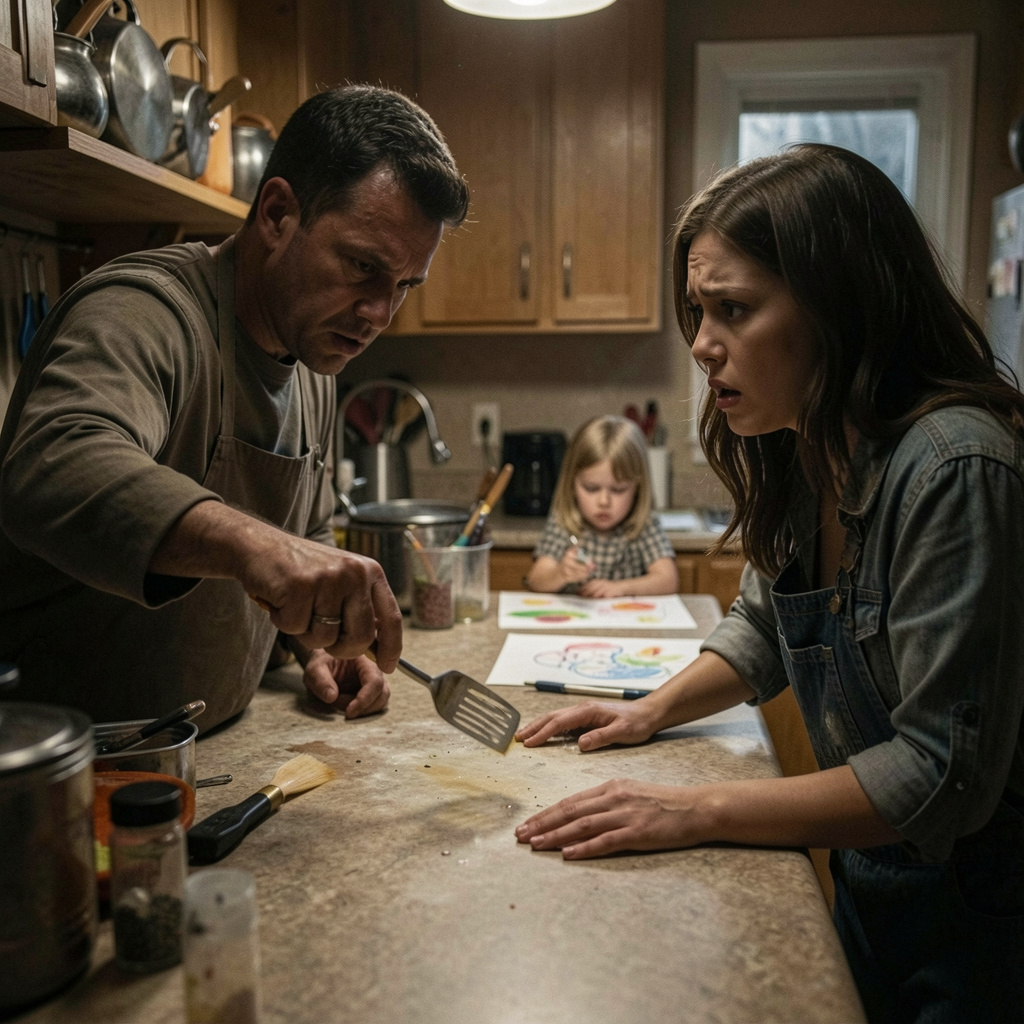
He went still. Not dramatically. Not like in a movie, where someone drops something or steps back. Just — still. His hand stopped on the spatula. He lowered it to the counter very slowly, as if moving too fast would break something.
He looked at Mari, who was at the table coloring, oblivious, her tongue pressed between her teeth in concentration.
And then he looked at me.
And I saw it. Not guilt, exactly — something older than guilt. Something that had been carried for a long time.
He crossed to the kitchen doorway and said, quietly, “Baby, can you go pick up your toys in your room for a few minutes?”
Mari didn’t look up. “I’m coloring.”
“I know. You can bring your coloring.”
She gathered her things with the elaborate put-upon sighing of a five-year-old and shuffled down the hallway. We waited until we heard her door creak.
Daniel turned back to me. He opened his mouth. Closed it. Looked at the floor.
“Emma,” he said, “is your daughter’s half-sister.”
The kitchen didn’t tilt. The floor didn’t drop. Nothing happened at all, which is somehow worse, when the world decides to stay exactly where it is while the inside of it rearranges entirely.
“Her name,” I said. “Emma.”
“Emma Rose.” He was speaking carefully, like a man picking his way through glass. “She’s seven. She’ll be eight in March.”
Eight in March. I counted back without meaning to. I have always been good at math. Eight in March meant conceived — seven, eight years ago. Early in our marriage. Before Mari. Before the miscarriage we’d grieved together, the one I’d thought had bonded us into something solid and permanent. Around the time he’d taken that project in Portland for four months. Around the time he’d come home and said he’d missed me so much.
“And Lucas,” I said.
He closed his eyes briefly. “He’s three. He turned three in September.”
September. Three years old.
“Her name,” I said. “The mother.”
“Claire.” He said it quietly, like he was ashamed of how ordinary it was. “Her name is Claire.”
I thought about the woman with the gray looped hair on the drawing. Then I realized — that wasn’t Claire. That was Daddy’s other mommy. His mother. Another family, a whole parallel structure, people who apparently called him by a name I didn’t know and set a place for him at a table I’d never sat at.
“How long have you been—” I stopped. Started again. “Is it — are you still—”
“It’s not — we’re not together. We haven’t been. She was someone I met, it wasn’t — it was never a relationship, it was—” He stopped. “That’s not what you’re asking.”
“I’m asking if you are currently sleeping with her.”
“No.”
“Do you see her?”
“I see the kids.” He met my eyes for the first time since Mari had left the room. “I drive up every few weeks. I’m on the birth certificates. I pay — I’ve been paying support since Emma was born.”
“From our accounts.”
He didn’t answer. Which was its own answer.
“Daniel.” I couldn’t say anything else. His name was the only thing I had.
“I know,” he said. “I know. There is nothing I can say to—”
“Mari knows them.” My voice cracked for the first time. “Our daughter has met them. On your iPad. While I was sleeping.”
He looked like he’d been hit. “She wasn’t supposed to — that was an accident, she came downstairs one night and I didn’t—”
“She drew them,” I said. “She drew them in her family tree. She has accepted them. She talks about baby Lucas like she talks about a cousin or a neighbor. She has made space for them.” I looked at him. “She did that without any help from you. She just — made room.”
He was crying. I had seen Daniel cry three times in eleven years: when his father died, when we lost the pregnancy, and once during a movie about a dog. He was crying now and I felt absolutely nothing about it, which told me more about the state of things than anything else could have.
I did not leave that night.
I have thought about that a great deal, since. People expect one of two things: either you slam the door and there’s a dramatic exodus, bag over one shoulder, car squealing out of the driveway — or you fold. You sit down and you weep and eventually he holds you and you try to find your way back to the person you thought you were married to.
I did neither. I served Mari her dinner. I helped her with her bath. I read her the book about the mouse who wants to give his mother a star, which she chose herself and which I read on autopilot while something in me sat very far away and looked at the ceiling.
When she was asleep, Daniel and I sat at the kitchen table and he told me everything.
It had started in Portland. Claire was a project manager for the firm they’d collaborated with. It had lasted, intermittently, through three more work trips — two to Portland, one to Seattle. When Claire called to tell him she was pregnant, he had come home and held my hand at a dinner I couldn’t remember anymore and told me I was the only thing in the world he was sure of.
Emma was born. He paid. He told Claire the marriage was real, that he had no intention of leaving, that he would be present for Emma but that was where the line was.
Three years later, there was Lucas.
“How does something like that happen?” I asked. “How does that happen twice?”
He didn’t have an answer. Of course he didn’t. There is no answer to that question that survives being said out loud.
“Your mother,” I said. “The woman in the drawing. Mari said Daddy’s other mommy.”
He looked confused for a moment. Then: “My Aunt Ruth. She lives near Claire. She watches the kids sometimes when Claire has a night shift.” He paused. “Mari must have heard me call her by—” He stopped. “I took Mari once. Last year. The trip I said was a work conference. You stayed here with the flu and I said I should still go and you said—”
“I said go, it’s fine, I’ll manage.” I remembered it. I had been proud of myself for not being clingy. “You took our daughter to meet your other children.”
“I know.”
“She was four.”
“I know.”
“And she never told me.”
“She didn’t understand what she’d seen. She was four. She talked about Emma for a week and I told you it was an imaginary friend and you—”
“I said how sweet,” I said. “I said it was good for her development.”
We sat with that for a while.
I called my sister in the morning. She said come here right now, which is what she has always said in every crisis since we were children, and I thought about going. I stood in the hallway with my phone and my coat and my keys and I listened to Mari singing something to herself behind her bedroom door, and I put the coat back on its hook.
I wasn’t ready to explain any of this to Mari. I wasn’t ready to see it through her eyes yet.
What I did instead was drive to a park on the north side of town that nobody we knew went to. I sat on a bench beside a man-made lake that was mostly geese. I thought about eleven years. I thought about the parking lot where we’d met, and the night he’d proposed at a restaurant so nervous he’d knocked over the wine, and the hospital room where they’d placed Mari on my chest while Daniel stood beside me crying and saying hi, hi, hi over and over, like she was someone he’d been waiting to meet.
All of that was real.
And all of this was also real.
The geese were uninterested. A child nearby threw bread. I watched the ripples spread and flatten and start again.
I called Claire.
I got her number from Daniel’s phone while he was in the shower, the second morning. I debated this for less time than I expected.
She picked up on the third ring. She had a steady voice, low and careful. When I told her who I was there was a silence, and then she said, “He told me this might happen eventually.”
“Did he tell you I didn’t know?”
“He told me you knew and had decided not to discuss it.” A pause. “I’m sorry. That was apparently not true.”
“No.”
She was quiet for a moment. “I’m not going to pretend this is comfortable for me. I’m not going to pretend I’m entirely innocent in how this started. But I want you to know — I stopped waiting for him a long time ago. The kids need their father and I’ve made my peace with what that looks like. But I’m not your enemy and I’m not trying to take anything from you.”
“I haven’t decided what I’m taking,” I said.
She actually laughed at that, soft and a little sad. “That’s fair,” she said.
I asked her about Emma. Whether she was doing well in school, whether she was happy. I don’t know why I asked. Some part of me needed to know if she had made it through her seven years okay, this girl who had not asked for any of this any more than Mari had.
“She’s good,” Claire said. “She’s really good, actually. She wants to be a marine biologist. Or a princess. She hasn’t decided.”
“Lucas?”
“He barely sleeps. But he laughs all the time, so we’re calling it even.”
After I hung up, I sat in my car in front of a gas station and I cried. Not for me, exactly. Not even for Daniel. I cried for Emma, who was seven and almost eight and who wanted to be a marine biologist or a princess. I cried for Lucas who barely slept but laughed all the time. I cried for Mari, who had simply looked at a drawing of the people in her world and put them all down in crayon without judgment, as if love was just a matter of making room.
She hadn’t been confused by it, my daughter. She’d been matter-of-fact about it, the way children are matter-of-fact about everything until we teach them otherwise.
That’s Daddy’s other mommy. And Emma. And baby Lucas.
As if of course. As if naturally. As if the world was big enough for all of them and why wouldn’t it be.
I don’t know what I will decide.
I know that sounds like an unfinished ending, and I think people expect something more decisive: a slammed door, or a second chance, or a finding-of-oneself in some sunlit moment. But the truth of it is more ordinary and more difficult than any of those things.
I know I love my husband in a way that has roots like an oak — deep and structural, nearly impossible to see from the surface. I know that love and betrayal are not, unfortunately, mutually exclusive. I know that my daughter will someday need to understand what her family is, in all its actual shape, and that the telling of it will be one of the hardest things I ever do.
I know that Emma is seven, almost eight, and that she exists independent of what her parents have done to each other. I know that Lucas laughs all the time.
I know that Mari drew six people in her family tree and did not think for even a moment that any of them should not be there.
She submitted it to school on a Friday. Mrs. Calloway hung it in the hallway with the others. I saw it when I picked her up — all those family trees papering the corridor, crayon faces grinning down at us in every size and shape and configuration.
Some had two parents. Some had four. Some had dogs in them, and once, true to what Daniel had remembered, a horse. One child had drawn a grandparent so large she dominated the entire page. One boy had carefully labeled every single person, twelve people, in a family that sprawled and ramified across the paper in every direction.
Mari’s was near the door.
I stood and looked at it for a long time. The six of them. The three I knew, and the three I hadn’t yet. All of them rendered equal, in the same careful crayon, with the same earnest attention.
A family, according to my daughter. This, all of it, was family.
I didn’t know if I could be as generous as she was. I didn’t know if I could make my heart as large as hers, or if any of us can, once we are grown and have learned all the particular ways that love can also hurt.
But I took a picture of it with my phone before I took it down.
I’m not sure why. Maybe because she’d worked so hard on it. Maybe because she’d used the good markers.
Maybe because somewhere in those six crayon figures — in that small, unsentimental, accurate picture of the world — there was a question I was still deciding how to answer.
And I wasn’t ready, yet, to put it away.