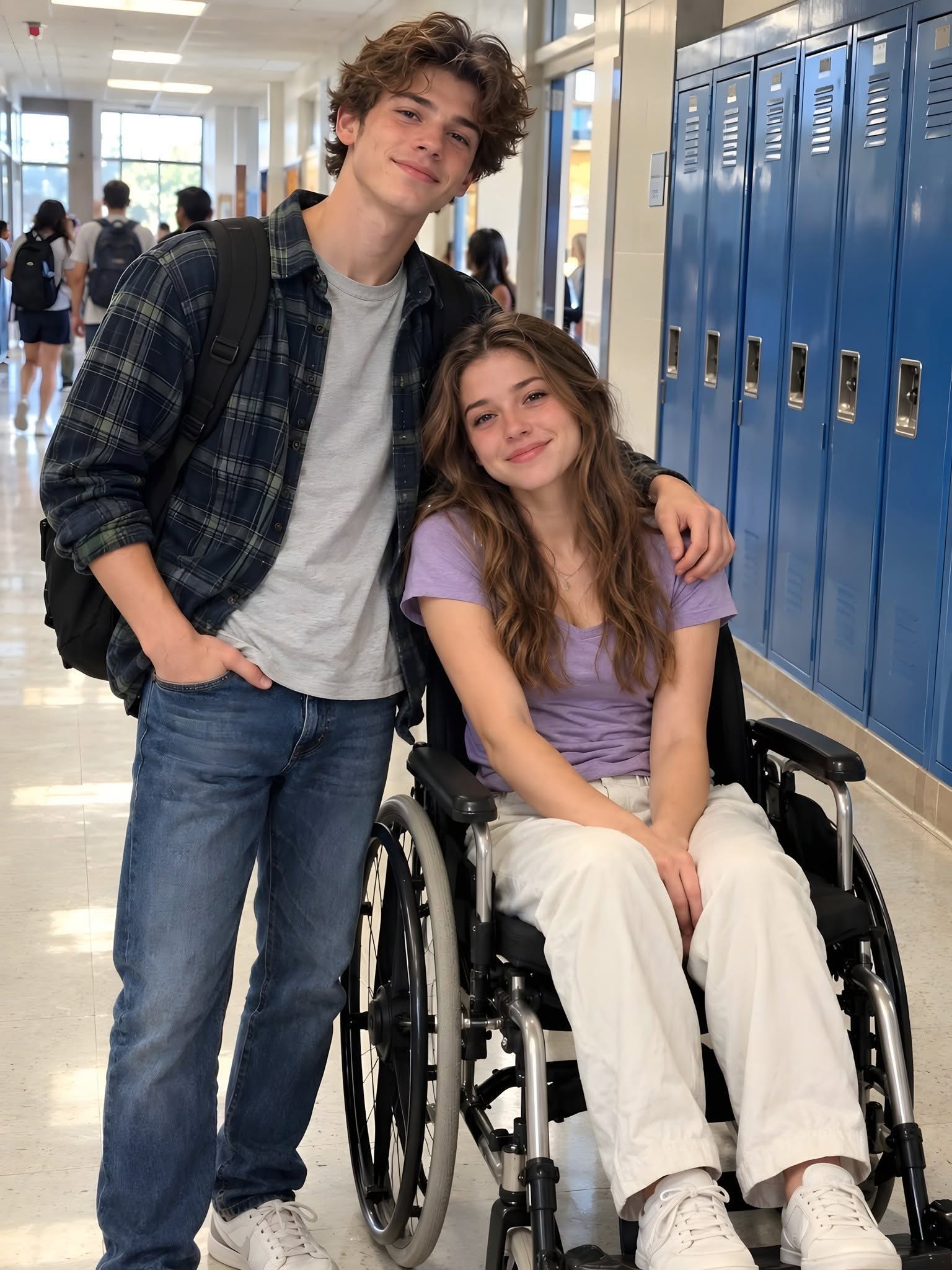
The second officer, a woman with tired eyes and a calm voice, stepped forward.
“Mrs. Vance, we have reason to believe your son was deceived. We’re here to understand what happened, not to assume he’s guilty.”
That was the first time I took a full breath.
The first officer continued.
“Your son sold his guitar to a man who claimed to be a medical equipment broker. That man advertised a nearly new, customized wheelchair online at a price your son could afford. The serial number on the chair matches equipment reported stolen from a warehouse three days ago.”
My knees nearly buckled.
I looked at my thirteen-year-old son, who was crying so hard he could barely stand.
“Tell me what happened,” I whispered.
Julian wiped his face with his sleeve.
“I found the listing on Tuesday. It said the chair was almost new, and the man said he was selling it cheaply because a hospital had canceled a bulk order.”
“Why didn’t you tell me?” I asked.
His expression crumpled.
“Because you would have said we couldn’t afford it.”
The words struck harder than I expected.
He wasn’t wrong.
We had been counting every dollar for months. His father, Daniel, had lost his job the previous winter, and my salary as a receptionist barely covered our mortgage, utilities, groceries, and the payments on Daniel’s old medical debt.
Julian had learned to recognize the sound of overdue bills being opened at the kitchen table.
He had also learned not to ask for much.
I swallowed the guilt rising in my throat.
“Go on, sweetheart.”
“The man met me outside the music shop. He looked normal. He showed me a receipt and a card with the name of his business. He even let me test the chair’s controls.”
“Did you pay him in cash?” the female officer asked.
Julian nodded.
“How much?”
“Eight hundred and fifty dollars.”
My heart sank. It had taken nearly two years of saving, birthdays, and Christmas gifts to buy that guitar.
“Did he give you any paperwork?”
“A receipt. And a warranty card.”
The officer exchanged another glance with her partner.
“Do you still have them?”
“I put them in the box with the charger.”
The woman nodded. “That could be important.”
Julian’s face suddenly changed.
“Wait. There’s something else.”
Both officers looked at him.
“The man asked me a strange question.”
“What question?” I asked.
Julian took a shaky breath.
“He asked whether Maya’s family knew who was paying for the wheelchair.”
A silence fell over the porch.
“What did you tell him?” the officer asked.
“I said no. I wanted it to be a surprise.”
“And what did he say?”
Julian stared at the pavement.
“He smiled and said, ‘Then she’ll never know who really helped her.’”
The female officer’s expression hardened.
“Did he tell you his name?”
“Marcus. Marcus Reed.”
The first officer closed his notebook.
“Mrs. Vance, we’d like you and Julian to come with us to the station. We also need the receipt and the warranty card.”
I pulled Julian against me.
“Is my son under arrest?”
“No,” the woman answered immediately. “At this point, we’re treating him as a witness and a possible victim of fraud. We need his help identifying the seller.”
Possible victim.
Those two words became the only things I could hold on to.
I kissed the top of Julian’s head.
“It’s going to be all right.”
He shook his head against my shoulder.
“No, Mom. I ruined everything.”
I pulled back and looked him directly in the eyes.
“You tried to help someone. If someone took advantage of your kindness, that is their wrongdoing, not yours.”
“But Maya might lose her wheelchair.”
I had no answer.
Because that was exactly what I feared.
And as I watched the officers walk toward their vehicle, I realized the truth was far more complicated than a stolen chair.
Someone had known a desperate boy would do almost anything to help a girl in need.
And someone had used that goodness to make money.
But why?
And how had he known about Maya in the first place?
At the police station, the officers took us to a small interview room.
A detective named Harris joined us shortly afterward. He was a broad-shouldered man in his fifties, with silver hair and an expression that suggested he had spent a lifetime listening to people explain things they wished they had done differently.
He placed a folder on the table.
“Julian, I’m going to ask you some questions. If you don’t remember something, just say so. Don’t guess. Understand?”
Julian nodded.
Detective Harris asked him to describe the seller, the meeting place, the vehicle he had arrived in, and the documents he’d received.
Julian remembered more than I expected.
The man had driven a dark blue van. He had a small scar beside his left eyebrow and a silver ring on his right hand. He had spoken kindly, even congratulating Julian for helping his classmate.
When Julian mentioned Maya’s name, the man’s smile had widened.
That detail made Detective Harris pause.
“Did he say he knew Maya?”
“No. But he said he’d heard about her situation.”
“From whom?”
“He didn’t say.”
The detective wrote something in his notebook.
Then he slid a photograph across the table.
It showed a dark blue van parked outside a warehouse.
“Is this the vehicle?”
Julian leaned forward.
“Yes.”
“Are you certain?”
“Yes, sir. The back door had a dent shaped like a crescent. I remember because I asked him about it.”
Detective Harris exchanged a glance with the female officer.
“We’ve been looking for that van.”
He explained that the warehouse had reported several pieces of medical equipment missing, including the motorized wheelchair. Security footage showed the van leaving the loading area shortly before the theft was discovered.
The seller had used false business details and a prepaid phone.
But the most troubling discovery was still to come.
Detective Harris turned another page in the folder.
“Julian, the wheelchair you purchased was not an ordinary model. It had been specially configured for a particular patient. The warehouse was preparing to deliver it to a rehabilitation center.”
“Then why was it for sale?” I asked.
“We’re still investigating that.”
“Could it have been stolen by someone who worked there?”
“That’s one possibility.”
Julian looked up.
“Does that mean Maya can’t use it?”
The detective’s face softened.
“I can’t promise what will happen to that particular chair. But we will work to make sure Maya receives the equipment she needs.”
Julian lowered his head.
“I should have checked everything.”
I reached for his hand.
“You’re thirteen. You shouldn’t have needed to investigate a criminal before doing something kind.”
Detective Harris gave a small nod.
“Your mother is right. The responsibility belongs to the person who stole the chair and deceived you.”
He stood and walked toward the door.
“One more thing. We need to speak with Maya’s family. And there’s something about the original order that I think all of you should know.”
He opened the folder again.
“The warehouse says the chair was originally purchased by a private donor. The order was canceled shortly before the equipment went missing.”
“Who was the donor?” I asked.
Detective Harris looked down at the paperwork.
“Daniel Vance.”
For several seconds, I couldn’t move.
Daniel.
My husband.
My son’s father.
The man who had spent the previous six months searching for steady work and apologizing whenever he couldn’t afford to take us anywhere.
“That doesn’t make sense,” I whispered. “Daniel doesn’t have that kind of money.”
Julian stared at the detective.
“Dad bought Maya a wheelchair?”
“I don’t know the full circumstances yet,” Harris said. “But his name appears on the original purchase documents.”
I felt as if I were standing at the edge of a cliff, looking down into a darkness I couldn’t understand.
Daniel had left for a job interview the previous morning.
He hadn’t mentioned anything about a wheelchair.
And if he’d arranged to buy one for Maya, why had the order been canceled?
Why had the chair ended up in the hands of a thief?
Most frightening of all, why had Daniel said nothing?
When we finally left the station, I called my husband.
He answered on the fourth ring.
“Sarah? Is everything okay?”
“Where are you?”
There was a pause.
“At the employment office. Why?”
“Daniel, the police found our son mixed up in a stolen wheelchair investigation.”
Silence.
Then, very quietly, he asked, “Is Julian all right?”
“Yes. But I need you to tell me something. Did you purchase a wheelchair for Maya Collins?”
I heard a sharp intake of breath.
“Sarah, where are you right now?”
“Answer me.”
“I will. Just please tell me you’re both safe.”
“Daniel!”
He exhaled shakily.
“Yes. I ordered the wheelchair.”
My free hand gripped the edge of the kitchen counter.
“Why didn’t you tell me?”
“Because I was waiting until everything was settled.”
“What does that mean? The police say the order was canceled, and the chair was stolen.”
“Canceled?” His voice changed. “No. I never canceled it.”
“Then what happened?”
“I’ll explain when I get home.”
“No. You’re going to explain now.”
Another silence followed.
Then he said the words that made my blood run cold.
“Sarah, the money for that wheelchair came from a life insurance payment.”
I stared at the wall.
“What life insurance payment?”
“My brother’s.”
I closed my eyes.
Daniel’s younger brother, Michael, had died in a car accident eleven months earlier. He’d been thirty-two, unmarried, and the kind of man who remembered everyone’s birthday. He had adored Julian and often took him fishing on weekends.
I had known Michael carried a life insurance policy. I’d assumed the money had gone to his parents.
“What does Michael’s insurance have to do with Maya?”
“Everything,” Daniel said softly. “Michael left instructions.”
My heart began pounding.
“What instructions?”
“Sarah, I need you to sit down.”
“I’m already sitting.”
“You remember the accident. You remember how Michael spent his last afternoon with us?”
Of course I remembered.
Michael had visited our house that Sunday. He’d played cards with Julian, repaired the loose hinge on our back gate, and stayed for dinner.
Before he left, he’d stood beside the kitchen window watching the children in the neighboring yard.
Maya had been there with her mother, struggling to push her old wheelchair up the uneven pavement.
Michael had watched for a long time.
Then he’d said something that I hadn’t understood at the time.
It’s strange how people can get used to seeing someone struggle, simply because they’ve seen it for so long.
I had assumed he was talking about something he’d seen at work.
Now Daniel’s voice trembled.
“Michael saw Maya that afternoon. He asked me about her condition and why she was using such an old chair. I told him what little I knew.”
I pressed my hand over my mouth.
“He asked whether anyone was helping her family. I said the school had tried organizing a fundraiser, but it hadn’t raised enough.”
“And?”
“And he told me that if anything ever happened to him, he wanted part of his insurance money used to help children who needed medical equipment.”
I stared at the floor.
“Daniel, why didn’t you tell me?”
“Because I hadn’t received the final paperwork until last month. The insurance company needed additional documents. By the time everything was approved, I was trying to find a way to make the payment without embarrassing Maya’s parents.”
My throat tightened.
“You could have told me.”
“I know.”
“Your son sold his guitar to buy the same wheelchair you were already arranging for Maya!”
“I know, Sarah.”
His voice broke.
“I found out yesterday afternoon. The warehouse called to tell me the chair had been stolen before delivery. Then I heard that Julian had somehow obtained one. I was going to tell you everything after I understood what had happened.”
I sank into the nearest chair.
“You knew he had sold his guitar?”
“Yes. I asked him about it. He told me he wanted to help Maya, and I couldn’t bring myself to tell him what Michael had planned until I knew the chair he’d bought was safe.”
“Why?”
“Because I didn’t want him to think his kindness didn’t matter just because someone else had the same idea.”
I closed my eyes.
For the first time that morning, my anger loosened its grip.
Daniel had been trying to protect our son from disappointment.
I had been trying to protect him from the consequences of his own generosity.
And both of us had underestimated how much Julian was willing to sacrifice.
“Come home,” I whispered.
“I will.”
“Daniel?”
“Yes?”
“Bring every document you have about Michael’s insurance.”
“I will.”
“And please, for once, don’t try to carry this burden alone.”
He didn’t answer immediately.
Then he whispered, “I’m sorry.”
When the call ended, I sat in silence.
Michael had wanted to help Maya.
Daniel had tried to honor that wish.
Julian had sold the thing he loved most to do the same.
Three people, connected by one simple desire.
And somewhere in the middle of it all, someone had stolen a wheelchair intended for a girl who desperately needed it.
I was beginning to understand why the police had looked so troubled.
This was no longer just a case of fraud.
It was a chain of good intentions that a cruel person had tried to turn into something ugly.
And I was determined not to let him have the last word.
FINAL PART: THE GIFT THAT COULD NEVER BE STOLEN
Daniel arrived home forty minutes later, carrying a thick envelope and looking as though he hadn’t slept in days.
Julian was sitting on the living room sofa, staring at the empty space where his guitar had once stood.
His father crossed the room and knelt in front of him.
“Hey, buddy.”
Julian looked up.
“Dad, I’m sorry.”
Daniel frowned. “For what?”
“I should’ve asked you before I sold the guitar. I should’ve told Mom about the man. And now Maya might lose the chair, and Uncle Michael’s money—”
“Stop.”
Daniel placed both hands on Julian’s shoulders.
“Look at me.”
Julian reluctantly met his eyes.
“You made a mistake by trusting someone you shouldn’t have trusted. That’s something you’ll learn from. But you did not make a mistake by caring about Maya.”
“But I lost my guitar.”
“I know.”
“I can’t buy it back.”
Daniel’s eyes shone.
“No, son. You can’t.”
Julian’s face crumpled again.
His father pulled him into an embrace.
“But listen to me. A guitar is an extraordinary thing. It can make people feel understood when they don’t have the words to explain themselves. You used something you loved to try to make someone else’s life better. That tells me more about the musician you’re becoming than any song you could play.”
Julian buried his face in his father’s shoulder.
I turned away, wiping tears from my cheeks.
For several moments, nobody spoke.
Then Daniel opened the envelope.
“I need to show you both something.”
Inside were copies of the insurance documents, the wheelchair purchase agreement, and a letter written in Michael’s unmistakable handwriting.
Daniel unfolded it carefully.
“I found this with his personal papers after the insurance company approved the claim. I think it’s time you both read it.”
The letter was addressed to Daniel.
Danny,
If you’re reading this, then I’ve probably managed to leave you with one final responsibility. Don’t let that worry you. I’ve always trusted you with the things that matter.
I want part of my insurance money to help children whose families can’t afford the medical equipment they need. Not because I think money can fix everything, but because sometimes a little help at the right moment can give someone back a piece of their life.
Please don’t put my name on a building. Don’t hold a ceremony. Don’t make a big deal out of it.
Find someone who needs help, and help them.
And if Julian is old enough to understand, tell him that being a good man doesn’t mean never making mistakes. It means caring enough to learn from them.
Take care of Sarah. Take care of the boy.
And don’t forget to keep making music.
Love,
Michael
By the time Daniel finished reading, Julian was crying openly.
“He wrote about me.”
Daniel nodded.
“He loved you more than you know.”
Julian touched the letter with one finger.
“I wish he were here.”
“So do I,” Daniel whispered.
For a long time, the three of us sat together, holding the memory of a man whose final act of kindness had continued long after he was gone.
Then the telephone rang.
It was Detective Harris.
“We have an update,” he said. “We’ve identified the seller as Marcus Reed. He has previous arrests for theft and fraud, and we’re working with investigators to locate him.”
“Have you found the wheelchair?” Daniel asked.
“Yes. We have reason to believe it’s still intact.”
I gripped the telephone.
“And Maya? Will she be able to keep it?”
There was a pause.
“We’re coordinating with the medical supplier and the district attorney’s office. We can’t promise what will happen with that particular chair until the evidence has been processed. But your son’s cooperation has helped us establish how it changed hands.”
“Thank you,” I whispered.
Before ending the call, Detective Harris added something that made me sit straighter.
“One more thing, Mrs. Vance. The seller didn’t choose Julian at random.”
My stomach tightened.
“What do you mean?”
“We recovered messages from the phone number used to arrange the sale. One of them referred to a boy who had been trying to raise money for a classmate’s wheelchair.”
Daniel went still beside me.
“Who sent the message?” I asked.
“We’re tracing it. At this stage, we don’t know whether the sender was connected to the theft itself or simply knew about the situation.”
After the call, I looked at Daniel.
“Someone knew about Maya’s situation before Julian ever contacted the seller.”
Daniel nodded grimly.
“We need to tell Maya’s parents everything.”
That afternoon, we drove to the Collins home.
Maya’s mother, Elena, opened the door. Her face was swollen from crying, and behind her, Maya sat in the living room beside the wheelchair Julian had purchased.
Two officers had allowed the family to keep it temporarily while arrangements were made for a safe replacement and the investigation continued. The chair had been inspected and secured, but its ownership still had to be resolved.
Maya looked up as we entered.
“Julian?”
He stood awkwardly in the doorway.
“Hi.”
Her gaze moved to his empty hands.
“Where’s your guitar?”
He swallowed.
“I sold it.”
“I know. You told me yesterday.”
“To buy your wheelchair.”
Maya nodded slowly.
“Why are you saying it like that?”
“Because I don’t know if you can keep it.”
Her face fell.
Elena placed a comforting hand on her daughter’s shoulder.
“Julian, sweetheart, we appreciate what you did. But the police explained that this chair may belong to someone else, and we can’t keep equipment that might have been stolen.”
“I know.”
He looked at Maya.
“I’m sorry.”
She frowned.
“Why are you apologizing to me?”
“Because I wanted to help, and now everything’s a mess.”
Maya’s eyes filled with tears.
“Julian, do you know what happened when you brought that chair to my house yesterday?”
He shook his head.
“For the first time in years, my mom didn’t spend the whole evening worrying about how she was going to get me to school. She just sat beside me and talked about what I wanted to do when I grew up.”
Elena covered her mouth.
Maya continued.
“I drove it around the living room for an hour. I made my little brother move every cushion out of my way. I felt like I could actually go somewhere without having to ask someone to push me.”
She looked directly at Julian.
“You gave me that feeling. Nobody can take it away.”
Julian wiped his eyes.
“But if they take the chair—”
“Then we’ll figure out what comes next.”
Maya tilted her head.
“You told me once that you wanted to be a musician because music made you feel free. Remember?”
Julian nodded.
“Well, yesterday you made me feel free. So don’t tell me you did nothing.”
For the first time since the police had arrived, Julian smiled.
It was small and fragile, but it was real.
Then Elena turned toward Daniel.
“I owe you an apology,” she said.
Daniel looked surprised.
“Why?”
“Because I knew someone had been trying to arrange a wheelchair for Maya, but I assumed it was the school district. I received a call last week from a man who claimed he worked with a charitable medical organization. He asked for details about Maya’s equipment and our financial situation.”
The room went silent.
“What did he call himself?” Detective Harris’s warning echoed in my mind.
Elena thought for a moment.
“Marcus, I believe. He said he might be able to find a chair at a reduced price.”
Daniel’s face drained of color.
“Did you give him any money?”
“No. I told him we couldn’t pay for anything. He said that wasn’t a problem and asked for Maya’s school schedule so he could arrange a demonstration.”
“Did you give it to him?” I asked.
Elena nodded reluctantly.
“I thought he was legitimate. He knew the name of the school and some details about her condition.”
Daniel sat down heavily.
“He used that information to find someone who would pay for the chair.”
Julian stared at the floor.
“So he knew I wanted to help Maya?”
“Possibly,” Daniel said. “Or he simply recognized an opportunity.”
Maya’s hands tightened around the wheelchair controls.
“I hate him,” she whispered.
Elena pulled her daughter close.
“You have every right to be angry.”
For a moment, nobody spoke.
Then Maya looked at Julian.
“But I don’t want him to be the reason we stop trusting people.”
Julian raised his eyes.
She gave him a watery smile.
“If we let one bad person decide what everyone else is allowed to do, he wins twice.”
Those words stayed with me long after we left the Collins home.
Because Maya, who had spent years being stared at, underestimated, and pitied, understood something the rest of us were still struggling to learn.
Kindness was not the same as recklessness.
And caution did not have to mean giving up on people.
We could learn to protect our generosity without letting fear destroy it.
Three days later, Detective Harris called with the news we’d been waiting for.
Marcus Reed had been arrested.
The investigation revealed that he had worked briefly for a medical equipment contractor and knew how to obtain information about deliveries. He had stolen several pieces of equipment and advertised them online using false documents.
He had learned about Maya through the fraudulent charitable scheme he had used to approach her family.
After Elena refused to pay, he had moved on.
When he discovered that Julian had saved money from years of gifts and small jobs, he saw an easy target: a child with a generous heart and no experience recognizing a convincing lie.
He had stolen the wheelchair, fabricated a receipt, and sold it to Julian for cash.
But the discovery that brought the greatest relief was that the warehouse had recovered the original order documents, confirming that Daniel’s purchase had been legitimate and that the wheelchair had been intended for Maya all along.
The medical supplier agreed to provide a replacement of the same model at no additional cost to Daniel, while the stolen chair was retained as evidence.
The company also reviewed its security procedures and agreed to work directly with Maya’s rehabilitation specialist to ensure the replacement met her needs.
A week after the police first knocked on our door, a delivery truck pulled up outside the Collins home.
Julian and I were waiting on the pavement with Elena and Maya.
Two technicians carefully unloaded a new wheelchair.
It was sleek, lightweight, and designed to navigate the tight corners of the school hallways where Maya had struggled for years. The seat was custom-fitted, the controls were adjusted to her reach, and the battery had enough capacity for a full day of classes and activities.
Maya stared at it as though she couldn’t believe it was real.
“Is it really mine?” she whispered.
Elena knelt beside her.
“Yes, sweetheart. It’s yours.”
Maya looked at Daniel.
“Did you buy it?”
Daniel shook his head.
“Your uncle Michael did, in a way.”
He explained the insurance money, the letter, and the promise he had made to his brother.
Maya listened quietly.
Then she looked at Julian.
“And you sold your guitar.”
Julian nodded.
She reached for his hand.
“I don’t know how to repay you.”
“You don’t have to.”
“But I want to.”
She thought for a moment.
“Then you have to promise me something.”
“What?”
“Don’t stop playing music.”
Julian laughed softly through his tears.
“I don’t have a guitar.”
“Then get another one someday.”
She squeezed his hand.
“And when you do, you have to teach me how to play.”
Julian smiled.
“Deal.”
The technicians helped Maya into her new chair.
Elena stood behind her, crying silently as her daughter adjusted the controls. Maya moved forward, then backward, then turned in a smooth circle.
A laugh burst from her chest.
Not a polite laugh.
Not the quiet, embarrassed sound she sometimes made when other students stared.
A full, unrestrained laugh of pure delight.
She drove down the pavement toward the street, turned around, and came back.
“Mom! Look!”
Elena clapped her hands over her mouth.
“I see you, baby!”
Maya grinned.
For years, her mother had been the one pushing her forward.
Now Maya could decide where she wanted to go.
I glanced at Julian.
He was watching Maya with tears shining in his eyes, but this time he wasn’t ashamed of them.
He was proud.
And I realized that the story had never really been about a guitar or a wheelchair.
It was about a boy who had seen another person’s suffering and refused to pretend it wasn’t his concern.
It was about a father honoring his brother’s final wish.
It was about a family learning that good intentions needed wisdom, but never needed to be abandoned.
And it was about a girl discovering that her life could still open up in ways she had barely dared to imagine.
Two weeks later, Julian and I visited a small music shop across town.
He walked slowly between the displays, running his fingers over the necks of the guitars.
He stopped in front of a used acoustic guitar with a dark cherry finish.
It wasn’t a custom Fender Stratocaster.
It didn’t have the same pickups, the same sound, or the same polished body.
But when he lifted it from its stand and played a few notes, something changed in his face.
The familiar concentration returned.
The gentle tilt of his head.
The way his fingers tested the strings before committing to a melody.
I watched him play for several minutes.
Finally, I asked, “Do you like it?”
He nodded.
“Yeah. I think I do.”
“Then let’s see what we can do.”
He turned to me.
“Mom, you don’t have to buy it.”
“I know.”
“I mean it. I can save up again.”
“I know that, too.”
He looked back at the guitar.
For the first time, he wasn’t looking at it as a replacement for what he’d lost.
He was looking at it as the beginning of something new.
We couldn’t afford to buy it that day, so we asked the shopkeeper whether he could hold it for a few weeks. Julian promised to help around the house, take on small jobs for neighbors, and save what he could.
When we got home, Daniel had spread a collection of old photographs across the kitchen table.
Michael appeared in nearly all of them, grinning with his arm around someone, holding a fishing rod, or making Julian laugh so hard that the camera had caught him with his eyes squeezed shut.
Daniel picked up one photograph and handed it to his son.
It showed Michael sitting on the back porch, teaching eight-year-old Julian how to hold a guitar pick.
“I’d forgotten about this,” Julian whispered.
“He used to tell me you had a natural ear for music,” Daniel said.
Julian traced the edge of the photograph.
“Do you think he’d be mad that I sold my guitar?”
Daniel considered the question seriously.
“No. I think he’d have told you to be careful about who you trust. Then he’d have asked whether you’d learned anything from the experience.”
Julian smiled faintly.
“What would I say?”
“That being kind doesn’t mean handing your trust to the first person who asks for it.”
“And?”
Daniel looked at him with deep affection.
“And that you can lose a possession without losing the part of yourself that made it precious.”
Julian looked down at the photograph again.
Then he placed it carefully beside the stack of bills on the counter.
“I think I’ll write a song about him.”
Daniel’s eyes filled.
“I think he’d like that.”
A month later, the school held its annual spring assembly.
Maya had asked Julian to perform a song he wrote for her and for Michael.
He was nervous. He’d spent weeks working on the melody using an old borrowed guitar, changing the lyrics almost every night.
The auditorium was full when we arrived.
Maya sat in the front row in her new wheelchair, wearing a blue dress and a smile that seemed impossible to contain.
Elena sat beside her.
Daniel and I took seats just behind them.
When Julian walked onto the stage, the microphone seemed enormous in front of him.
He adjusted the strap of the borrowed guitar and looked out at the audience.
“I wrote this song,” he began, “because someone once told me that helping people doesn’t always mean fixing everything for them. Sometimes it just means noticing when they’re struggling and deciding not to look away.”
The room grew quiet.
He glanced at Maya.
“And sometimes, even when things go wrong, people can still find a way to make something good happen.”
Then he began to play.
The song was simple, with a gentle melody and lyrics about broken things, open doors, and the courage to begin again.
He sang about a girl who had spent too many days watching the world move around her.
He sang about a man who had left behind a promise.
He sang about the difference between losing something you love and losing the reason you loved it in the first place.
And in the final verse, he sang about a light that could pass from one person to another without ever growing dim.
By the time he finished, the auditorium was silent.
Then Maya stood.
Not physically, but in the way she could: she lifted her hands and began to clap, her face wet with tears.
The applause spread through the room.
Students who had once snickered at her old wheelchair were on their feet.
Teachers wiped their eyes.
Daniel gripped my hand so tightly it hurt.
I didn’t care.
Our son stood on that stage with a borrowed guitar, his voice trembling, his cheeks flushed with embarrassment.
He had no idea how extraordinary he was.
After the assembly, several students approached Maya to ask about her wheelchair and the things she enjoyed doing outside school. One boy who had previously made jokes about her old chair apologized awkwardly.
Maya accepted the apology, but she didn’t pretend it erased what had happened.
“Just don’t do it again,” she told him.
He nodded.
And for once, nobody laughed.
That evening, when we got home, Julian found a small envelope on his pillow.
Inside was a handwritten note from Elena and Maya.
For Julian,
You helped our family remember that there are still people who will notice when someone needs help.
We cannot give you back the guitar you sold. We know that.
But we want you to have something to remember this by.
Attached was a modest gift card for the music shop, purchased with money Maya had saved from her allowance and money Elena had set aside for the occasion.
Julian stared at it.
“Mom, I can’t take this.”
I sat beside him.
“Why not?”
“Because I didn’t help Maya to get anything back.”
“I know.”
He turned the card over in his hands.
“But she saved for this.”
“And she chose to give it to you.”
He was quiet for a long moment.
Then he smiled.
“Okay. I’ll use it toward the guitar.”
He placed the note in the drawer beside Michael’s photograph.
It was the beginning of a collection of things he would keep for the rest of his life.
Not because they were expensive.
Because they reminded him of the people he had loved, the mistakes he had learned from, and the moments when he had discovered what kind of person he wanted to become.
Six months later, on a crisp autumn afternoon, Julian brought home his new guitar.
It was the used cherry-finished acoustic we’d seen in the shop.
He had saved for it himself, using the gift card from Maya, money from helping our neighbors, and a little birthday money he’d been keeping in an envelope.
He carried it through the front door as carefully as he had once carried his Fender.
But something about him had changed.
The first guitar had represented a dream he was afraid to lose.
This one represented a dream he understood he could rebuild.
That evening, Daniel cooked dinner while Julian played in the living room.
The house filled with music again.
I stood in the doorway, listening.
For a moment, I could almost imagine Michael sitting in his old chair beside the window, tapping his foot to the rhythm.
Then Julian began playing the song he’d performed at school.
The melody drifted through the house, soft and warm.
When he finished, he called out, “Mom? Dad? Can I tell you something?”
We joined him on the sofa.
He held the guitar across his lap.
“I’ve been thinking about what happened with Marcus.”
Daniel nodded.
“That’s understandable.”
“I keep remembering how scared I was when the police came. I thought I’d ruined everything. I thought being a good person meant I had to be able to fix everything I touched.”
He paused.
“But I don’t think that’s true anymore.”
“What do you think now?” I asked.
Julian considered the question.
“I think being a good person means trying to do the right thing, even when you’re scared. But it also means learning how to do it properly. Asking questions. Getting help. Not letting someone trick you into thinking you’re responsible for every problem in the world.”
Daniel smiled.
“That sounds like a lesson worth learning.”
Julian looked down at the guitar.
“And I think Uncle Michael would have liked Maya’s wheelchair.”
“He would have loved it,” Daniel said.
We sat together for a while, letting the quiet settle around us.
Then Julian added, “I don’t regret selling my Fender.”
I felt a lump rise in my throat.
“Not even a little?”
He shook his head.
“I miss it. Sometimes I still wish I had it. But when I see Maya moving around school without having to wait for someone to help her, I know why I did it.”
He glanced toward the window.
“I just wish I’d known how to keep someone from taking advantage of me.”
I took his hand.
“That’s something you learn with time. And you’ll never have to learn it all alone.”
He leaned against my shoulder.
Outside, the last light of the afternoon faded across the garden.
For the first time in months, I felt no fear when I thought about what might happen next.
We had lost money. We had endured the terrifying uncertainty of a police investigation. Our son had learned that kindness could make him vulnerable, and that trust, once broken, could leave a lasting ache.
But we had also discovered that a mistake did not have to define a person.
Marcus had been arrested and held accountable for what he had done. The stolen equipment had been returned to its rightful owner, and Maya had received the wheelchair she needed. Daniel had honored Michael’s final wish. Julian had found his way back to music.
And our family had learned to speak honestly about our fears instead of hiding them behind silence.
Months later, when Maya entered a school talent competition, Julian accompanied her on guitar as she performed a spoken-word piece about independence, friendship, and the right to move through the world without being treated as a burden.
She won second place.
She was furious about losing first.
Julian laughed so hard that he nearly dropped his guitar.
And Maya, who had once been embarrassed to ask for help in the school hallway, rolled up beside him and declared that next year they were going to win.
Together.
I watched them from the audience, my heart full.
That night, after everyone had gone to bed, I took Michael’s letter from the kitchen drawer and read it one more time.
Find someone who needs help, and help them.
For months, I had thought the words were a simple instruction.
Now I understood that they were also a promise.
Not a promise that helping someone would always work out neatly.
Not a promise that the world would reward goodness or that every person would deserve our trust.
It was a promise that the way we responded to another person’s suffering could change something, even if we couldn’t change everything.
Michael had planted that idea in Daniel.
Daniel had carried it forward.
Julian had made it his own.
And Maya, in her own way, had returned it to all of us.
I folded the letter carefully and placed it beside the photograph of Michael teaching Julian to play guitar.
Then I switched off the kitchen light.
From upstairs came the faint sound of Julian practicing his new song, stopping occasionally to try a chord again.
I smiled in the darkness.
The guitar had come back into our home.
But that was not what mattered most.
What mattered was the boy playing it—the boy who had learned that a generous heart needed both courage and wisdom, and that the world could still be changed by someone willing to care.
We had thought the police at our door would mark the day our son’s kindness brought disaster into our lives.
Instead, it became the day we discovered how much good one act of compassion could set in motion.
And every time Julian played, I remembered the truth I had nearly missed in my fear:
The most precious things we give away are not always the things we lose. Sometimes, they are the things that teach us who we are.
THE END