A family drama about betrayal, hidden ownership, and the price of underestimating the daughter who sacrificed everything.
## PART 1: The Night My Mother Threw Away My Daughter’s Dinner
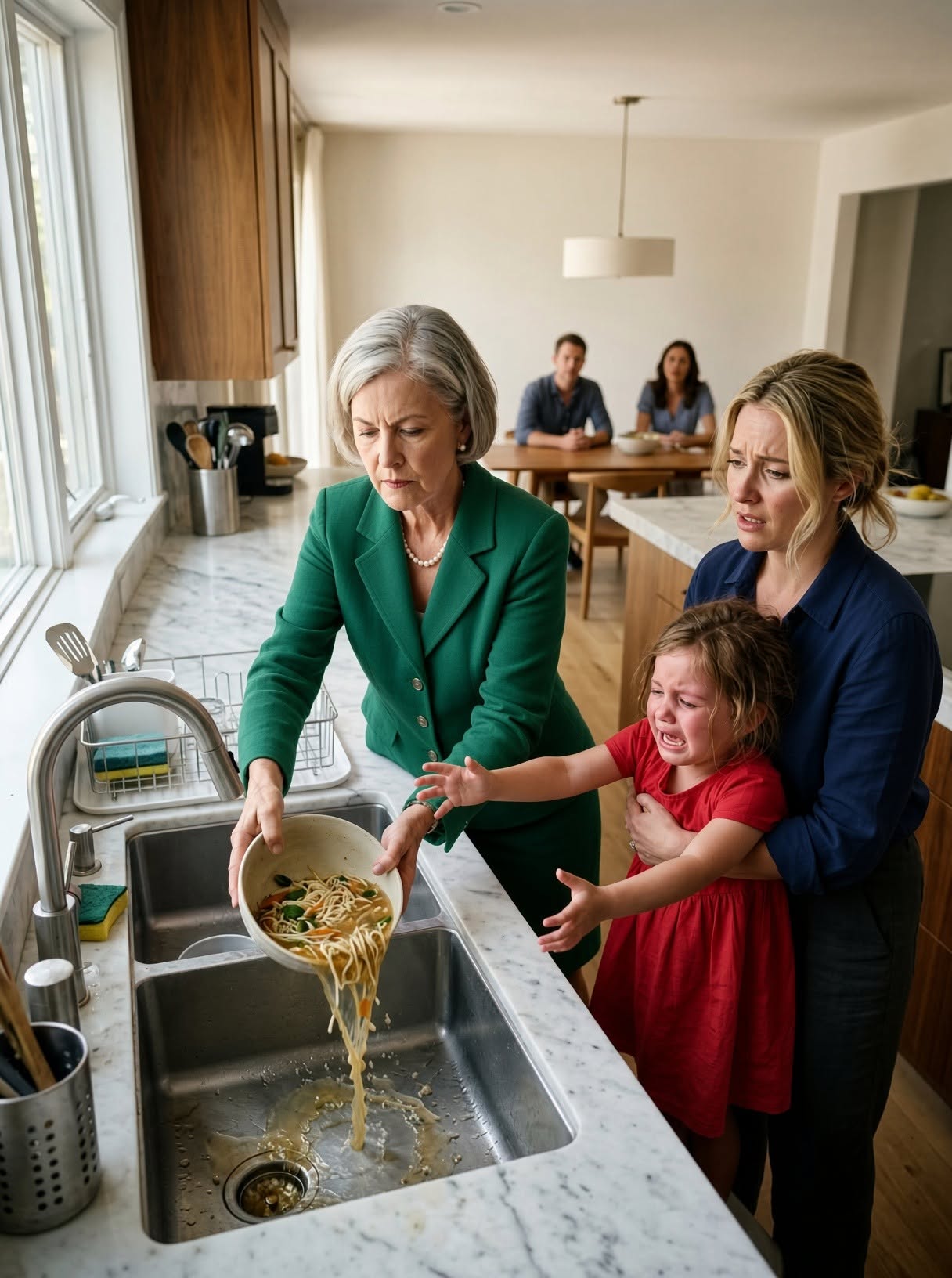
“If you’re thirty-four years old, stop living like a parasite and find somewhere else to die with your daughter.”
My mother, Margaret, said those words while holding my two-year-old daughter Sophia’s bowl of chicken soup.
Then she dumped it into the kitchen sink.
The warm broth swirled down the drain. A few noodles clung to the metal strainer, and a tiny piece of carrot floated near the plug before disappearing.
Sophia stared at the empty bowl.
“Grandma,” she whispered, “my soup.”
My mother turned off the faucet.
“Then perhaps your mother should learn how to provide for you.”
I felt something inside me go completely still.
My younger sister, Karla, sat by the dining-room window, scrolling through her phone. She was twenty-nine, wore designer clothes, and had recently posted photographs of herself standing beside a luxury SUV she claimed to have purchased with her own money.
She didn’t even bother to hide her smile.
“Mom’s right, Laura. You’ve been here long enough. Some people actually work for what they have.”
I looked at her.
For nearly four years, I had been transferring $850 every month to Karla’s mortgage lender. She believed her boyfriend was helping her pay for the condo. In reality, I had been quietly covering the shortfall because she had begged me to help her avoid losing it.
Not once had she thanked me in front of our parents.
Not once had I demanded recognition.
And now she was calling me a parasite.
My father, Arthur, folded his newspaper.
For one hopeful second, I thought he might finally say something.
Instead, he walked to the front door, picked up Sophia’s stroller, and placed it outside on the concrete landing.
Then he returned to his chair.
That hurt more than my mother’s words.
Six months earlier, my marriage had collapsed. My husband had left me for another woman, and the divorce had taken most of my emotional strength. I worked as a freelance editor, earning enough to support Sophia and myself, but not enough to immediately secure a suitable apartment in our expensive city.
My parents had insisted that I move in temporarily.
“This will always be your home,” my mother had promised. “You don’t have to worry about anything while you get back on your feet.”
I believed her.
I paid for groceries, internet, utilities, and my father’s heart medication. I cleaned the apartment every weekend and cooked meals when my mother complained that she was tired.
Gradually, my contributions became invisible.
If I bought groceries, she criticized what I chose. If I paid the electricity bill, she asked why I hadn’t paid the gas bill too. If Karla visited, she took food home without asking.
Still, I kept telling myself that family was supposed to help one another.
But family was also supposed to protect a two-year-old child from humiliation.
I wiped Sophia’s cheeks, put on her yellow coat, and lifted her into my arms.
“Come on, sweetheart. We’re leaving.”
My mother laughed.
“Don’t act as if you’re doing me a favor, Laura. You’ll be back within a week. When you discover what rent costs, you’ll come crawling back and apologize.”
I picked up the stroller from the landing.
Then I turned toward her.
“Thank you for everything, Mom.”
She smiled triumphantly, believing I was surrendering.
She had no idea what I meant.
That night, Sophia and I stayed in a modest boarding house near the city center. Our room had a double bed, a small wardrobe, and a window overlooking a narrow alley.
The elderly landlady, Mrs. Gable, accepted weekly cash payments and didn’t ask questions when she saw my swollen eyes.
I tucked Sophia into bed.
“Are we going home tomorrow?” she asked sleepily.
I brushed her hair away from her forehead.
“We’re going to make a new home, baby.”
After she fell asleep, I opened my laptop.
I logged into my bank account and canceled the $850 recurring transfer to Karla’s mortgage lender.
Then I opened a secure folder I had maintained for five years.
Inside were a property deed, certified registration records, bank statements, receipts for household expenses, and a collection of correspondence bearing my parents’ signatures.
At the top of the folder was a document that could change everything.
The deed to my parents’ apartment.
Five years earlier, they had voluntarily transferred ownership of the property to me.
They had signed the documents themselves.
They had witnessed the registration.
And they had watched me put the original deed into a safe-deposit box.
Somehow, over the years, they had convinced themselves that because they continued living there, the apartment still belonged to them.
I stared at the signatures.
Then I opened a private note titled PLAN B.
I typed three words.
Sunday: Activated.
For the first time that evening, I smiled.
My family believed I had left their apartment with nothing.
Tomorrow, they would discover that the woman they had thrown out might be the only person in the family who actually owned it.
## PART 2: The Lawyer Who Remembered Everything
At nine the next morning, I arrived at the office of Daniel Mercer, the attorney who had handled the property transfer five years earlier.
He was in his early sixties, with silver hair, rimless glasses, and the habit of listening without interrupting.
He examined the deed.
Then he examined the registration certificate.
Finally, he looked up.
“Your parents threw you out last night?”
“Yes.”
“And the child was present?”
“My daughter.”
He removed his glasses.
“Laura, before we discuss what happens next, I need you to understand something. A registered property transfer is a serious legal matter. We need to confirm that the transfer was properly executed, that no later documents changed ownership, and whether your parents retained any right to occupy the apartment.”
“I understand.”
“Do they know the property is registered in your name?”
“They knew when they signed it.”
Daniel leaned back.
“Then tell me why they transferred it.”
I had expected that question.
Five years earlier, my father had suffered a serious health scare. His small construction business was struggling, and he and my mother had become worried about what would happen if financial problems worsened.
Their apartment was the most valuable thing they owned.
My father had approached me after a family dinner and asked whether I would help them protect it.
“We want the apartment to stay in the family,” he had explained. “We trust you more than anyone else, Laura.”
My parents proposed transferring ownership to me while continuing to live there.
They wanted the security of knowing that the apartment would remain available to them. I agreed, provided the arrangement was documented properly and they could continue occupying the home under the terms set out in the legal paperwork.
I paid the legal expenses.
They signed the transfer.
The property was registered in my name.
At the time, I thought the arrangement represented trust.
Later, I discovered that my parents had begun telling relatives that they had merely placed my name on some administrative documents.
I challenged them once.
My father waved me away.
“It’s just paperwork, Laura. You know this place will always be ours.”
I had let the comment pass because I didn’t want to turn a family arrangement into a fight.
That had been my mistake.
Daniel finished reviewing the documents.
“The transfer appears to have been registered,” he said, “but I want the complete title history and a current search before drawing any final conclusions. We also need to review the occupancy arrangement. Ownership doesn’t automatically mean you can remove residents immediately.”
“I don’t want to throw them onto the street.”
“Good. Then we can proceed properly.”
He explained the next steps: obtain the current property records, confirm there were no later transfers or registered interests, review the agreement governing my parents’ residence, and prepare a formal notice if appropriate.
I nodded.
“What about Karla’s mortgage payments?” I asked.
“Is the mortgage yours?”
“No. Her condo is hers. I’ve simply been paying part of her monthly obligation.”
“Then you can generally stop making voluntary payments, subject to any agreement you may have made. But don’t interfere with her lender or misrepresent your role.”
“I won’t.”
Daniel closed the folder.
“One more question. Why did you wait five years to address the situation?”
I thought of Sophia asking why her soup had disappeared.
“Because I thought being a good daughter meant making things easier for everyone else.”
“And what do you think now?”
I looked at the deed.
“I think I confused love with permission to be mistreated.”
Daniel gave a small nod.
“Then let’s make sure your next decisions are guided by facts rather than anger.”
Before I left, I signed the authorization allowing his office to obtain the necessary records.
For the first time in months, I felt that my life was moving forward instead of simply reacting to other people’s demands.
I wasn’t planning revenge.
I was reclaiming responsibility for my own future.
## PART 3: The First Call Came at 10:17 A.M.
My phone rang while I was buying Sophia a banana and a carton of milk.
Karla’s name appeared on the screen.
I answered.
“Where is my mortgage payment?”
Her voice was sharp enough to turn heads.
“Good morning to you, too.”
“Don’t be clever, Laura. The bank sent me a notification. The payment hasn’t arrived.”
“I canceled the transfer.”
There was a brief silence.
“You what?”
“I stopped paying your mortgage.”
“But you always pay it!”
“Yes. I did.”
“You can’t just stop without telling me!”
I almost laughed.
For years, I had covered $850 every month while Karla accepted the credit. Now, less than twenty-four hours after my mother had thrown my daughter’s dinner away, my sister was furious that her free money had stopped.
“It’s your mortgage, Karla. You’ll need to arrange your own payments.”
“You know I can’t cover everything myself!”
“Then contact your lender and discuss your options.”
She lowered her voice.
“Is this because Mom told you to leave? You’re seriously punishing the whole family because of one argument?”
“One argument?” I repeated. “You watched Mom throw Sophia’s soup away. You watched Dad put our stroller outside. And you called me a parasite.”
“I was joking.”
“Sophia was crying.”
“She won’t remember it.”
“I will.”
Karla hung up.
I stood in the grocery store holding the milk, feeling a strange mixture of sadness and relief.
I had not stopped loving my sister.
I had simply stopped mistaking her dependence on me for affection.
Twenty minutes later, my mother called.
“Your sister says you’ve stopped paying her mortgage.”
“That’s correct.”
“What has gotten into you?”
“I’m no longer paying expenses that aren’t mine.”
My mother scoffed.
“After everything this family has done for you, you’re going to behave like this?”
I closed my eyes.
“You told me to leave.”
“You should have known I didn’t mean it.”
“You emptied Sophia’s soup into the sink.”
“Oh, don’t start with that again. It was just soup.”
“No, Mom. It was my daughter standing in your kitchen, asking why her grandmother had taken away her dinner.”
My mother fell silent for a moment.
Then she said the words I had heard throughout my childhood.
“You’re always making yourself the victim.”
I looked down at Sophia, who was carefully trying to put her banana into her coat pocket.
“I’m not asking you to admit anything. I just want you to understand that things are changing.”
“Changing how?”
“I’ll explain when the time is right.”
I ended the call.
That afternoon, my father sent a message.
Your mother is very upset. Come home so we can settle this like adults.
I replied with one sentence.
I no longer live there, Dad.
He didn’t respond.
Two hours later, Daniel called.
The initial title search had confirmed that the property was still registered in my name.
There was no subsequent transfer back to my parents.
No sale.
No registered gift.
No mortgage recorded against the apartment.
But Daniel had found something else.
The original transfer documentation included a declaration signed by both my parents acknowledging that ownership had passed to me.
They had also acknowledged the terms under which they could continue occupying the property.
“They cannot simply claim the deed was meaningless because they regret signing it,” Daniel explained. “However, we’ll need to review the entire agreement and the applicable local law before determining what options are available.”
“Can they lose the apartment?”
“They don’t currently hold registered ownership, according to the records we have. Whether they have other enforceable rights is a separate question.”
I thanked him and hung up.
That evening, Mrs. Gable brought Sophia a small bowl of homemade vegetable soup.
“I made too much,” she said.
Sophia’s face lit up.
“For me?”
“For you, sweetheart.”
My daughter ate every spoonful.
I sat beside her, watching the steam rise from the bowl.
It was such a small act of kindness.
Yet it reminded me of something my family had made me forget: care didn’t need to be purchased, and love didn’t require humiliation.
## PART 4: The Family Meeting
Three days later, my parents invited me to a family meeting.
My mother called it a chance to “clear up the misunderstanding.”
Daniel advised me not to sign anything or agree to any new arrangement without independent legal review.
I agreed to attend, but I made arrangements for Sophia to stay with Mrs. Gable.
When I arrived at the apartment, Karla was already there.
She wore a cream-colored dress and an expression of righteous indignation.
My father sat at the dining table. My mother had prepared coffee, as if the previous week’s events had never happened.
“Sit down,” she said.
I remained standing.
“What do you want?”
My father cleared his throat.
“We think everyone has become emotional. Your mother was frustrated. You were upset. These things happen.”
“Is that why I’m here? To pretend nothing happened?”
“Laura,” he said impatiently, “we’re family.”
Karla crossed her arms.
“And families don’t abandon each other over a bowl of soup.”
I looked at her.
“Then why did you support Mom when she threw it away?”
She glanced at our mother.
“That’s not the point.”
“It’s exactly the point.”
My mother struck the table with her palm.
“Enough! We brought you here because we want you to stop this nonsense. Your father and I need you to come home, apologize, and resume helping with the household expenses.”
I stared at her.
“You want me to come back?”
“Of course. Where else are you going to live?”
“I’ve found somewhere to stay.”
“A boarding house?” Karla laughed. “With your daughter? How long do you think that will last?”
I didn’t answer.
My father leaned forward.
“Laura, we’re willing to forget your behavior over the past few days. But you must understand that this apartment is our home. We have every right to decide who lives here.”
I reached into my handbag and placed a photocopy of the property deed on the table.
Nobody spoke.
My mother glanced at it, then pushed it away.
“What is this supposed to be?”
“Do you recognize the document?”
She barely looked at the page.
“Some legal paperwork.”
“Read the first paragraph.”
My father picked it up.
His expression changed.
Karla leaned over his shoulder.
“What does it say?”
My father read silently, his eyes moving back to the top of the page.
Then he looked at me.
“Where did you get this?”
“You signed it.”
My mother snatched the document.
She stared at the names beneath the signatures.
Her face drained of color.
“No,” she whispered.
“Yes.”
“This was only supposed to be for protection.”
“It was a legal transfer of ownership. That’s what the document says.”
My father stood up so quickly that his chair scraped across the floor.
“We never intended for you to take our home!”
“You intended to transfer it to me. You asked me to arrange the paperwork. You signed the documents in front of the lawyer.”
“We trusted you!” my mother shouted.
I felt the familiar pull to apologize, to soothe her, to make the discomfort disappear.
This time, I resisted it.
“You trusted me enough to put your most valuable asset in my name. But apparently, you never trusted me enough to treat me with basic respect.”
Karla shook her head.
“This is disgusting. You’re using legal tricks to steal from your own parents.”
“No. I’m showing you a document you signed.”
My father pointed at the door.
“Get out.”
I looked at him.
“You’re asking the registered owner of this apartment to leave?”
He froze.
For the first time in my life, my father appeared to have no answer.
I gathered the photocopy and slipped it back into my handbag.
“I didn’t come here to threaten you. My lawyer is reviewing the paperwork. Until then, I won’t make any decisions about the property. But I will not pretend that I have no rights simply because acknowledging them makes you uncomfortable.”
My mother began to cry.
“You would really do this to us?”
I swallowed the ache in my throat.
“You did something to me, too, Mom. You just assumed I would keep forgiving you.”
Then I walked out.
Behind me, I heard Karla whisper something to our father.
I didn’t stay to listen.
## PART 5: The Secret Behind the Deed
The following morning, Daniel asked me to return to his office.
He had reviewed the complete property file, including correspondence exchanged when the transfer was registered.
“There’s an important detail you should understand,” he said.
He showed me a letter my father had written five years earlier.
In it, my father explained that he and my mother wanted to transfer the apartment to me because they trusted me to manage it responsibly.
They specifically acknowledged that I would become the legal owner.
Another letter recorded their agreement to continue living there under the arrangement described in the transfer documents.
The file also contained the registration receipt and a statement confirming that the transfer had been completed.
“This strengthens the evidence that your parents understood what they were signing,” Daniel said. “It doesn’t mean every possible dispute is automatically settled, but it makes their claim that they never intended a transfer harder to reconcile with their own written statements.”
I read the letters twice.
My father had not been tricked.
My mother had not been confused.
They had made a deliberate decision.
What had changed was their attitude toward me.
When I was the reliable daughter who paid bills, they called me generous.
When I stopped paying, they called me selfish.
When they needed someone to protect their property, they trusted me.
When I asserted my rights, they accused me of stealing it.
“What’s the best way forward?” I asked.
Daniel folded his hands.
“First, we document everything. Second, we determine exactly what rights your parents retained under the agreement. Third, we decide whether you want to negotiate a peaceful arrangement or pursue formal proceedings if negotiations fail.”
“I don’t want them homeless.”
“Then don’t make homelessness your objective. Make clarity and accountability your objective.”
That distinction stayed with me.
For years, I had believed there were only two choices: submit to my family or destroy the relationship completely.
Daniel helped me understand that there was another option.
I could establish boundaries without becoming cruel.
I could protect my daughter without humiliating my parents.
And I could insist on the truth without using the law as a weapon.
I asked Daniel to prepare a formal letter confirming the registered ownership, explaining that all future property discussions should go through his office, and inviting my parents to negotiate a clear written occupancy arrangement.
I also asked him to make it clear that I would not tolerate further threats or attempts to pressure me into signing away my rights.
When I left his office, I felt lighter.
For the first time, the deed wasn’t a secret I could use to frighten my family.
It was a responsibility I had to handle carefully.
## PART 6: The Day Their Confidence Crumbled
The letter arrived at my parents’ apartment the following Tuesday.
My mother called within fifteen minutes.
“What have you done?”
“I asked my lawyer to contact you.”
“You’re sending lawyers after your own parents!”
“He sent a letter explaining the legal position and inviting you to discuss it.”
“Your father is beside himself!”
I heard my father shouting in the background.
Then Karla’s voice cut in.
“You need to tell them to stop. This is getting out of control.”
I took a slow breath.
“Nothing is out of control. Daniel has asked everyone to communicate through his office so that we can avoid arguments.”
My mother began to cry again.
“Laura, please. We made a mistake. We never thought you would take this so far.”
I closed my eyes.
There it was.
Not an apology for Sophia.
Not an acknowledgment of what had happened.
A confession that they had never expected consequences.
“Mom, you told me I would come crawling back. You believed I couldn’t survive without you.”
“I was angry.”
“So was I. But I didn’t throw your belongings into the street. I didn’t threaten your housing. I didn’t take food away from a child.”
Silence.
Then my father took the phone.
“Listen to me. Your mother and I are getting older. We don’t need this stress.”
“I don’t want you to suffer, Dad. I want us to resolve this fairly.”
“Then transfer the apartment back to us.”
I stared at the wall.
“That’s not a fair resolution simply because you want it.”
“We raised you!”
“And I helped support you. I paid bills, bought groceries, and covered your medication. I also paid Karla’s mortgage for years.”
“You volunteered,” he snapped.
“Yes. I did. And now I’m choosing to stop.”
He hung up.
That evening, Karla sent me a long message accusing me of ruining the family.
She claimed that her mortgage payment was overdue and that she might lose her condo.
I reminded her that I had never been legally responsible for her mortgage. I suggested she contact her lender immediately and discuss a payment plan.
She responded with a single line.
I hope you’re happy.
I didn’t reply.
The next day, my parents’ lawyer contacted Daniel.
They wanted to discuss a settlement.
Daniel arranged a meeting for the following week.
In the meantime, I continued working, caring for Sophia, and saving every dollar I could.
Mrs. Gable found us a slightly larger room in the boarding house, with enough space for a small table and a secondhand toy chest.
Sophia began to call it our little house.
One evening, while I was editing a client’s manuscript, she climbed onto my lap.
“Mommy, is Grandma mad at us?”
I set the laptop aside.
“Grandma is having some difficult feelings.”
“Did I spill the soup?”
My heart tightened.
“No, sweetheart. You didn’t do anything wrong.”
“Then why did she take it?”
I held her close.
“Sometimes grown-ups make unkind choices. It’s their job to fix them.”
Sophia thought about that.
Then she wrapped her arms around my neck.
“Can we have soup tomorrow?”
I kissed her forehead.
“Of course.”
And I promised myself that whatever happened with the apartment, my daughter would never have to earn the right to feel safe in her own home.
## PART 7: The Truth at the Negotiation Table
The meeting took place in Daniel’s conference room.
My parents arrived with their attorney. Karla came, too, despite not being a party to the property agreement.
She seemed convinced that her presence would somehow help.
My mother wore the pearl necklace she saved for formal occasions. My father carried a leather folder. Neither looked at me when they entered.
Daniel began by summarizing the documented history of the transfer.
He explained that the apartment was registered in my name and that the existing paperwork needed to be considered as a whole.
My parents’ attorney acknowledged the registration but argued that the family’s long-standing occupation and the original circumstances deserved careful consideration.
Daniel agreed that their occupancy rights and any other enforceable interests needed to be reviewed.
Then he laid out the proposed resolution.
I would recognize any valid occupancy rights established by the existing agreement and applicable law. My parents would have a clear opportunity to negotiate continued residence under written terms. Both sides would agree to communicate through their legal representatives while the matter was resolved.
No one would be required to sign anything that day.
My father finally looked at me.
“So you’re going to let us stay?”
“If the agreement and law support your continued residence, I’ll respect that. If we need a new arrangement, I’ll consider one. But I won’t sign the apartment away because you are angry with me.”
My mother dabbed her eyes.
“We never meant for this to happen.”
I nodded.
“Then you should have treated me differently.”
Karla leaned forward.
“This is ridiculous. Laura doesn’t even need the apartment. She’s doing this to punish us.”
Daniel turned toward her.
“Your sister’s reasons do not determine who owns the property. The registration and relevant agreements do.”
Karla flushed.
“But she lived here for free!”
I looked at her.
“I paid household expenses. I paid Dad’s medication costs. I bought groceries. And I paid your mortgage.”
Her mouth fell open.
My mother turned sharply.
“What mortgage?”
Karla went pale.
I hadn’t planned to reveal the payments during the meeting. But Karla had opened the door herself.
“For nearly four years,” I said. “Eight hundred and fifty dollars every month.”
My father stared at her.
“You told us you were paying everything yourself.”
Karla shook her head.
“Laura offered to help.”
“You told your friends you were doing it alone,” I said. “You told Mom that I was irresponsible with money. You never mentioned the payments.”
My mother looked between us.
“Why would you do that?”
“Because Karla said she was struggling, and I wanted to help her keep her home.”
Karla’s eyes filled with tears.
“You’re making me look terrible.”
“No, Karla. I’m explaining what happened.”
For a moment, the conference room was silent.
Then my father spoke quietly.
“We thought you were the one who needed help.”
“I did need help. I needed a temporary place to live after my divorce. You offered it to me. But I never agreed to be the family’s permanent financial safety net.”
My mother began to cry.
This time, I did not rush to comfort her.
The meeting ended without a final settlement, but something important had changed.
The family story that had always portrayed me as the dependent daughter no longer matched the documented facts.
My parents had transferred the apartment to me.
I had supported the household.
I had supported my sister.
And when I stopped, the family discovered how much they had relied on the person they dismissed.
## PART 8: What My Parents Finally Lost
The following weeks were difficult.
My parents initially resisted every proposed arrangement. Their attorney requested further documentation, and Daniel responded with the registration records, transfer correspondence, and the original agreement.
Eventually, the discussions became more practical.
My parents agreed to stop claiming that the transfer had never occurred. In return, I agreed to negotiate their continued residence under clear written terms, subject to their legal rights and the final agreement.
The terms included responsibility for ordinary household expenses, reasonable notice before any changes to the arrangement, and a process for resolving future disagreements.
There was no dramatic eviction.
No police arriving at dawn.
No family standing on the pavement surrounded by suitcases.
The real consequence was quieter.
My parents could no longer use the apartment’s ownership as a way to control me.
They could no longer pretend that I had no say in decisions affecting the property.
And they could no longer threaten to throw me out whenever I disagreed with them.
Karla’s situation was less comfortable.
Without my monthly payments, she had to speak honestly with her lender. She sold her expensive car, reduced her spending, and arranged a more manageable repayment plan.
She was furious for weeks.
Then, one afternoon, she called me.
“I had to sell the car,” she said.
“I heard.”
“Do you know how embarrassing that was?”
I remained silent.
She sighed.
“I know you’re going to say I should have been grateful.”
“I wasn’t going to say that.”
“Then what?”
“I was going to say that I hope you can build a life you can afford without depending on someone else to keep it standing.”
She didn’t answer immediately.
Finally, she whispered, “I really thought you’d keep paying.”
“I know.”
“Why didn’t you tell everyone you were helping me?”
“Because I didn’t want to humiliate you.”
Her voice cracked.
“And I humiliated you.”
“Yes.”
For once, she didn’t argue.
She apologized for calling me a parasite and for laughing when our mother threw Sophia’s soup away.
It wasn’t a perfect apology. She still tried to explain how stressed she had been, how our parents had always compared us, and how she had felt threatened by my ability to manage money.
But it was the first time she had acknowledged her part in what happened.
I accepted her apology without promising to resume the payments.
Forgiveness, I was learning, did not require restoring the circumstances that had hurt you.
My father was slower to change.
He eventually sent a short letter admitting that he should have intervened when my mother insulted me and that putting the stroller outside had been wrong.
He didn’t know how to say much more.
I appreciated the letter, but I didn’t pretend it erased years of silence.
My mother took the longest.
For weeks, she insisted that I had misunderstood her intentions.
Then, one Saturday, she appeared at Mrs. Gable’s boarding house carrying a container of homemade chicken soup.
Sophia was sitting at our little table, drawing pictures with crayons.
My mother stood in the doorway.
“I brought something for her.”
I didn’t immediately invite her inside.
“Did you come to apologize?”
Her eyes dropped to the container.
“I have been thinking about what happened.”
“That isn’t what I asked.”
She swallowed.
“I was cruel to you. And I was cruel to Sophia.”
My daughter looked up.
“Grandma?”
My mother’s face crumpled.
She knelt beside the table.
“I’m sorry I took your soup away, sweetheart.”
Sophia looked at the container.
“Is this my soup?”
My mother nodded.
“Yes.”
Sophia considered the matter with the solemnity only a two-year-old could manage.
Then she said, “You can put it on the table.”
My mother let out a trembling laugh through her tears.
I watched them carefully.
I wanted to believe the apology meant something.
But I knew that the real test would come later, when my mother became frustrated again, when I disagreed with her, or when I refused to do something she wanted.
An apology was a beginning.
It was not proof that everything had changed.
I allowed her to visit Sophia under clear boundaries. We kept our conversations calm and our expectations realistic.
And I continued building a life that didn’t depend on my parents’ approval.
## PART 9: The Home I Chose for My Daughter
Three months after that terrible dinner, I signed a lease on a small two-bedroom apartment.
It wasn’t luxurious.
The kitchen was narrow, the living room needed fresh paint, and the balcony overlooked a busy street.
But it had a lock I controlled, a little bedroom for Sophia, and a sunny corner where I could put a desk.
I paid the deposit with money I had saved by working longer hours and cutting unnecessary expenses.
For the first time since my divorce, I didn’t feel as if my life was waiting for someone else’s permission to begin.
On moving day, Sophia carried a stuffed rabbit through the front door.
“This is our house?” she asked.
“Our home,” I corrected gently.
She ran toward her bedroom, laughing.
I stood in the empty living room and cried.
Not because I was sad.
Because every decision in that apartment was mine.
I chose the curtains.
I chose the dishes.
I chose where Sophia’s books would go.
And I chose the kind of atmosphere I wanted my daughter to grow up in.
There would be no threats disguised as jokes.
No affection withheld to force obedience.
No child made to feel that a meal, a bed, or a kind word was something she had to earn.
A week later, my parents visited for lunch.
My mother brought flowers. My father carried a small wooden stool he had repaired himself.
They looked around the apartment quietly.
“It feels peaceful here,” my father finally said.
“It is,” I replied.
My mother studied the little table where Sophia sat drawing.
“I didn’t realize how much you were carrying,” she admitted.
I thought about all the years I had spent making their lives easier while convincing myself that my own discomfort didn’t matter.
“I don’t think you wanted to realize it,” I said.
She looked hurt, but she didn’t argue.
We ate lunch together.
When Sophia spilled a little water, my mother reached for a cloth.
For a brief moment, I watched her face.
There was no anger.
No insult.
She simply wiped the table and helped Sophia refill her cup.
It was an ordinary moment.
But ordinary kindness was precisely what our family had been missing.
After lunch, my father asked about the apartment they still occupied.
We discussed the written arrangement, the expenses, and the need to keep communication respectful. He asked questions instead of issuing orders. My mother disagreed with one of the proposed terms, but she listened when I explained my position.
We did not resolve every old wound.
We did not suddenly become a perfect family.
But we were finally speaking as adults rather than as people trapped in roles we had inherited.
Before leaving, my father paused at the door.
“Laura, I want you to know something.”
I waited.
“When we signed that deed, we believed you were the person we could trust with our future.”
I looked at him.
“Then you should have treated me like someone you trusted.”
He lowered his head.
“You’re right.”
It wasn’t enough to erase the past.
But it was honest.
And honesty was a better foundation than the promises we had been making for years.
That evening, after my parents left, I tucked Sophia into bed.
She held her stuffed rabbit beneath her chin.
“Mommy?”
“Yes, sweetheart?”
“Can we have chicken soup tomorrow?”
I smiled.
“Yes. We can have chicken soup whenever we want.”
She closed her eyes.
I sat beside her until her breathing became slow and peaceful.
Then I walked into the kitchen, where the deed’s certified copy lay inside a folder I had brought home from Daniel’s office.
For months, I had imagined that document as a kind of shield.
It had protected my legal rights when my family tried to make me feel powerless.
It had forced everyone to confront the truth.
It had ended the fiction that my parents could threaten to remove me from a home they had legally transferred to me.
But the deed had not been the most important thing I reclaimed.
I had reclaimed my voice.
I had reclaimed my ability to say no.
And I had reclaimed the right to make decisions without begging the people who benefited from my sacrifices to approve them.
My parents still had a home, subject to the legal agreement governing their occupancy. My sister still had a mortgage, but she was finally responsible for managing it herself. Our family still had difficult conversations ahead.
There would be no magical ending in which everyone forgot the past.
Trust would have to be earned slowly.
Respect would have to be demonstrated consistently.
And love would have to become something we practiced rather than something we demanded.
I put the deed away and turned off the kitchen light.
The next morning, Sophia would wake up in her own bedroom.
She would have breakfast at her own table.
And if she ever asked why we had left Grandma’s apartment, I would tell her the truth in words a child could understand.
I would tell her that sometimes people we love make choices that hurt us.
I would tell her that we can forgive people without allowing them to hurt us again.
Most importantly, I would tell her that nobody has the right to make her feel worthless just because she needs help.
Because the greatest lesson I had learned wasn’t that a signed deed could cost my family their home.
It was that no amount of money, property, or family history could give anyone the right to treat another human being as disposable.
My mother had thrown away a bowl of soup and pointed at the door.
She thought she was reminding me that I had nowhere else to go.
Instead, she forced me to discover that I had spent years standing on my own two feet while pretending I needed her permission to do so.
And the home I built afterward wasn’t simply an apartment with a lock and a key.
It was a life in which my daughter and I could finally breathe.
A life in which kindness was freely given, boundaries were respected, and love no longer came with a price tag.
My parents had signed away a property five years earlier.
They had forgotten what the paperwork meant.
But I would never forget what happened the night my daughter asked her grandmother for soup—and the woman who should have loved her most decided that cruelty was an acceptable answer.
That was the night I stopped begging to belong.
And started building somewhere we already did.