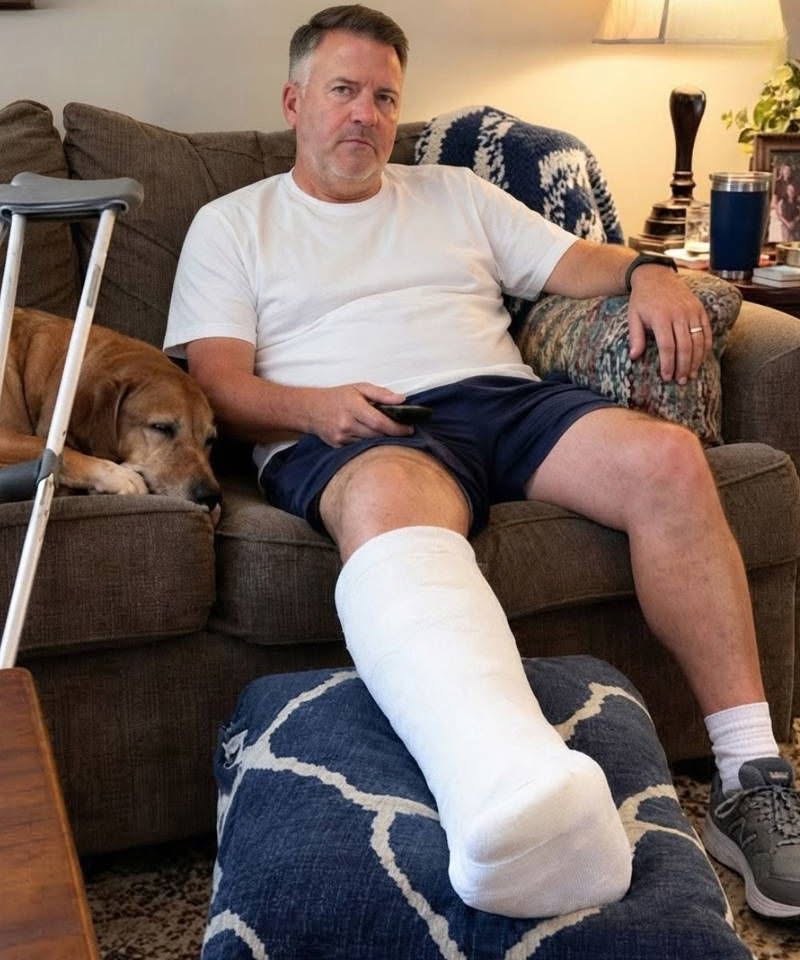
The Secret Beneath My Husband’s Cast After 32 Years of Marriage
“Conor, what exactly have you been hiding from me?” My voice sounded unfamiliar, even to me. It was quiet, almost a whisper, but the question seemed to fill the entire bathroom.
My husband sat on the cold tile floor, clutching a towel against his damaged cast. His face had gone pale, and his eyes moved from mine to the bathroom door as though he were searching for an escape.
For thirty-two years, I had known this man.
I had held his hand through his father’s funeral, stayed awake beside him when he lost his job, and celebrated every small victory we had achieved together. I had raised our children with him, paid bills with him, and fallen asleep beside him thousands of times.
I believed I knew his silences as well as his words.
But that evening, looking at the fear in his eyes, I realized there was a part of my husband I had never met.
“Please, Cynthia,” he murmured. “Just give me a little time.”
I stared at the scar above his cast.
“No. You’ve had two weeks. You’ve had every opportunity to explain whatever this is. Now I need an answer.”
He closed his eyes.
Then he said something that made the room feel suddenly smaller.
“I didn’t break my ankle at work.”
For a moment, I thought I had misunderstood him.
“What?”
“The story I told you about slipping on the wet floor.” He swallowed hard. “It wasn’t true.”
I slowly stood up.
My first reaction wasn’t anger. It was disbelief.
“You told me you fractured your ankle at work. Your coworker brought you home. You said the doctor took X-rays.”
“I know.”
“And you’ve let me take care of you every day while you’ve been lying to me?”
His eyes filled with tears.
“I never wanted you to find out this way.”
I almost laughed at the absurdity of his words.
He had hidden something beneath a cast for weeks, locked doors in our home, refused my help, and arranged secret medical appointments. Yet somehow, he seemed more upset about the manner of his discovery than about the deception itself.
“What happened to your leg, Conor?”
He looked down at the towel.
Then he began to tell me a story that would change everything I believed about our marriage.
Two weeks before he came home with the cast, Conor had received a phone call from an unfamiliar number.
He was at work, sitting in his office, when the call came through.
The man on the other end introduced himself as Dr. Samuel Reed, a specialist at a private medical center.
According to Conor, the doctor asked whether he was somewhere he could speak privately.
Conor said he was.
Then the doctor told him that an examination he had undergone several months earlier had revealed something concerning.
A small mass had been discovered deep in the tissue of his right leg.
At first, the doctors believed it was probably harmless. But further imaging suggested that it needed immediate investigation.
A biopsy had been recommended.
Conor had agreed to the procedure without telling me.
“When?” I asked, interrupting him.
“Three weeks ago.”
“Three weeks ago?” My voice rose. “You had a medical procedure three weeks ago, and I didn’t even know you were seeing a doctor?”
He nodded miserably.
“Why?”
He rubbed his forehead.
“Because I was afraid.”
“Afraid of what? A medical bill? A hospital visit? Me asking questions?”
“Cancer.”
The word fell between us.
Suddenly, the scar looked different to me.
It wasn’t evidence of some mysterious accident or secret adventure. It was evidence that my husband had undergone a procedure serious enough to leave a mark, and he had been carrying the fear alone.
My anger didn’t disappear.
But it collided with something else.
Fear.
“Did the doctors say you have cancer?”
“No.”
“Then why didn’t you tell me?”
“Because they hadn’t ruled it out.”
He explained that the initial scan had been ordered after he complained of persistent discomfort in his leg. He had mentioned it casually during a routine medical appointment months earlier, assuming it was an ordinary strain from years of walking and standing at work.
When the discomfort didn’t improve, his doctor ordered additional tests.
The first results were inconclusive.
Conor had spent several weeks convincing himself that everything was fine.
Then came the phone call.
The specialist explained that the mass needed to be removed or sampled so the medical team could determine exactly what it was. Conor scheduled the procedure and told his employer he needed a few days away.
He hadn’t told me because he thought the results would arrive quickly.
He intended to wait until he knew something definite.
But after the procedure, the doctor had explained that the tissue needed further examination. The final report would take longer than expected.
Conor went home with stitches, a protective dressing, and instructions to keep the area clean while it healed.
He also went home with a mind full of terrible possibilities.
“I kept thinking about you,” he said. “About the kids. About what would happen if the news was bad.”
“Our children are adults, Conor.”
“I know. But they’re still our children.”
“And I’m still your wife.”
He lowered his head.
“I know that, too.”
“Then why did you decide I couldn’t handle the truth?”
He had no answer.
I helped Conor get to his feet and settle on the edge of the bathtub.
Despite everything, I could see that he was shaken by the fall. His cast was cracked, and the padding had shifted around the area of the scar.
“We need to get that checked,” I said.
He nodded.
For once, he didn’t argue.
I fetched his phone and called the medical center. The nurse advised us to have the damaged cast assessed promptly and to avoid trying to repair or remove it ourselves.
While we waited for a family friend to drive us, I sat across from Conor in the living room.
The television was off. The house was quiet.
I looked at the man who had shared my life for more than three decades and tried to reconcile him with the stranger who had been hiding things from me.
“Did you tell anyone else?” I asked.
“No.”
“Not your brother? Not your friends?”
“No one.”
“Why invent the broken ankle?”
He hesitated.
“The cast was supposed to protect the area while it healed. I needed something to explain why I was walking with crutches and staying home. I thought if I told you I had a simple fracture, you’d worry less.”
I shook my head.
“You thought I would worry less if I believed you were injured in an accident?”
“When you say it like that, it sounds ridiculous.”
“Because it is ridiculous.”
He looked at me with exhausted eyes.
“I didn’t know how to tell you I might have cancer.”
There it was.
The truth beneath all the other truths.
My husband hadn’t been protecting a secret lover or hiding some elaborate betrayal. He had been trying to protect himself from a possibility he couldn’t bear to say aloud.
But his fear had led him to shut me out of the very part of his life where he needed companionship most.
I reached for my cup of tea and realized my hands were trembling.
“I wish you’d trusted me,” I said.
“I know.”
“No, Conor. I don’t think you do. We have been married for thirty-two years. I’ve watched you struggle. I’ve seen you cry. I’ve sat beside you when you had nothing left to say. You don’t have to be brave for me.”
He covered his face with both hands.
“I was afraid that if I said the word, it would become real.”
I looked away because I understood that feeling more than I wanted to admit.
When our daughter, Megan, had been sixteen, she had undergone emergency surgery after a serious infection. I remembered sitting in a hospital corridor, waiting for the surgeon to speak to us.
Conor had held my hand so tightly that my fingers hurt.
We had been terrified then, too.
But we had faced it together.
That was what marriage had always meant to me.
Not the promise that nothing terrible would happen, but the promise that neither of us would have to face it alone.
“I’m angry with you,” I told him. “I’m not going to pretend otherwise.”
He nodded.
“But I don’t want you going through this alone anymore.”
His face crumpled.
For the first time since the cast appeared, he reached for my hand instead of pulling away.
At the medical center, a nurse examined the damaged cast and the surrounding area.
After assessing the injury, the medical team arranged for the cast to be replaced with an appropriate protective dressing and made sure the surgical site wasn’t showing signs of a complication.
The doctor also reviewed Conor’s upcoming appointment.
“We’re still waiting for the complete pathology report,” he explained. “I know the waiting is difficult, but we shouldn’t jump to conclusions before we have the results.”
I sat beside Conor, holding a notebook where I wrote down the doctor’s instructions and questions we wanted answered.
Conor watched me quietly.
On the drive home, he finally spoke.
“You don’t have to come to every appointment.”
I turned toward him.
“Are you serious?”
“I just don’t want your life to become nothing but hospital visits and worrying about me.”
“My life has included you for thirty-two years. I think I can manage a few appointments.”
He gave a faint smile.
Then his expression became serious again.
“There’s something else.”
I felt my stomach tighten.
“What now?”
“After the procedure, the doctor told me there was a possibility that the mass was malignant. He also said that even if it wasn’t, they might need another procedure depending on the results.”
“Why didn’t you tell me that?”
“Because I kept hoping the next phone call would make everything disappear.”
I watched the road ahead.
“Conor, hoping is fine. But you can’t build a life around pretending something isn’t happening.”
“I know.”
“And if you ever get frightening medical news again, I want you to tell me. Even if you don’t understand it yet. Even if you’re terrified. Especially then.”
He squeezed my hand.
“I will.”
I wanted to believe him.
But trust, I was learning, wasn’t restored by a single apology.
It was rebuilt through what happened next.
The following morning, I found Conor sitting at the kitchen table with an old photograph in his hands.
It was taken on our twenty-fifth wedding anniversary.
We were standing on a beach, laughing because the wind had blown my hair across his face just as the camera flashed.
He looked up when I entered.
“Do you remember that day?”
“Of course.”
“You told me you wanted us to grow old together.”
I poured myself coffee.
“I still do.”
He looked at the photograph again.
“That’s what scared me. I started thinking about all the things I haven’t done. All the things I thought I’d have more time for.”
I sat beside him.
“What things?”
“Taking that trip to Ireland. Fixing the garden properly. Seeing the grandchildren grow up. Sitting on the porch with you when we’re eighty and arguing about the neighbors.”
I smiled despite myself.
“You’ll still be arguing about the neighbors at ninety.”
He laughed, but the sound broke halfway through.
“I don’t want to leave you.”
I placed my hand over his.
“Then don’t start saying goodbye before we even know what we’re dealing with.”
He nodded.
For the first time, he told me about the nights he had spent awake, imagining different diagnoses and different futures.
He had searched the internet for symptoms and medical explanations until every ordinary ache seemed ominous. He had reread the doctor’s notes, trying to find certainty in sentences that offered none.
He had even considered canceling the follow-up appointment because he was afraid of hearing the results.
I listened without interrupting.
When he finished, I told him something I had never said aloud.
“I was afraid, too.”
He looked surprised.
“Of what?”
“Of growing old and discovering that the person I thought I knew had become someone who didn’t trust me.”
He reached for my hand.
“I never stopped trusting you.”
“Then you need to understand that trust means letting me see you when you’re frightened, not just when you have everything under control.”
He looked at the photograph for a long time.
Then he placed it on the table between us.
“I’ll try,” he said.
For that morning, trying was enough.
Three days later, the specialist called.
Conor was in the kitchen when his phone rang. I was washing dishes, but the moment I saw his expression, I turned off the tap.
He answered and listened.
At first, he said nothing.
Then he asked the doctor to repeat something.
My heart began pounding.
When he finally ended the call, he remained perfectly still.
I dried my hands and walked toward him.
“What did he say?”
Conor looked at me.
“The results are back.”
I sat down slowly.
“And?”
He swallowed.
“The mass isn’t cancerous.”
For a second, neither of us moved.
Then the meaning of his words reached me, and I covered my mouth.
“Oh, thank God.”
Conor began to cry.
Not quietly, not with the careful restraint he had maintained for weeks, but with the unguarded relief of someone who had been carrying a terrible burden alone.
I wrapped my arms around him.
He buried his face against my shoulder.
“They said it was a benign growth,” he whispered. “They removed it, and the results don’t show cancer.”
I held him tighter.
We stayed that way for a long time.
I had imagined this moment in countless ways since seeing the scar. I had feared betrayal, another family, secret debts, and explanations that might shatter our marriage.
Instead, I found myself holding the man I loved while he cried because he had been given back a future he thought he might lose.
Eventually, he pulled away and wiped his eyes.
“There is still some recovery ahead,” he said. “The doctor wants to monitor the area, and I have to follow the instructions carefully. But he thinks the outlook is good.”
“Then we’ll follow every instruction.”
He nodded.
I kissed his forehead.
For the first time in weeks, the silence between us felt peaceful.
But the medical results, as wonderful as they were, hadn’t erased what happened.
And I knew we still had something important to work through.
That evening, after dinner, Conor asked me to sit with him in the living room.
He had written something on a piece of paper.
“I’ve been thinking about what you said,” he began. “About trust.”
He unfolded the paper, then seemed embarrassed by it.
“I wrote down the reasons I didn’t tell you.”
I waited.
“First, I was afraid you would panic. Second, I didn’t want to see the fear in your eyes. Third, I thought I could handle it myself. And fourth…”
He stopped.
“Fourth?”
“I was ashamed.”
I frowned.
“Of having a medical problem?”
“Of being frightened. I’ve always thought of myself as the person who takes care of things. When the children were young, I was the one who told everyone it would be all right. When money was tight, I told you we’d find a way. I didn’t want to be the person who needed reassurance.”
I leaned back against the sofa.
“Do you remember when I had my surgery twelve years ago?”
He nodded immediately.
“You stayed at the hospital every night.”
“And when I came home, I couldn’t even carry a cup of tea without help. You washed my hair, prepared my meals, and helped me get dressed. Did you ever think less of me because I needed you?”
“Of course not.”
“Why would you think I would think less of you?”
He stared at the floor.
“I don’t know.”
“Conor, being strong doesn’t mean never needing help. Sometimes it means admitting you can’t do everything by yourself.”
He nodded slowly.
“I should have told you.”
“Yes, you should have.”
“I hurt you.”
“Yes.”
He looked at me, and I saw that he wasn’t asking me to pretend otherwise.
“I can’t undo those weeks,” he said. “But I can promise that I won’t make decisions like that again without talking to you.”
I considered his words.
“Don’t promise that you’ll never be afraid,” I said. “You can’t control that. Promise that you won’t let fear make you lie to me.”
He reached across the sofa and took my hand.
“I promise.”
I didn’t tell him that everything was forgiven.
Not because I wanted to punish him, but because I knew that forgiveness wasn’t something I needed to rush in order to make him comfortable.
Instead, I squeezed his hand.
“We’ll work on it together.”
For the first time, that seemed to be enough for both of us.
Over the next several weeks, Conor recovered gradually.
The doctors continued to monitor his leg, and he followed their instructions. The damaged cast was no longer an obstacle between us, but the experience left a mark on our marriage that neither of us wanted to ignore.
We began talking more honestly.
Not just about medical appointments, but about the things we had both been postponing.
Conor admitted that he had been feeling older lately. Several friends had retired, one had suffered a serious illness, and another had died unexpectedly.
He had started thinking about time in a way he never had before.
“I used to think retirement meant I would finally have time to do everything,” he told me one afternoon. “Now I’m realizing that having time doesn’t mean much if you’re too afraid to use it.”
I looked up from the garden catalog in my lap.
“Then let’s stop postponing everything.”
We booked the trip to Ireland we had discussed for years.
We planned to renovate the garden, slowly and within our budget. We invited our daughter and son to dinner and told them more about what had happened than we initially intended.
Conor was nervous about their reactions.
But when he explained that he had hidden the medical procedure because he was frightened, our daughter reached across the table and took his hand.
“Dad, you don’t have to protect us from every difficult thing,” she said. “We’re grown-ups. We can be scared with you.”
Our son nodded.
“You always told us family meant showing up. That includes when you’re the one who needs someone.”
Conor lowered his eyes.
“I think I forgot that part.”
“No,” our daughter replied gently. “I think you were scared and made a mistake.”
Those words seemed to relieve him more than anything else that evening.
He hadn’t lost his family’s respect.
But he had learned that love wasn’t a test he had to pass by appearing invulnerable.
It was something he could lean on.
A month after the accident in the bathroom, Conor was finally moving comfortably enough to walk around the garden without assistance.
One Sunday morning, I found him standing beside the flower beds, studying the rosebushes.
“What are you doing?” I asked.
“Trying to decide whether these need pruning.”
“You’ve been standing there for ten minutes.”
“It’s an important decision.”
I laughed.
There he was again: the dramatic man who could turn a minor inconvenience into a household event.
But when he turned toward me, his expression softened.
“Cynthia?”
“Yes?”
“I’ve been thinking about that night.”
“So have I.”
He looked down at his leg.
“When you saw the scar, I thought my life was falling apart. I was certain you would be furious, and I was afraid you’d look at me differently.”
“I was furious.”
“I know.”
“And I was frightened. Not just because of your health, but because I realized how much I didn’t know about what was happening to you.”
He nodded.
“I never want you to feel that way again.”
I walked closer and took his hand.
“Then keep talking to me.”
“I will.”
We stood together in the garden while the morning sun warmed the grass.
After a while, Conor turned toward the house.
“Do you think we should make tea?”
I smiled.
“Of course you do.”
“And perhaps something to eat?”
“Conor.”
“What?”
“You’ve recovered from the mysterious injury. You can make your own tea.”
He pretended to look offended.
“Thirty-two years of marriage, and this is how you treat me?”
I laughed so hard that he started laughing, too.
For the first time in weeks, the sound felt completely natural.
Our trip to Ireland took place the following spring.
We walked through small villages, watched the waves break against the rocky coast, and spent long afternoons drinking tea in cafés while the rain moved across the windows.
On our third evening, we sat together overlooking the ocean.
Conor reached into his jacket pocket and took out a small envelope.
“What is that?” I asked.
“Something I’ve been carrying around.”
He handed it to me.
Inside was a photograph of us from our twenty-fifth anniversary, the same one we had looked at in the kitchen.
On the back, he had written a sentence.
Thirty-two years ago, I promised to share my life with you. I finally understand that sharing my life means sharing the frightening parts, too.
I read it twice.
Then I looked at him.
“You could have just told me this.”
“I know.”
“You didn’t need stationery.”
“I thought the stationery made it more convincing.”
I shook my head, smiling through my tears.
Then he became serious.
“I can’t promise we’ll never have another difficult season. I can’t promise that we’ll always have good news from doctors or that we’ll never be frightened again. But I can promise that I won’t shut you out just because I’m afraid.”
I folded the note carefully and slipped it back into the envelope.
“That is the promise I needed.”
He took my hand.
We watched the ocean until the evening light began to fade.
For thirty-two years, I had believed that knowing someone meant learning all their habits, recognizing their moods, and remembering the small details of their life.
Now I understood something more important.
Knowing someone also meant accepting that there would always be parts of them they struggled to explain.
And loving someone meant making room for those difficult conversations, even when the truth arrived late, awkwardly, or wrapped in fear.
The scar on Conor’s leg eventually faded.
The medical appointments became less frequent, and life returned to its ordinary rhythm. We argued about groceries, complained about the weather, and teased each other over small household inconveniences.
But something between us had changed.
When Conor received a worrying letter from the doctor, he showed it to me immediately.
When I became anxious about an upcoming appointment of my own, I told him instead of pretending I wasn’t worried.
We stopped treating fear as something that had to be hidden to protect the people we loved.
One evening, months later, I was putting clean towels away when I noticed Conor standing in the bedroom doorway.
He held out his right leg with exaggerated caution.
“Cynthia, I have a very serious medical question.”
I looked at him suspiciously.
“What now?”
“Do you think this leg looks better than it did last month?”
I rolled my eyes.
“Your leg looks fine.”
“Are you sure? Perhaps you should examine it more closely.”
I threw a towel at him.
He caught it, laughing.
Then he walked over, wrapped his arms around me, and rested his forehead against mine.
“Thank you,” he whispered.
“For what?”
“For staying.”
I touched his cheek.
“Conor, I didn’t stay because you were never going to make a mistake. I stayed because I love you. But loving you doesn’t mean I want you to hide from me.”
He nodded.
“I understand now.”
I hoped he did.
Because after thirty-two years of marriage, I had discovered that the greatest danger to our relationship wasn’t the frightening diagnosis we had imagined.
It was the belief that one of us had to suffer in silence to spare the other.
That night in the bathroom, I had thought the scar beneath his cast would reveal a terrible secret.
Instead, it revealed something we both needed to learn.
My husband had been afraid of losing his future.
I had been afraid of losing the man I thought I knew.
And neither of us had realized that silence was making us feel more alone than the truth ever could.
We couldn’t change those weeks.
We couldn’t erase the fear, the lies, or the questions that followed.
But we could choose what happened next.
And every day after that, we chose to speak a little more honestly, listen a little more carefully, and remember why we had promised to share our lives in the first place.
Because thirty-two years of marriage had taught me many things.
But the most important lesson came from the secret beneath my husband’s cast:
Sometimes, the person you love isn’t hiding something because they love you less. Sometimes, they’re hiding because they’re terrified of how much they have to lose.
And sometimes, the bravest thing two people can do is stop pretending they’re not afraid—and face the truth together.